From booking fees to airport surcharge exceptions, a guide to choosing a ride and checking the bill
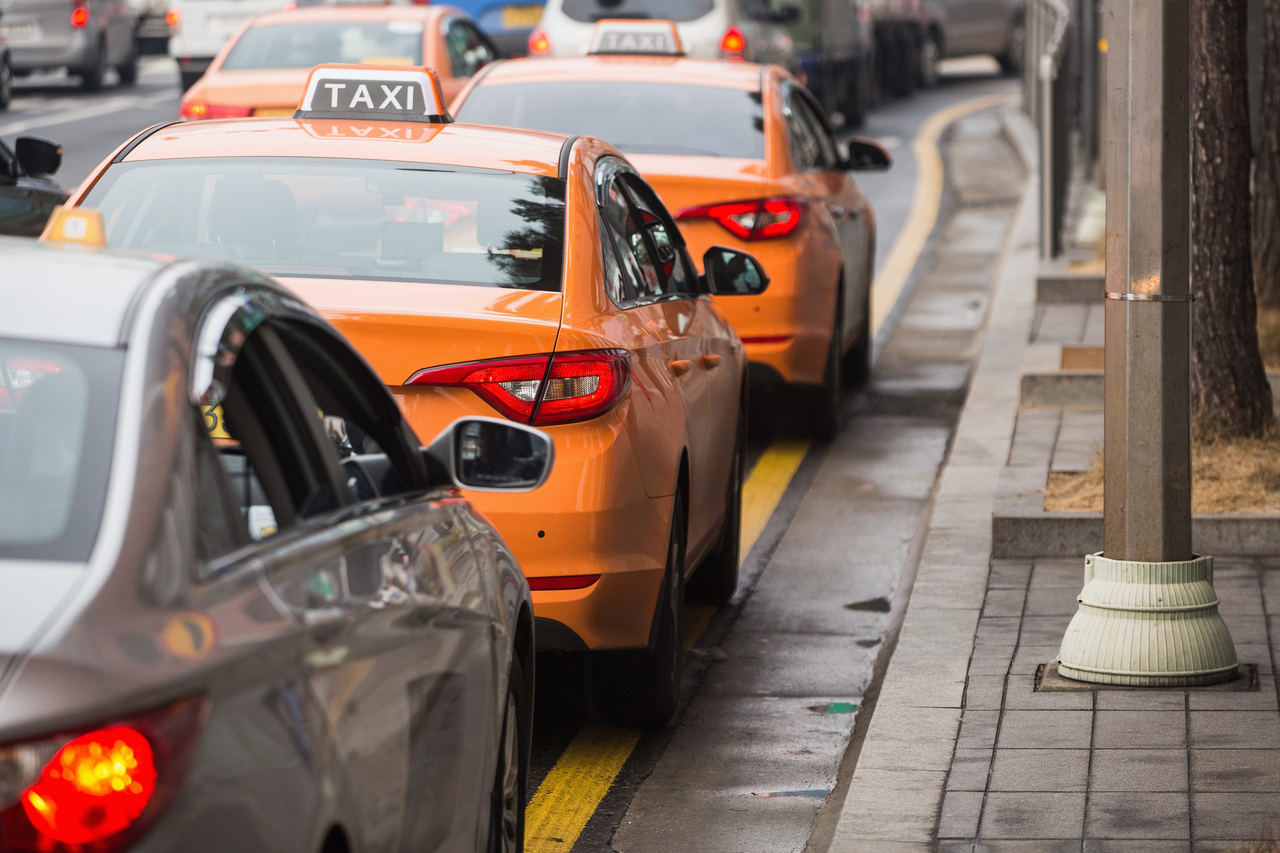
An empty taxi may already be booked, an app’s “Standard” ride may carry a service fee, and a trip beyond Seoul’s boundary does not always qualify for an out-of-area surcharge.
For foreign passengers, understanding those distinctions can make booking a taxi easier and help identify charges that need questioning.
Taxi fares and regulations vary across Korea. The following guide focuses on Seoul.
Finding an available taxi
Look for the windshield signs. The one reading "빈차," or “bincha,” generally displayed in red, means that it's vacant. The one that says "예약," or "yeyak,” generally shown in green, means it's reserved. A taxi displaying that sign might be empty but already on its way to pick up a passenger.
Street-hailed taxis can be paid for with cash, a credit card or a transportation card. App payment is a separate arrangement. If your booking uses an automatic payment method, do not pay the driver again.
Booking without a Korean card
Kakao T offers regular taxis alongside more expensive options such as Blue, Venti and Black.
Where available, its “Pay to the driver” option allows passengers to settle the fare directly rather than through a registered app.
Kakao Mobility also operates K.ride, designed for international visitors. Users can sign up through Google, Apple or email without a Kakao account and pay with overseas-issued cards or digital wallets such as Alipay+ and GrabPay.
Its interface is available in English, Japanese, simplified Chinese and traditional Chinese. Destination searches and automatically translated chats with drivers support more than 100 languages.
However, the convenience comes with an additional cost. The published K.ride fee schedule lists a 10 percent service fee for its domestic taxi categories, on top of the applicable fare calculation.
Its “Standard” category connects users to Blue Partners taxis, which do not cost the same as regular street-hailed taxis.
Cancellation charges apply under specified conditions after dispatch or if a passenger fails to board. The conditions and amounts differ by service.
Passengers who already use Uber can request an Uber Taxi in Korea through their existing app and payment information, according to the Korea Tourism Organization.
Choosing between regular and premium rides
A taxi booked through an app is not necessarily a premium taxi. Uber Taxi and Uber Black, for example, are different service categories.
Seoul’s regular taxis, deluxe taxis known as "모범," or “mobeom,” and premium services have different pricing structures. Larger vehicles offered through Kakao Venti and i.M also have their own fare arrangements.
A lower starting fare does not necessarily mean a cheaper trip. Some services charge for time and distance simultaneously and apply dynamic pricing. Compare the estimated total and any booking or reservation charges, rather than the base fare alone.
When the meter runs faster
For a regular Seoul taxi, the daytime base fare is 4,800 won ($3.60) for the first 1.6 kilometers from 4 a.m. to 10 p.m. Beyond the initial distance, the meter adds 100 won per 131 meters. Below 15.72 kilometers per hour, a time charge of 100 won per 30 seconds also applies.
Late-night fares depend on the hour.
From 10 p.m. to 11 p.m. and from 2 a.m. to 4 a.m., the base fare is 5,800 won. Subsequent distance and time increments rise to 120 won.
From 11 p.m. to 2 a.m., the base fare is 6,700 won, with increments of 140 won for extra time and distance.
Those rates already incorporate the late-night surcharge. The listed nighttime base fare is not an amount to which another 20 or 40 percent should be added.
Deluxe taxis have a daytime base fare of 7,000 won for the first 3 kilometers and a 20 percent late-night surcharge from 10 p.m. to 4 a.m.
The airport surcharge exception
For regular Seoul taxis, a 20 percent out-of-area surcharge applies to eligible travel beyond the service boundary. Combined late-night and out-of-area surcharges can reach 60 percent.
But crossing a city boundary does not automatically justify the charge. Seoul taxis operating between Seoul and Incheon Airport are exempt from the out-of-area surcharge under the airport’s joint service arrangements.
Road tolls are separate and may still be charged. The exemption concerns the out-of-area surcharge, not the cost of using a toll road.
International taxis are a separate option for passengers seeking foreign-language service. They can be booked in advance or arranged through the International Taxi Information Desk at Incheon Airport.
Their airport–Seoul service uses zone-based fares. For metered international taxi journeys within Seoul or leaving the city, a 20 percent international-service surcharge applies. Confirm which fare arrangement applies when booking.
Checking and disputing a charge
For an ordinary metered ride, the driver should use the meter. Approved fixed-fare arrangements and other authorized pricing systems are exceptions; an arbitrary price demanded by a driver is not.
Seoul began adding English to key receipt fields in December 2025, including the final fare and boarding and arrival times. Receipts also indicate whether late-night or out-of-area surcharges were applied.
Suspected overcharging and other taxi complaints can be reported through the city’s 120 Dasan Call Center or its QR-code reporting system, available through stickers inside taxis.
Keep the receipt, payment record and app booking details, and record the full license plate number.
In an Oct. 19 explanation of its enforcement process, Seoul said missing receipts or photographs and discrepancies between complaints and trip records were among the reasons violations could be difficult to establish.
Investigators examine the route, meter fare and payment records, making documentation important when disputing a charge.