
Jun Young-hyun predicts sweeping changes to corporate culture as global experts gather at Samsung forum to explore agentic AI
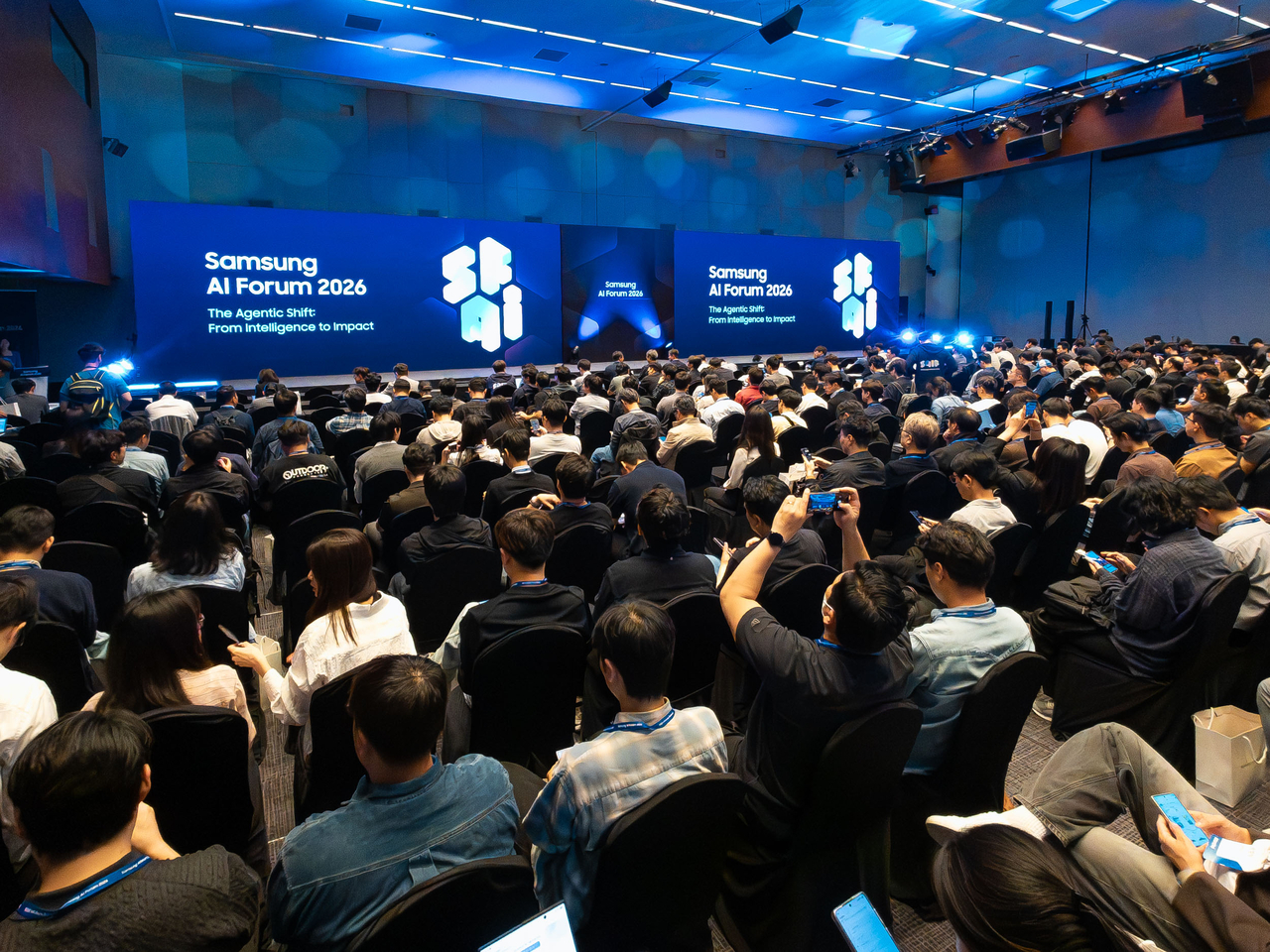
Samsung Electronics co-CEO Jun Young-hyun said Wednesday that AI agents will fundamentally reshape work and corporate culture, setting the agenda for the company’s annual artificial intelligence forum in Seoul.
“Agentic AI will bring fundamental changes to the way we work and to corporate culture, beyond technological innovation,” Jun said, adding in opening remarks that Samsung will work with global AI leaders to identify the direction of the technology and pursue practical innovation.
Samsung AI Forum 2026, now in its 10th year, brought together experts from leading global technology companies and prominent AI researchers, with OpenAI's hardware chief Richard Ho delivering the opening keynote.
Ho, who leads the ChatGPT maker's development of in-house AI chips, addressed the shift from chatbots to agentic workflows. He outlined how systems powered by large language models could independently make decisions and carry out tasks, potentially transforming operations across a range of industries.
Ho’s appearance also drew attention because of his role in OpenAI’s hardware strategy as major AI developers seek more computing capacity and alternatives to existing chip suppliers. The visit comes as Samsung seeks to strengthen its position in advanced AI memory and contract chip manufacturing.
David Green, Amazon Web Services’ AI technology leader for the Asia-Pacific region, outlined security and governance strategies for deploying AI agents safely and economically in corporate environments.
University of Washington professor Ranjay Krishna presented research aimed at overcoming the reasoning limitations of vision-language models and achieving high-performance robotics AI with smaller models.
Yoon Kim, a Samsung Research executive who is also a professor at the Massachusetts Institute of Technology, discussed next-generation “agentic intelligence” architectures designed to broaden the capabilities and applications of AI agents.
The afternoon program was divided into two tracks covering technology development and business implementation.
Samsung’s Device eXperience division, which handles consumer electronics and computing, presented work in efficient AI, physical AI and continual learning, according to the company. It discussed design and optimization methods for improving the user experience, along with products equipped with on-device AI platforms that can process information without relying entirely on cloud infrastructure.
The physical AI sessions examined world models that learn how real-world environments operate to predict future conditions and simulate the consequences of actions. Speakers also reviewed the prospects and limitations of robot foundation models and presented Samsung’s related research, the company said.
Samsung also showcased personalized AI that can learn new information without losing previously acquired knowledge, as well as “self-evolving AI” designed to analyze user feedback and improve product performance after launch.
The semiconductor division’s AX Innovation track focused on AI applications in chip design, manufacturing and process improvement. Samsung’s AX/PI Center presented internal cases showing how the technology is being used to address operational problems across the semiconductor business.
AX refers to artificial intelligence transformation, while PI is process innovation.
Dell Technologies and Anthropic also discussed the use of trustworthy AI agents in the workplace and approaches to building enterprise AI factories.
herim@heraldcorp.com