Korean bakery and food company doubles down on US expansion
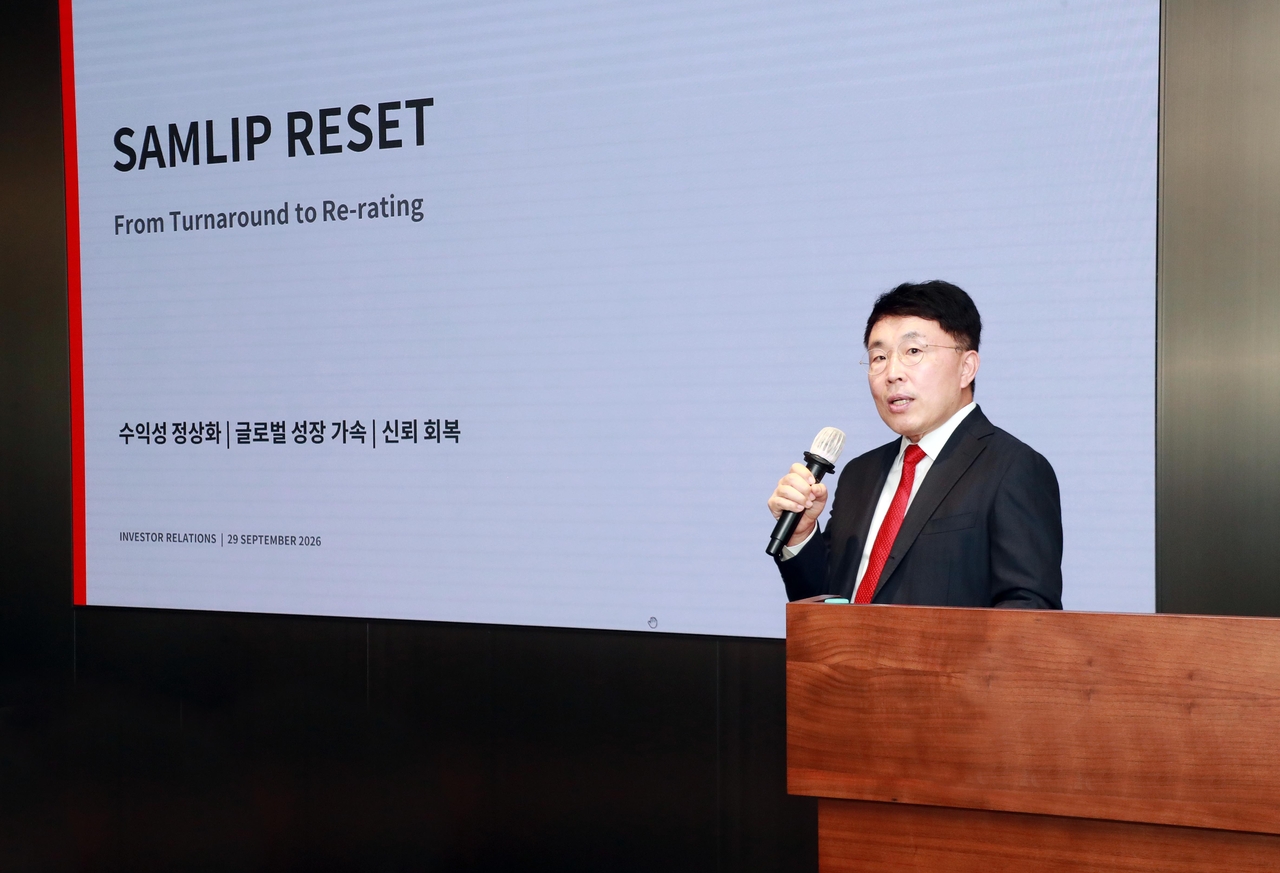
Samlip is doubling down on bolstering its global businesses, as the Korean bakery and food company has set ambitious goals of reaching 2.11 trillion won ($1.6 billion) in stand-alone revenue and 170 billion won in operating profit with an operating margin of 8 percent by 2030.
Samlip's Jeong In-ho, who took office as co-CEO in April this year, underscored the firm's four growth pillars — global expansion, digital commerce, frozen dough and product innovation — while highlighting its commitment to increasing investment in research and development and marketing during an investor relations session in Seoul on Tuesday.
“The next 18 months will be an important turning point as Samlip begins to improve its business structure around profitability and build a foundation for growth,” Jeong said.
“Through global expansion and business structure innovation, we will establish a sustainable growth system and increase both corporate and shareholder value.”
Samlip said it plans to boost its global sales from the current figure of around 75 billion won to 500 billion won by 2030. The firm noted that it will establish what it calls a “Global Scale Model” by using its experience in the US, such as its business with Costco, as a template for expansion into other regions and distribution channels.
As Samlip will look to focus on flagship bakery products and Korean-style desserts as it expands exports, it aims to increase sales through Costco in the US by more than five times from 30 billion won this year to 150 billion won in 2030. Its goal is to expand the number of Costco stores carrying its products from 300 to more than 900 worldwide and ramp up its product lineup from two to six.
The company also pointed out that it will strengthen its position in the sandwich and salad markets while expanding into business-to-business supplies of low-sugar and wellness sauces, Korean-style sauces and ready-to-eat meals.
According to Samlip, its processed meat business that will focus on business-to-business channels is expected to improve profitability by about 2.5 billion won each year. The company will look to generate another 14 billion won in profitability improvements through measures including the disposal or restructuring of nonessential businesses.
For its shareholders, Samlip set a medium- to long-term dividend payout ratio target of 30 percent and said it will introduce a systematic framework for managing investment returns to establish a consistent and predictable stakeholder-return policy.
Samlip also presented measures to strengthen safety management and shift toward an execution-focused management system by establishing a safety-first culture, proactively improving high-risk equipment, standardizing work procedures at production sites and strengthening management oversight and independent verification.
The company said its cumulative accident rate from January through August this year was 0.48 percent, which was below the food industry's average of 0.99 percent in 2025, citing data from the Korea Occupational Safety and Health Agency.
Samlip logged 1.6 trillion won in stand-alone revenue and 38.7 billion won in operating profit last year.
hwkan@heraldcorp.com


![[Exclusive] S. Korean Embassy to US woos Trump allies to expedite skilled visa talks](https://wimg.heraldcorp.com/news/cms/2026/09/29/rcv.YNA.20260924.PGT20260924167001009_R.jpg?type=h&h=120)