Defense chief says DMZ explosion result of armistice violation, vows to take measures
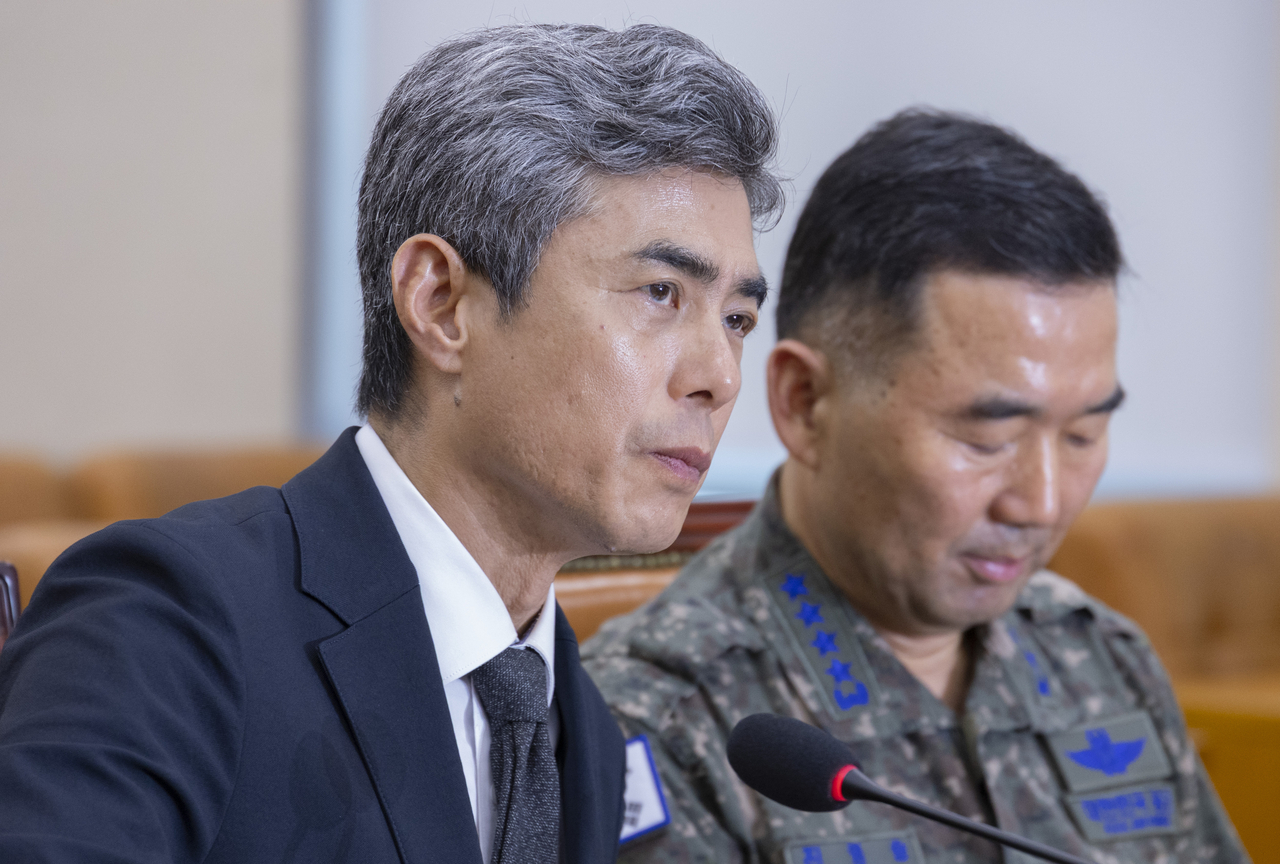
South Korean Defense Minister Kang Shin-chul said Tuesday that the North Korean mine believed to have caused last week's explosions in the Demilitarized Zone had been planted rather than displaced from elsewhere, linking it to Pyongyang's efforts to fortify the inter-Korean border.
"It does not appear to have been displaced from elsewhere," Kang said during a plenary meeting of the National Assembly's National Defense Committee in Seoul.
Kang, however, cautioned against concluding that the mine had been planted recently.
Soil and roots found over one of the mines suggested that it had remained underground for some time and could even predate North Korean mine-laying activity detected in the area in September 2025, he explained.
In recent years, North Korea has stepped up fortification work near the Military Demarcation Line, laying mines and installing fences and anti-tank barriers. Pyongyang announced in October 2024 that it would sever inter-Korean roads and railways and further fortify areas along the border.
South Korea has since detected North Korean construction and mine-laying activity close to the MDL. Seoul has raised concerns that some of those activities could violate the 1953 Armistice Agreement, which halted the 1950-53 Korean War, while the United Nations Command has taken a more cautious view on whether border fortification itself constitutes a violation.
At Tuesday's meeting, Kang said the latest mine incident amounted to a clear violation of the Armistice Agreement.
"The violation of the Armistice Agreement is clear, and we will implement necessary measures in stages accordingly," Kang said.
He declined to elaborate on possible countermeasures, saying the details involved operational matters.
The hearing came a day after the Joint Chiefs of Staff said North Korean mines were highly likely to have caused the Sept. 21 explosions.
The JCS pointed out that there was no record of South Korean mine-laying at the site, signs of North Korean mine-laying activity nearby, and forensic findings showing TNT and brown-colored material but no metal fragments. Personnel also reported seeing a brown, rectangular object resembling a North Korean plastic anti-personnel mine near the blast site.
The military has yet to issue its final conclusion or determine when the mines were laid.
Evidence pointing to North Korea strengthened further Tuesday when investigators discovered another North Korean plastic anti-personnel mine during a joint field investigation earlier in the day. With the mine found Tuesday, four such devices have been confirmed at the location, each 1 to 2 meters apart.
Army Maj. Gen. Yang Jin-hyuk, the JCS director of operations, told lawmakers that the mine was found about 1 meter behind the crater left by the second explosion. The JCS said it was separate from the unexploded mine-like object reported by personnel immediately after the Sept. 21 blasts.
Tuesday's committee meeting also focused on opposition criticism over the timing of the investigation and the military's disclosure of the incident.
Some opposition lawmakers have questioned whether political considerations surrounding President Lee Jae Myung's Sept. 22 address to the UN General Assembly in New York contributed to delays in the investigation.
Kang rejected the allegation during the hearing, saying the investigation was also a military operation and that there had been "absolutely no concealment or delay."
Earlier Tuesday, Cheong Wa Dae also rejected claims that the field investigation had been delayed because of Lee's UN address, saying the JCS and the UNC determined the schedule based solely on military considerations and recommendations from commanders in the field.
Lee called Tuesday for a swift and thorough investigation during a Cabinet meeting, saying the military should establish the facts transparently in close cooperation with the UNC and take necessary measures based on the findings.
He also urged political circles not to fuel "groundless conspiracy theories" over the incident.
South Korean military personnel were previously injured by North Korean mines planted on the Southern side of the DMZ, in August 2015.
Two South Korean soldiers were seriously injured in the 2015 incident after stepping on wooden-box mines later determined to have been planted by North Korean troops.
Seoul responded by resuming loudspeaker broadcasts toward North Korea. The Lee administration halted the broadcasts in June 2025 as part of efforts to ease military tensions and reduce inconvenience to residents in border areas.
flylikekite@heraldcorp.com
![[Exclusive] S. Korean Embassy to US woos Trump allies to expedite skilled visa talks](https://wimg.heraldcorp.com/news/cms/2026/09/29/rcv.YNA.20260924.PGT20260924167001009_R.jpg?type=h&h=120)
![[Exclusive] Enhypen to return with new album in November, agency confirms](https://wimg.heraldcorp.com/news/cms/2026/09/29/news-p.v1.20260929.41760e88b0f048fcb5fa3e0dd9b75524_R.jpg?type=h&h=120)