
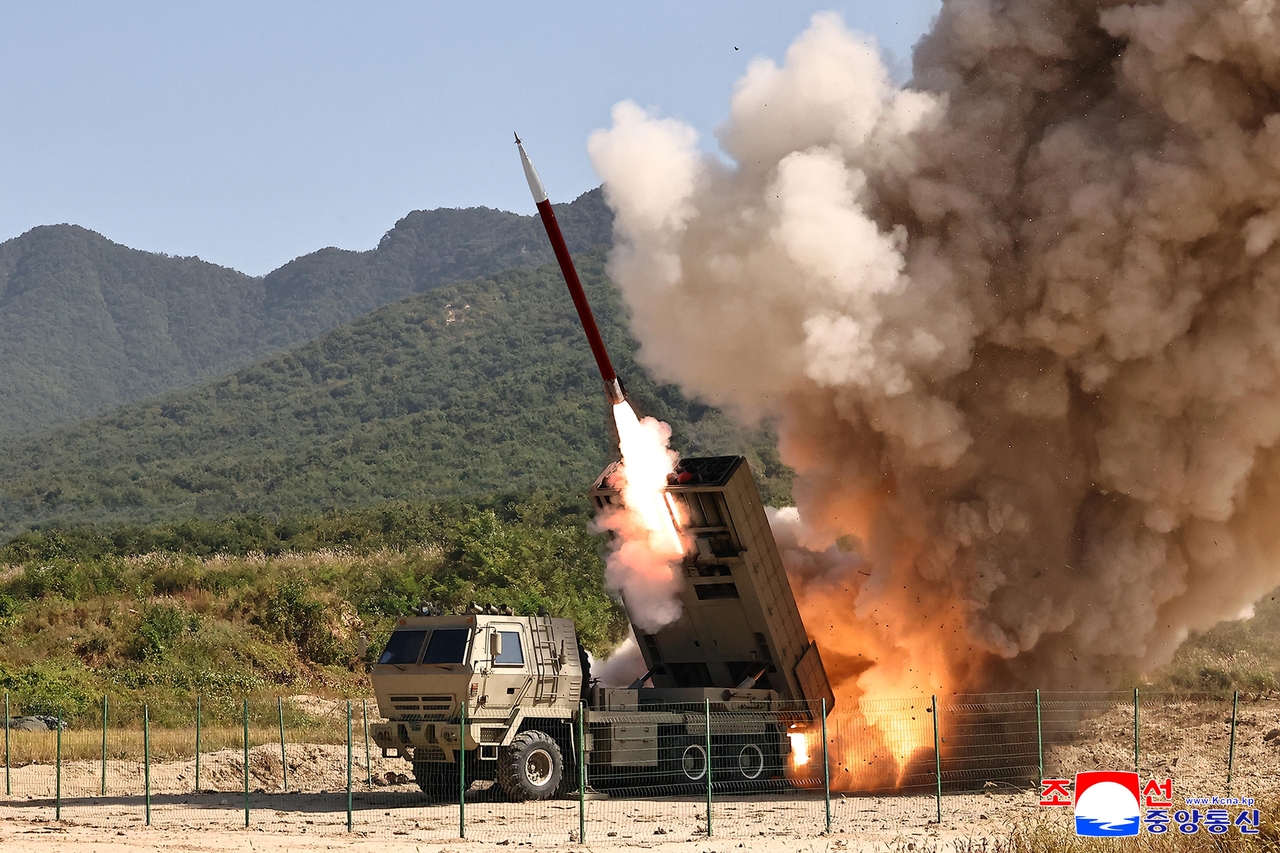
North Korea said Thursday it had successfully tested an enhanced 240 mm multiple-launch rocket system with greater range and precision, while calling for its most destructive weapons to be deployed along the inter-Korean border.
The test, conducted Tuesday, involved newly developed guided rockets that Pyongyang claims can travel as far as 115 kilometers, potentially broadening the area within reach of its frontline artillery, according to the North's state-run Korean Central News Agency.
The upgraded rockets, equipped with what Pyongyang calls an "autonomous pinpoint guide system," can strike targets 100 km away in a ballistic trajectory and reach up to 115 km using a combined glide flight mode, KCNA said.
Senior military officials overseeing the test said the development of the extended-range rockets would bring about a "significant change" in firepower readiness along what North Korea calls its "southern border."
Pak Jong-chon, vice chairman of the Central Military Commission of the ruling Workers' Party of Korea, stressed the need to "concentrate the deadliest and destructive attack forces on the southern border," according to KCNA.
Pak also called for making the North's adversaries aware that Pyongyang had replaced its military's long-range strike assets with its latest weapons systems at an accelerated pace, the report said.
The latest system marks a significant upgrade from North Korea's older 240 mm rockets, expanding both their range and precision-strike capabilities, according to Yang Moo-jin, a distinguished professor at the University of North Korean Studies.
Earlier versions had a range of around 70 km and were largely considered a threat to the Seoul metropolitan area. The upgraded system's range of up to 115 km could extend its potential reach to major US military installations in Pyeongtaek and Osan, as well as parts of northern Chungcheong Province, Yang said.
Yang said the combination of extended range, precision guidance and a maneuvering glide trajectory represents an evolution from conventional artillery rockets toward more sophisticated precision-guided weapons.
The glide capability could also be intended to complicate South Korea's efforts to intercept incoming projectiles through its multilayered missile defense system for the Seoul metropolitan area, he said.
Yang said the weapon's relatively low production cost compared with ballistic missiles could allow North Korea to mass-produce the rockets and accelerate their deployment to frontline units.
If their capabilities are sufficiently demonstrated, Pyongyang could also seek to export the guided rockets as a relatively cost-effective weapons system to generate foreign currency revenue, he added.
The development comes as North Korea has increasingly sought to strengthen its strike capabilities against South Korea since declaring inter-Korean relations to be those between "two hostile states" in late 2023.
Yang said Pyongyang's emphasis on keeping its adversaries under constant military pressure suggests a shift toward a more offensive and coercive concept of deterrence.
The buildup of increasingly capable firepower near the inter-Korean border could further intensify the arms race between the two Koreas and raise the risk that even a relatively minor confrontation escalates into a localized conflict, he said.
South Korea's military said it had tracked several projectiles fired by the North toward the Yellow Sea on Tuesday and was examining the launches to determine their characteristics.
It said Seoul remained prepared to counter any North Korean provocation while keeping close watch on Pyongyang's military movements in coordination with the United States.
mkjung@heraldcorp.com