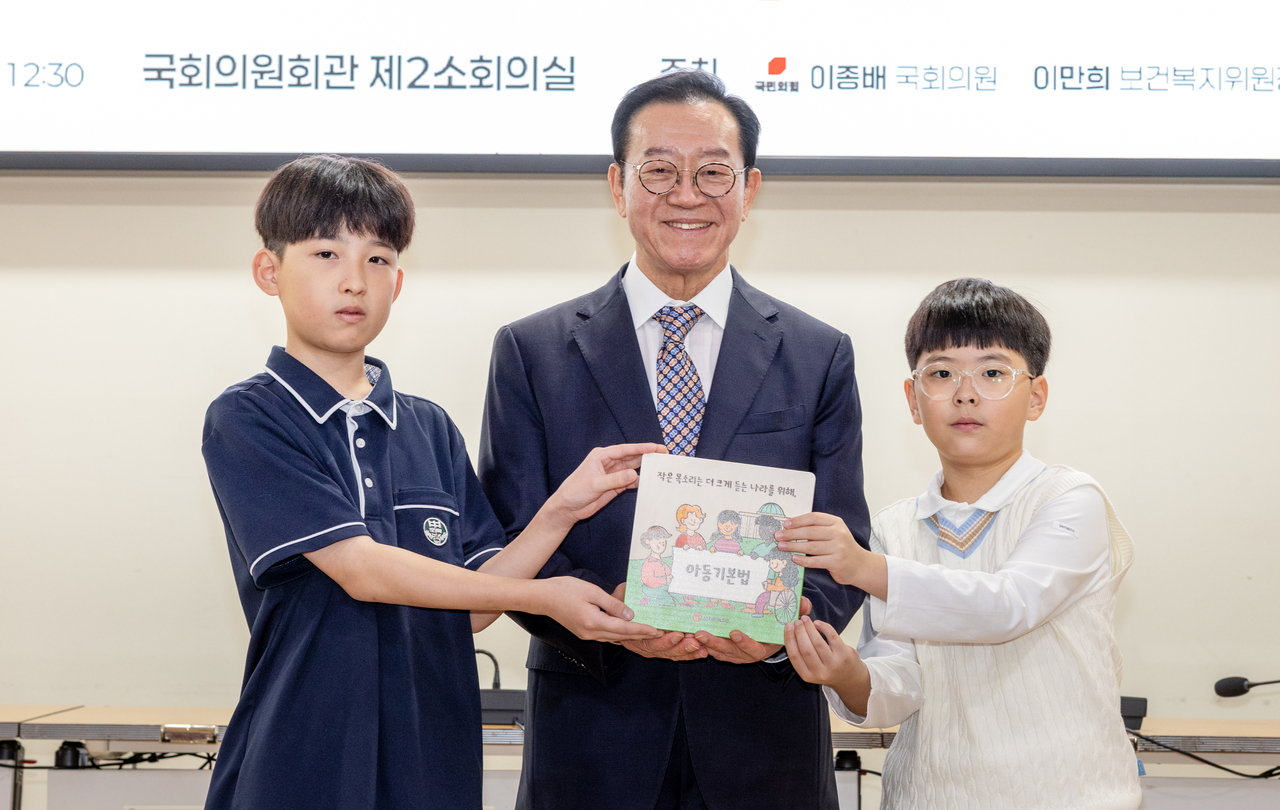
It was a rare moment in South Korea's legislature on Monday when two school children spoke up for themselves before an audience of over 100, including lawmakers.
Their demand was simple.
They asked adults to recognize children as independent people with their own thoughts, tastes and feelings.
"I hope adults ask us what we like, before they make decisions for us," Kim Jae-jun, a third grader from Chungju, North Chungcheong Province, said at the parliamentary forum on policies and legislation on children.
"I hope we can make more choices for ourselves on our own."
Listing off his favorite things ― hanging out with friends, chasing his dream of becoming a police officer, and imagining a special day when hamburgers are served in a school meal ― Kim said every child deserves to be happy, and there is a role that adults can play.
"I hope adults listen to children and have children speak about their thoughts and that children can grow up happily," Kim said. "I hope no child is neglected or bullied. I want every child to live a happy life."
Monday's parliamentary forum was designed to shed light on South Korea's ongoing effort to move away from the conventional viewpoint that children are merely the subjects of adults care.
The Child Welfare Act was implemented in 1961 and has since provided the legal framework for protecting children from domestic abuse, poverty and gaps in care.
But there have been persistent calls to address remaining tasks, such as granting children autonomous rights, preventing discrimination and consolidating government functions under a unified body dedicated to child-related policies.
Another student at Monday's event claimed the current legal system focusing on welfare leaves blind spots in the country's effort to guarantee children's right to happiness.
Yoon Dong-geon, a seventh grader, spoke about his experience of feeling unwelcome simply because he was not an adult.
"Have you ever come across a signboard saying 'No Kids Zone' and turned away? Every time I notice the signboard I feel like I'm not a whole citizen," said Yoon, who is a child committee member of the National Center for the Rights of the Child.
"There are places I feel I'm not welcomed."
No basic law has been enacted to outline the country's responsibility to ensure children's rights to survival, protection, development and participation in decisions affecting their lives, since South Korea's ratification of the United Nations Convention on the Rights of the Child in 1991.
People Power Party lawmaker Rep. Lee Jong-bae, one of the cohosts of the event along with Save the Children Korea, floated a bill on Friday to introduce a basic law on the rights of children. The lawmaker, representing the constituency of Chungju, was the latest to have proposed such a law in South Korea's decadeslong legislative efforts toward that goal.
In the 22nd National Assembly alone since 2024, three lawmakers ― Kang Hoon-sik, who was later appointed as the presidential chief of staff, Rep. Baek Sun-hee of the minor liberal Rebuilding Korea Party and Lee of the People Power Party ― have submitted bills.
All of the bills remain pending at the National Assembly.
This contrasts with Japan, which is party to the CRC and whose Basic Act on Children’s Policy came into effect in 2023, and European countries like Sweden or the United Kingdom where independent public officials promote children’s rights as laid out in the UN Convention.
Yoon called for a shift in the country's tendency toward viewing children as individuals with their own rights.
"We cannot deny that children are the subjects of protection, but we are not a mere existence meant to be protected," Yoon said.
"Just like adults, I live my life, I feel, I think and I pursue happiness as an individual person."
consnow@heraldcorp.com