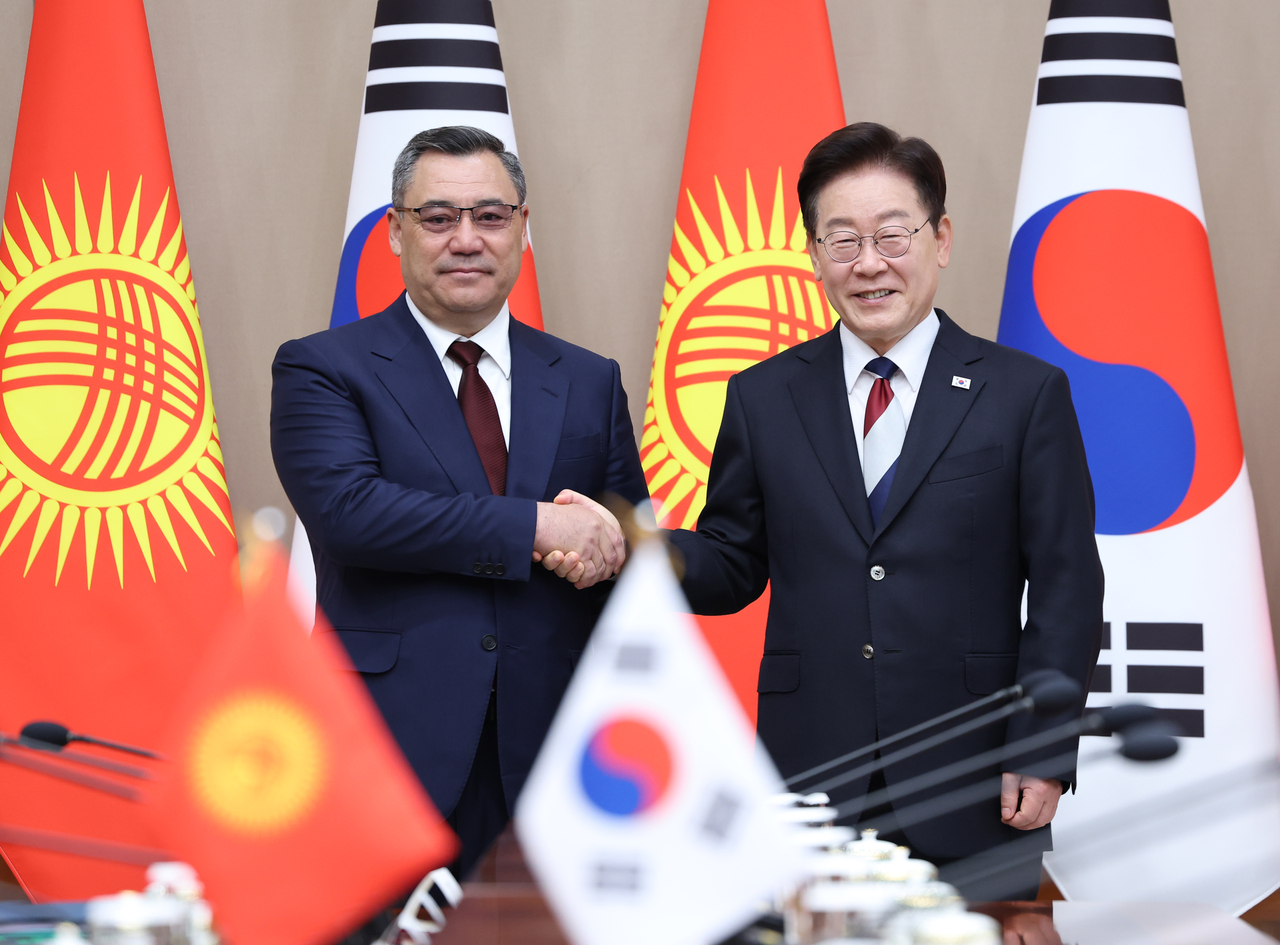
President Lee Jae Myung and Kyrgyz President Sadyr Japarov agreed Wednesday to elevate their countries’ comprehensive partnership across a range of fields.
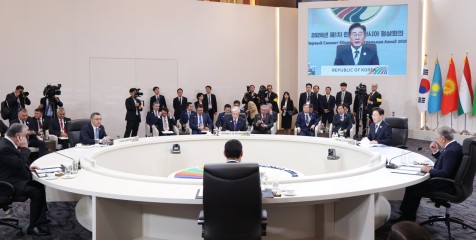
Lee’s meeting with Japarov was the last in a series of one-on-one summits he had held with the leaders of all five Central Asian countries since Monday, ahead of the inaugural Korea-Central Asia summit later Wednesday.
Lee and Japarov “held broad discussions on ways to strengthen bilateral relations and expand substantive cooperation,” according to Cheong Wa Dae.
"The two leaders agreed to take the Korea-Kyrgyzstan comprehensive partnership to the next level, building on the considerable potential for cooperation between the two countries,” Seong Ghi-hong, senior presidential secretary for public relations and communication, said in a press statement.
“They also agreed to expand cooperation across a wide range of areas, including trade and investment, critical minerals, urban development and infrastructure, development cooperation, food security, public administration, public security and disaster response, artificial intelligence, climate and the environment, people-to-people exchanges, culture and education,” he added.
The two leaders welcomed the recent sharp increase in bilateral trade and agreed to strengthen support for businesses by opening a KOTRA trade office in Bishkek and establishing a “Korea Desk” within the National Investment Agency under the Kyrgyz president, according to Seong.
During the summit, Lee called Kyrgyzstan “a steadfast partner with which Korea has developed cooperation across politics, the economy, culture and many other fields since establishing diplomatic ties in 1992.”
Lee noted that Kyrgyzstan is South Korea’s second-largest trading partner in Central Asia and that people-to-people exchanges have increased by nearly 50 percent since direct flights connecting the two countries were launched three years ago.
“Building on the considerable potential for cooperation between our two countries, I hope bilateral exchanges will expand even further,” Lee said.
“I hope we can have in-depth discussions on expanding mutually beneficial cooperation between our two countries, ranging from infrastructure development, public administration, public security and disaster response to food security, climate and the environment, culture and trade,” he said.
Lee also congratulated Kyrgyzstan on its election to a two-year term as a nonpermanent member of the UN Security Council beginning next year and thanked Japarov for his country’s “unwavering support for peace on the Korean Peninsula.” Kyrgyzstan was elected in June to serve on the council for the 2027-28 term.
“I hope Kyrgyzstan will continue to be a steadfast partner on our journey toward a Korean Peninsula of peace and prosperity,” Lee said.
Lee told Japarov he had been “looking forward to meeting him again in Korea,” noting that the Kyrgyz leader’s previous visit to Seoul in December 2024 coincided with then-President Yoon Suk Yeol’s declaration of martial law just hours after their summit. During that visit, the two countries elevated their relationship to a comprehensive partnership.
Japarov, in turn, said he attached great significance to meeting Lee in person for the first time, describing South Korea as “one of Kyrgyzstan’s key partners in Asia.”
“We attach great importance to further strengthening cooperation with Korea across a wide range of fields,” Japarov said, adding that the two countries share similar positions on many regional and international issues.
“I believe there remains considerable untapped potential between the Kyrgyz Republic and the Republic of Korea,” he said. “I am confident that we can further develop bilateral relations and expand substantive cooperation as our relationship enters a new stage.”
Japarov proposed using the summit to “thoroughly exchange views on key issues in bilateral relations,” while seeking to “jointly identify new areas of cooperation and discuss concrete ways to further advance the bilateral partnership.”
The two sides signed 18 agreements and memorandums of understanding spanning infrastructure, trade, energy and other fields, aimed at translating the partnership into more concrete cooperation.
On infrastructure, the two sides agreed to cooperate on urban planning, transport and other public infrastructure, including smart construction technologies and public-private partnership projects.
The two countries also revised their trade and investment agreement to add cooperation in critical minerals, digital transformation, halal certification and textiles.
Several memorandums were designed to make it easier for companies to do business in each other’s markets.
The two sides agreed to strengthen customs cooperation, while mutual recognition of halal certification is expected to reduce the time and cost Korean exporters face in obtaining local certification.
dagyumji@heraldcorp.com