The long-term stability of relations between states depends not only on political agreements or economic projects, but also on the opportunities created for human capital.
After all, specialists capable of mastering new technologies, applying scientific ideas in practice, and communicating effectively with international partners do not emerge on their own.
Behind this lies quality education, scientific research, and the exchange of experience.
In this regard, the educational dimension of the relationship that has developed over the years between Uzbekistan and South Korea — the Republic of Korea — deserves special attention.
Alongside trade, economic, and investment projects, relations between the two countries are increasingly expanding in the areas of higher education, professional training, science, technology, and human capacity development.
During President Shavkat Mirziyoyev's meetings and negotiations concerning relations with the Republic of Korea, great importance has been given to training qualified personnel, adopting advanced practices, and aligning the education system with the needs of a modern economy.
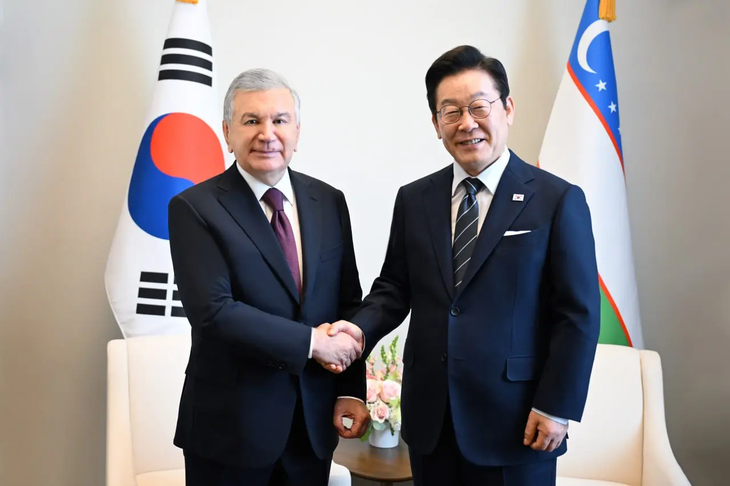
During a meeting with President of the Republic of Korea Lee Jae-myung in New York on September 23, 2025, it was noted that four branches of leading Korean higher education institutions and vocational training centers in the regions are already operating in Uzbekistan.
The parties also agreed to prepare a new long-term Technology and Industrial Partnership Program aimed at developing high technology and modern manufacturing. This program envisages implementing projects in chemistry, mechanical engineering, agriculture, transport, aviation, biotechnology, and other priority areas.
In this process, the role of education extends far beyond simply training personnel, because importing technology alone is not enough for development.
What is needed are knowledgeable specialists who can understand, improve, and adapt technology to local conditions.
The Unity of Education, Science, and Production
The attention being paid in our country to bringing education closer to science and the real economy stems from precisely this need.
On June 2, 2026, during a videoconference dedicated to the accelerated development of the chemical industry and the implementation of investment projects in the regions, President Shavkat Mirziyoyev spoke with young laboratory assistants and students engaged in dual education, and reviewed presentations by scientists.
At the meeting, it was emphasized that an integrated system combining education, scientific research, laboratories, and startups needs to be created.
This approach also offers a new interpretation of the essence of the modern university: a higher education institution should not be merely a place for classroom instruction, but a hub connecting scientific research, innovation, and production.
To this end, plans are underway to establish an innovative scientific-production and educational cluster covering 60 hectares in the Mirzo Ulugbek district.
Within this cluster, a Chemical Technology Innovation Center is planned to be built in cooperation with South Korea.
Half of the costs associated with pilot testing work at the center are expected to be covered.
This initiative reflects the new substance of Uzbekistan–Korea relations. It is no longer just about introducing ready-made technology or equipment.
It is about uniting knowledge, research, laboratories, personnel training, and production into a single system.
The President's 2026 Address also emphasized the importance of training specialists based on science and modern technology in sectors that create high added value, in order to ensure the country's competitiveness.
In particular, tasks have been set to introduce advanced foreign experience, including Korean experience, into technical education programs.
This means that education is not merely a supplementary direction in relations between the two countries.
On the contrary, it is one of the key factors shaping the human capital that ensures the effectiveness of projects in other fields.
Language — the Human Bridge of Partnership
The teaching of Korean language holds a special place in Uzbekistan State World Languages University's relations with the Republic of Korea.
Korean has been taught at the university as a second foreign language since 1995, and since 2017 it has also been included in the curriculum as one of the main foreign languages.
Currently, 826 undergraduate students are studying in Korean language groups. At the master's level, 26 students are continuing in this field, and another 120 students are studying Korean as a second foreign language. In total, 972 young people are studying Korean.
This figure alone reflects how the relations between the two countries are expanding in the fields of education and culture. Knowing a language is not merely acquiring a means of communication — it also provides a better understanding of another people's worldview, values, culture, and business practices.
Last academic year, 32 professors and instructors worked in the Korean language program, including 8 from Korea and 24 local specialists.
The blending of different educational schools and pedagogical experience in a single classroom creates an opportunity for students to enrich theoretical knowledge with practical skills.
Inter-University Relations: From Experience to Opportunity
The real value of educational ties is reflected above all in the opportunities created for students.
Uzbekistan State World Languages University cooperates with Seoul National University, Jeju National University, Liaodong University, Suncheon University, Pusan University of Foreign Studies, Chung-Ang University, Duksung University, Tongmyong University, and Sungshin University.
Such partnerships expand not only academic exchange but also opportunities for students to study and pursue professional development in Korea. To date, more than 60 students have had the opportunity to study and advance their qualifications in Korea.
The value of studying abroad is not defined solely by acquiring new knowledge. Students become acquainted with a different education system, communicate with representatives of different cultures, and develop skills in independent thinking and adaptability — all of which are essential competencies for their future professional careers.
The results of our students in international competitions also demonstrate the practical impact of these opportunities. A student from the Korean language group won first place both in the national round and in the final round held in Korea of the "Quiz on Korea" competition.
KOICA: Investment in the Educational Environment
The Korea International Cooperation Agency (KOICA) has also made a significant contribution to Uzbekistan–Korea educational relations.
The agency has been providing methodological and technical support to Uzbekistan State World Languages University. With KOICA's support, Korean Language and Culture Centers were established at the Faculty of Oriental Philology and the Information Resource Center.
They were equipped with computers, televisions, educational and literary materials, and country-study resources.
At the Faculty of Translation Studies, two simultaneous interpretation training rooms were established with KOICA's support, equipped with simultaneous interpretation equipment manufactured in Germany.
Such infrastructure helps move the language-learning process from theoretical study toward practical application — and this is especially valuable for professions such as interpreting, which directly serve international communication.
A $1,116,000 Project
In 2025, KOICA allocated a grant of 1 million 116 thousand US dollars to develop the Korean Language and Culture Center at Uzbekistan State World Languages University.
Within the framework of this three-year project, it is planned to bring in 70 volunteers from Korea.
In addition to Korean language classes, they will also take part in organizing cultural events and clubs in taekwondo, dance, music, and other areas.
On April 8, 2026, the rector of Uzbekistan State World Languages University, Ilkhomjon Tukhtasinov, together with the head of the international cooperation department and the dean of the Faculty of Oriental Philology, familiarized himself with the work being carried out at the Korean Language and Culture Center established through the KOICA grant.
During the visit, the technical equipment, furniture, Korean national costumes, and musical instruments provided by KOICA were inspected.
The progress of the project's work and the center's design solutions were also reviewed. By that time, 38 volunteers had already visited the university.
Starting April 8, another 15 volunteers took part in adaptation and Uzbek language courses before beginning their own activities. On April 21, preparations for the center's opening ceremony were reviewed with the participation of the Embassy of the Republic of Korea in Uzbekistan and KOICA leadership.
Rector Ilkhomjon Tukhtasinov also gave an interview for a special video about the project.
The significance of the center lies not in its name, but in the environment being created — a space where opportunities for language learning, cultural familiarization, communication, and gaining international experience come together.
Another Direction of Cooperation — Training Specialists
Relations with Korea are not limited to teaching the Korean language and culture. Since 2022, the Korea Education Center has been cooperating with the Scientific Research Center for Pedagogical and Psychological Diagnostics under the Department of Pedagogy and Psychology at Uzbekistan State World Languages University. Within this partnership, three projects have been implemented.
In 2022, two projects, and in 2024, one project, provided professional retraining courses in Korean for philology specialists. All expenses for these courses were covered by the Korea Education Center.
This experience shows that the reach of international relations is not limited to students. Improving the qualifications of professors and specialists is also an important condition for enhancing the quality of education.
Human Capital That Connects the Future
As relations between Uzbekistan and the Republic of Korea grow richer through new technologies, investments, and joint projects, the need for qualified specialists naturally increases as well.
A new manufacturing enterprise needs engineers, a scientific project needs researchers, international negotiations need interpreters, a joint venture needs managers, and an educational project needs modern educators.
What unites all of them is knowledge and competence.
That is why education can be called the long-term foundation of Uzbekistan–Korea relations.
Economic projects may yield results within a certain period, but the human capital formed through education creates a potential that passes from generation to generation.
The initiative to establish a Chemical Technology Innovation Center in cooperation with South Korea in the chemical industry is important precisely from this perspective, as it clearly demonstrates the interconnection between education, scientific research, laboratories, and production.
For Uzbekistan State World Languages University, this process sets new tasks: substantively expanding academic ties with Korean higher education institutions, developing student and faculty exchange, increasing joint scientific and educational projects, and actively introducing modern pedagogical and digital technologies into the educational process.
This also explains the importance of specialists who have thoroughly mastered the Korean language.
As economic, scientific, cultural, and educational ties between Uzbekistan and Korea expand, the value of personnel capable of professional-level communication between the two countries grows even further.
Today, the 972 students studying Korean at Uzbekistan State World Languages University are direct participants in this future. Some of them may become translators, others educators, researchers, diplomats, specialists at international companies, or representatives of the cultural sphere.
What matters is that each of them represents a new generation carrying forward the relations between the two countries on a human level.
In this sense, it would not be accurate to evaluate Uzbekistan–Korea educational relations only within the framework of universities, grants, exchange programs, or language courses.
This is a long-term process that unites the exchange of knowledge and experience, academic mobility, cultural dialogue, scientific research, and human capital development.
It is precisely this process that creates a solid foundation for future cooperation, because the most enduring bridges between states are built not of technology or structures, but of people who understand one another, share knowledge, and strive toward common goals.
Ilkhomjon Tukhtasinov is rector of Uzbekistan State World Languages University. Views expressed are his own. — Ed.
khnews@heraldcorp.com