
Over 2 in 5 Korean students achieve top levels in new digital problem-solving assessment
South Korean students remained among the world’s strongest performers in science and mathematics and scored highly in a new assessment of digital problem-solving, even as their reading performance showed a statistically significant decline over the past decade.
Korean 15-year-olds scored an average of 526 in science, 501 in reading and 522 in mathematics in the 2025 Program for International Student Assessment, according to results released Tuesday by the Organization for Economic Cooperation and Development.
All three scores were well above the corresponding OECD averages of 482, 461 and 463.
PISA's scoring system uses a statistical framework on a bell curve that was originally anchored at 500 points.
Among OECD members, South Korea was estimated to rank between first and third in science, first and second in mathematics and first and ninth in reading. Among all participating countries and economies, it ranked between fifth and seventh in science and mathematics and between third and 13th in reading.
PISA reports rankings as ranges because it assesses samples of students rather than entire populations. When score estimates for several education systems are statistically indistinguishable, their rankings overlap.
The latest results showed diverging long-term trends across the three core subjects.
Korea’s science score edged down from 528 in 2022 to 526, but the long-term change is still positive. The OECD’s trend analysis showed a statistically significant 12-point improvement over the 10-year period beginning in 2015.
Reading fell from 515 in 2022 to 501. The OECD found a statistically significant 14-point downward trend over the decade from 2015.
The mathematics score declined from 527 in 2022 to 522, but its estimated one-point change over the longer 10-year period was not statistically significant, indicating that performance remained broadly stable.
Strong showing in digital problem-solving
Korean students scored 538 in Learning in the Digital World, compared to the OECD average of 500. Korea ranked between second and fifth among OECD members and between sixth and 10th among all participating countries and economies.
The newly introduced domain assesses students’ ability to use computational tools to construct knowledge and solve problems through an iterative, self-regulated process.
Korea had a relatively large share of high performers, with 41.5 percent of students reaching Levels 5 or 6, compared to the OECD average of 26.1 percent. Level 6 is assessed as the highest proficiency level.
Meanwhile, 13.4 percent of Korean students performed below Level 2, substantially lower than the OECD average of 22.7 percent.
Macao topped the LDW assessment with a score of 572, followed by Singapore at 563 and the participating regions of Beijing, Shanghai, Jiangsu and Zhejiang in China at 560.
The results also showed contrasting gender gaps. Korean girls outscored boys by 28 points in reading, while boys led by 11 points in mathematics. Both differences were statistically significant. No significant gender gap was found in science or LDW.
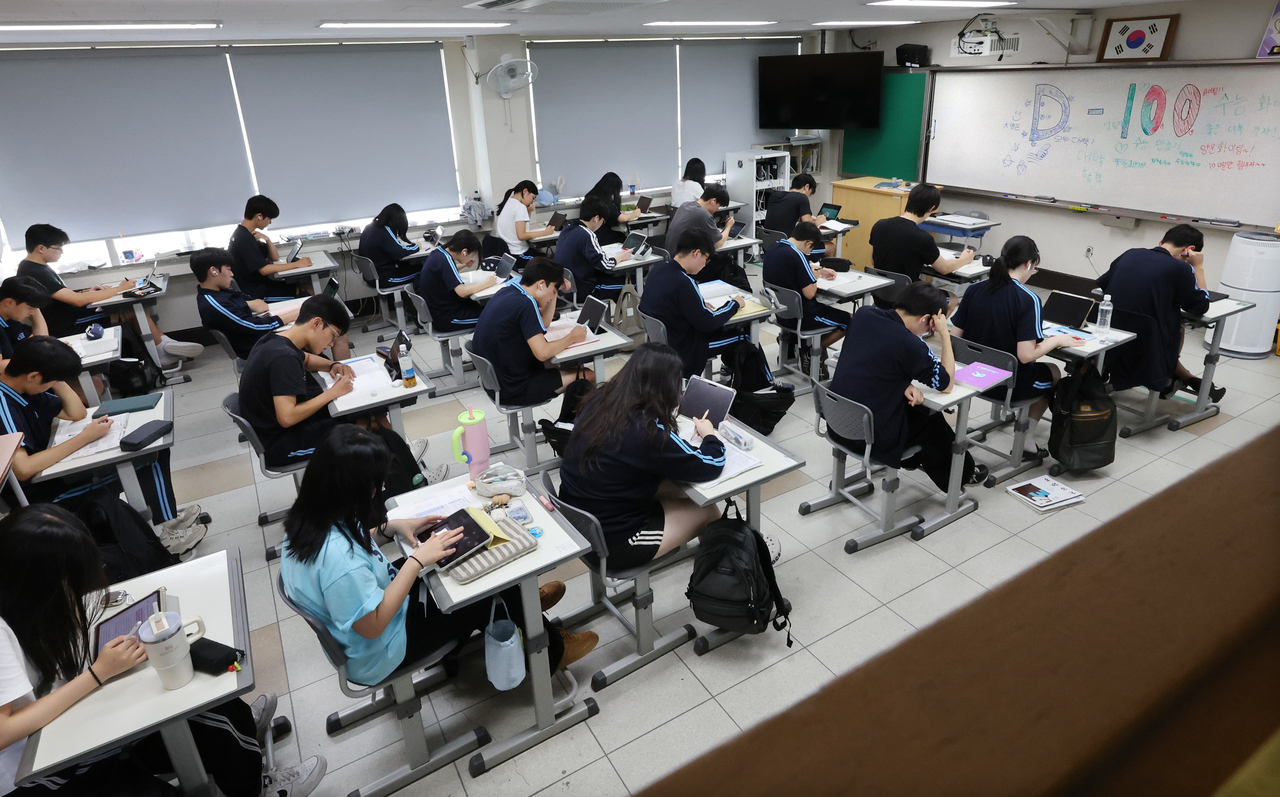
PISA 2025 assessed about 760,000 students across 91 countries and economies, including all 38 OECD members. In Korea, 6,859 students from 196 schools took the computer-based assessment from May 8-30, 2025.
Conducted every three years since 2000, PISA assesses how well 15-year-olds can apply knowledge and skills considered essential for participation in modern society.
Science was the main assessment domain in 2025, while LDW was introduced as an innovative domain. PISA is scheduled to move to a four-year cycle beginning in 2029.
shwang9@heraldcorp.com