
South Korea is reviewing the possible deployment of military personnel to the Strait of Hormuz as one of several options to help ensure safe passage through the waterway, Cheong Wa Dae said Friday.
A senior presidential official, speaking on condition of anonymity, said any deployment would be assessed based on two key considerations: defense readiness posture on the Korean Peninsula and domestic legal requirements. The official stressed that no decision has been made.
The remarks came after local broadcaster JTBC reported Thursday that the government was reviewing troop deployment to the Strait of Hormuz and that it would “not be long” before a deployment consent motion could be submitted to the National Assembly.
Responding to the report, the official said the government had not settled on any particular course of action, while reiterating Seoul’s position that it would make “substantive and military contributions” to securing safe maritime routes through the Strait of Hormuz.
“Nothing has been decided, but we are continuing to review the options,” the official said.
The official said military contributions could take a variety of forms and that the government was examining a broad range of possibilities.
“Some (military contributions) involve participation in combat, while others are noncombat roles. There could also be various options related to search operations,” the official said. “We are reviewing them comprehensively.”
The official also noted that “troop deployment” can even refer to the overseas dispatchment of a very small number of military personnel.
“‘Troop deployment’ is a term stipulated in the Constitution,” the official said. “So, for example, if even one or two service members were sent to the area, whether in a combat or noncombat role, that would be classified as a troop deployment.”
The official sought to distinguish that legal definition from the broader public perception of troop deployment as necessarily involving combat or a sizable military force.
“When people hear the term ‘troop deployment,’ they may immediately associate it with combat or the deployment of a large number of troops,” the official said. “Against that backdrop, what I can say is that there could be a variety of options, and we are reviewing them.”
“Any substantive contribution” by South Korea in the Strait of Hormuz, the official said, would first have to be assessed against the country’s military readiness on the Korean Peninsula.
“We are reviewing various possibilities in terms of our readiness posture on the Korean Peninsula,” the official said. “We believe there may be some room for maneuver as long as it does not significantly undermine our readiness posture on the Korean Peninsula.”
Domestic legal requirements would also have to be taken into account. Under Article 60, Paragraph 2 of the Constitution, the National Assembly has the right to consent to the overseas deployment of South Korean armed forces.
“Domestic legal procedures ultimately mean consultations with the National Assembly and obtaining its consent,” the official said. “We have not reached that stage yet.”


Rationale behind Seoul's deliberation
Doo Jin-ho, a visiting research fellow at the Institute for Far Eastern Studies at Kyungnam University, suggested that Seoul may see a potential deployment to the Strait of Hormuz as a way to gain traction on a host of other trade and alliance issues with Washington.
“Why consider a troop deployment at this point? It seems the government believes some kind of extraordinary measure is needed,” Doo told The Korea Herald.
The two allies are grappling with a range of disagreements across both trade and security. They include differences over the timeline for transferring wartime operational control to South Korea and slow progress in follow-up negotiations on the Joint Fact Sheet issued by the two countries in mid-November.
“There are simply too many areas of disagreement between South Korea and the US right now,” Doo said. “Ultimately, I think the government may be trying to break through the current difficulties between South Korea and the US by demonstrating a greater contribution to the alliance.”
The senior presidential official also acknowledged Friday that security negotiations had again run into difficulties after making some progress earlier in the year.
“It was around May that talks got back on track, and there was some progress, but things have become difficult again,” the official said. “The situation is intertwined with a number of other issues.”
Cheong Wa Dae has previously acknowledged that follow-up security negotiations were effectively stalled from January through May, partly amid friction stemming from South Korea’s investigation into a massive data breach involving US-listed e-commerce giant Coupang.
The talks began moving again around May, with the two sides launching interagency consultations in early June on nuclear cooperation provisions in the Joint Fact Sheet. Those discussions include Seoul’s push to acquire nuclear-powered submarines and expand its rights to enrich uranium and reprocess spent nuclear fuel for peaceful purposes.
At Friday’s briefing, the official said the wide range of outstanding issues between Seoul and Washington were affecting one another, with difficulties in one area at times slowing progress elsewhere.
“There are various pending issues between South Korea and the US across different areas, and they influence one another. Some can cause delays, while others can become obstacles. It is a complicated situation, and we are working to untangle it,” the official said.
“We are making considerable efforts through close consultations with the US to ensure that these issues do not become obstacles to progress in other areas.”
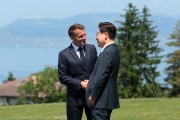
Seoul’s deliberations over a potential deployment came to light just days before President Lee Jae Myung’s summit with French President Emmanuel Macron in Paris on Tuesday, where the Strait of Hormuz could be on the agenda.
France has taken an active role in international efforts to safeguard freedom of navigation through the strategically vital waterway, including by working with the United Kingdom to spearhead efforts to establish a multinational military mission.
The issue has also featured in the recent summit in Seoul in April, where Lee and Macron agreed to work together to help ensure safe maritime passage through the Strait of Hormuz.
“It would be difficult to rule out that possibility, given that France was one of the first countries to actively push for international cooperation to ensure freedom of navigation through the Strait of Hormuz,” the official said when asked whether the issue could be placed on the summit agenda.
dagyumji@heraldcorp.com