Political parties from four continents and across ideological divides will gather in Seoul on Sunday to launch a new dialogue on pressing shared challenges, from geopolitical tensions to the accelerating pace of AI-driven change.
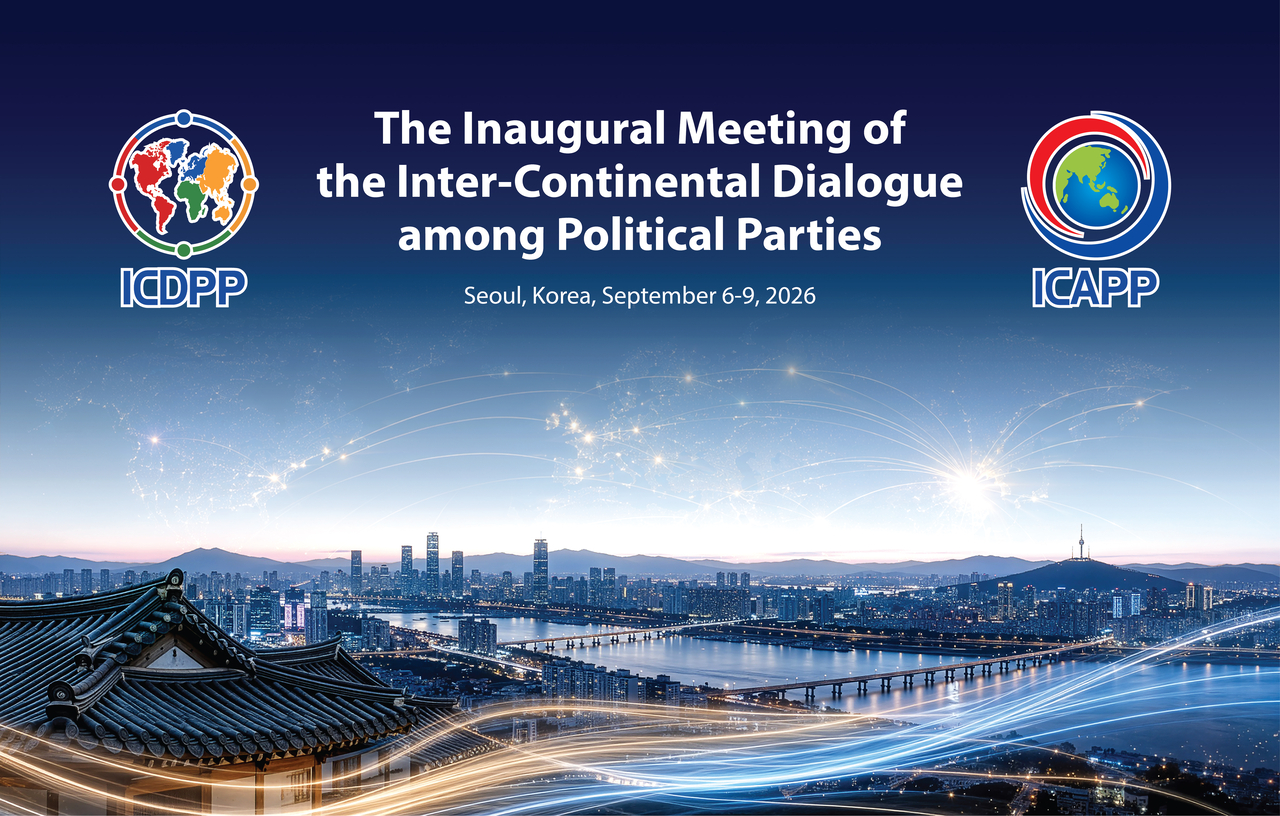
The meeting will mark the formal launch of the Inter-Continental Dialogue among Political Parties, bringing together political party organizations and networks from Asia, Africa, the Americas and Europe.
The inaugural gathering, organized by the International Conference of Asian Political Parties, whose secretariat is based in Seoul, will be held Monday at The Plaza Seoul.
Founded in 2000, ICAPP brings together some 360 political parties from 52 countries across Asia and Oceania. Since last year, it has been consulting political party organizations and networks on other continents on ways to build broader cooperation, with plans for the inaugural ICDPP meeting finalized at an ICAPP Standing Committee meeting in Ulaanbaatar, Mongolia, in June.
Through the inaugural meeting, ICAPP said it aims to formally establish the ICDPP as a global cooperation platform linking political party organizations and networks across the four continents.
The initiative is intended to create a standing channel through which parties with different political traditions and ideological backgrounds can deepen mutual understanding and pursue practical cooperation.
The dialogue in Seoul will focus on how political parties can, “on the basis of mutual respect,” respond more effectively to complex challenges that cross national borders, including climate change, geopolitical tensions, economic uncertainty and rapid advances in science and technology such as artificial intelligence, according to ICAPP.
The inaugural meeting is expected to draw high-level representatives from 24 political parties of 23 countries.
The participants will represent six major political party organizations and networks spanning four continents: ICAPP in Asia; the African Political Parties Initiative; the Permanent Conference of Political Parties of Latin America and the Caribbean and the Union of Latin American Parties in the Americas; and two political groups within the Parliamentary Assembly of the Council of Europe — the Group of the European People’s Party and the European Conservatives, Patriots & Affiliates.
Among the participants will be Chung Eui-yong, chairperson of the ICAPP Standing Committee and a former South Korean foreign minister and presidential national security adviser under the Moon Jae-in administration.
The official program will begin Sunday evening with a welcome reception hosted by Chung.
At Monday’s opening ceremony, Chung will deliver an opening address alongside Jeffrey Thamsanqa Radebe, chairman of the APPI Advisory Council; Alejandro Moreno Cardenas, president of COPPPAL; and Zsolt Nemeth, chairman of ECPA.
The first plenary session, “From Vision to Reality: The Launch of the Inter-Continental Dialogue among Political Parties,” will focus on putting the new forum on an institutional footing.
Participants are expected to discuss its long-term vision, organizational structure, cooperation mechanisms and priority areas before finalizing the ICDPP’s Terms of Reference, which will define its objectives, governance and direction for future activities.
The afternoon session will shift from building the institution to the problems it is intended to address under the theme “Political Parties in an Era of Geopolitical Uncertainty: Challenges, Responsibilities and Global Cooperation.”
Participants will discuss political polarization and declining trust in democracy, economic instability and inequality, human rights, conflict prevention and ways to strengthen international peace and stability.
Participants are expected to adopt a Seoul Declaration outlining areas of agreement and joint approaches to those challenges, along with the ICDPP’s Terms of Reference, at the closing ceremony.
An official dinner hosted by National Assembly Speaker Cho Jeong-sik will follow at the National Assembly.
ICAPP said it planned to expand international dialogue and exchanges among political parties and strengthen the role of party diplomacy, building on the inaugural ICDPP meeting.
The organization is also set to hold its 13th General Assembly in Seoul from Nov. 4 to 7, co-hosted by the ruling Democratic Party of Korea and the main opposition People Power Party. Around 100 political parties from more than 40 countries across the region are expected to attend.
dagyumji@heraldcorp.com