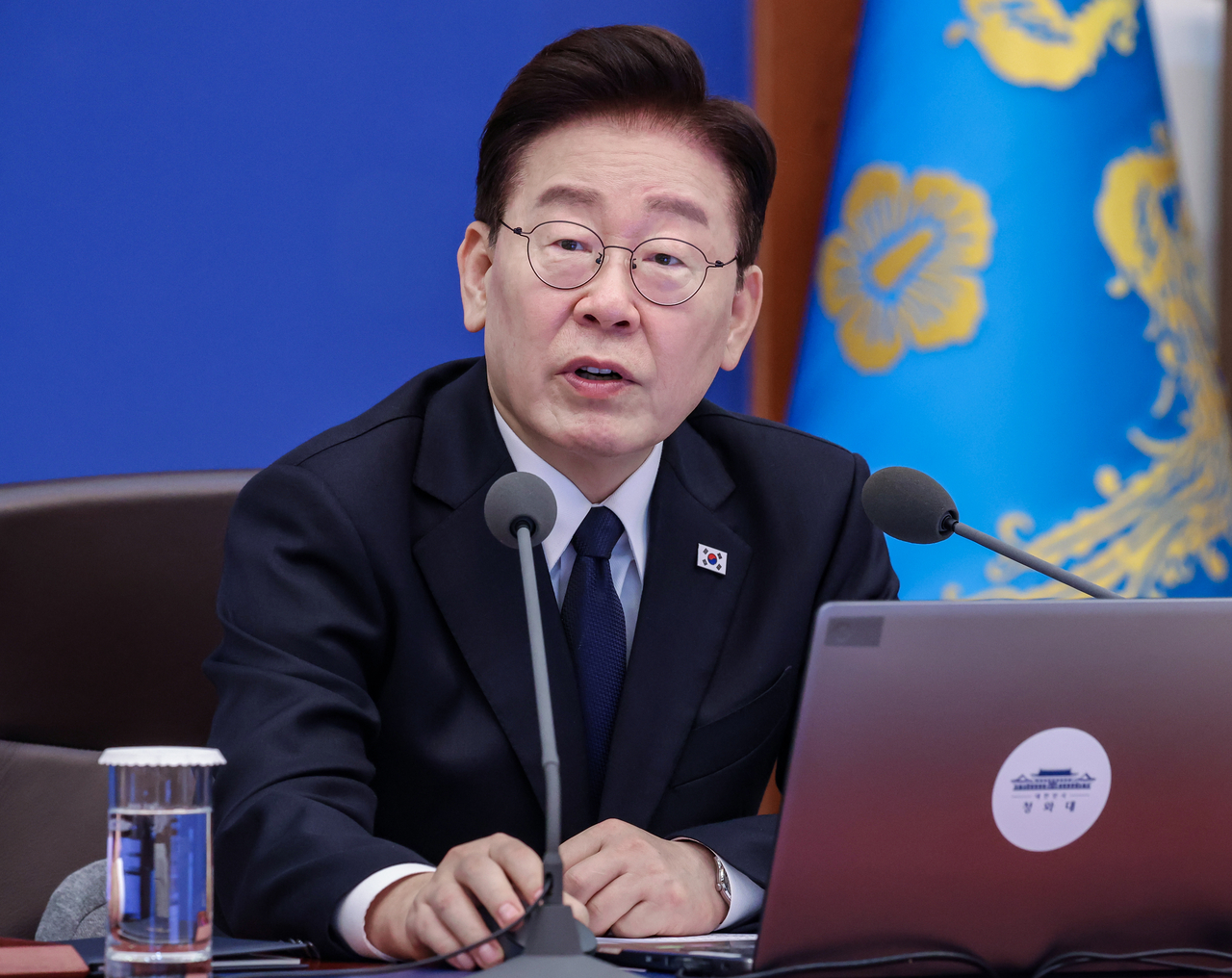
President Lee Jae Myung ordered officials Thursday to tighten South Korea’s national and basic pension systems to curb improper benefit claims enabled by loopholes in the programs.
Lee’s instruction came amid growing scrutiny of cases in which foreign nationals and newly naturalized citizens have received pension benefits under rules that have raised questions about fairness.
Lee further noted that one such case has been identified, but added that there appear to be quite a few cases in which foreigners paid contributions for several months before making retroactive payments covering a substantial period.
“We are moving quickly to address the institutional shortcomings,” Lee said during a weekly meeting with senior aides and secretaries at Cheong Wa Dae.
“Social security programs funded by resources collectively contributed by the public must be designed carefully and fairly so that no one can gain an unfair benefit and citizens do not suffer unreasonable losses,” he added.
The retroactive payment system was originally designed to protect pension rights for Korean nationals whose contribution records were interrupted by unemployment, business closures or other periods in which they were exempt from paying premiums. It allows eligible subscribers to make up for those gaps by paying premiums retroactively for up to 119 months.
The controversy stems from the fact that foreign nationals can also make retroactive payments for eligible periods if they were registered as residents in South Korea at the time.
Critics argue that this can allow some foreign subscribers with only a short period of actual enrollment to make years of back payments at once and qualify for benefits that may far exceed their contributions, given the pension system’s relatively favorable payout structure for low-income and short-term contributors.
Another issue is that once recipients return overseas, difficulties in verifying deaths or changes in dependent status could increase the risk of improper payments.
Lee further called for revisions to the current basic pension system, under which naturalized Koreans can receive benefits regardless of when they acquired citizenship as long as they meet income, asset and other eligibility requirements.
“There is also growing debate over whether it is really appropriate for someone who acquired citizenship just a month ago to be deemed eligible for the basic pension simply because they have low income and few assets,” Lee said.
Lee said that, to take an extreme example, someone who had lived their entire life as a foreign national and acquired Korean citizenship late in life after moving to Korea could immediately become eligible to receive the same basic pension as Koreans who had paid taxes throughout their lives.
Lee said he did not expect such cases to be common. But he stressed that “this is not a matter of how many such cases there are, but a matter of principle.”
“The very fact that such a gap exists, regardless of how many actual cases there are — or whether there are any at all — is bound to be perceived as an unreasonable form of discrimination by the vast majority of citizens of the Republic of Korea who have faithfully fulfilled their tax obligations,” Lee said, referring to South Korea by its official name.
Lee further noted that most countries that provide basic pensions funded by tax revenue require recipients to have resided in the country for a certain period.
“We should examine ways to improve the system, including setting a minimum required period of residence in the country, after thoroughly reviewing overseas cases and domestic research,” Lee said. “Similar legislative bills have also been submitted to our National Assembly.”
Lee also called for a broader review of other social security and government-funded programs to identify and close any loopholes that could undermine “common sense and the principle of fairness.”
dagyumji@heraldcorp.com