
President reiterates commitment to regain wartime OPCON from US, stressing Seoul’s responsibility for peninsula peace
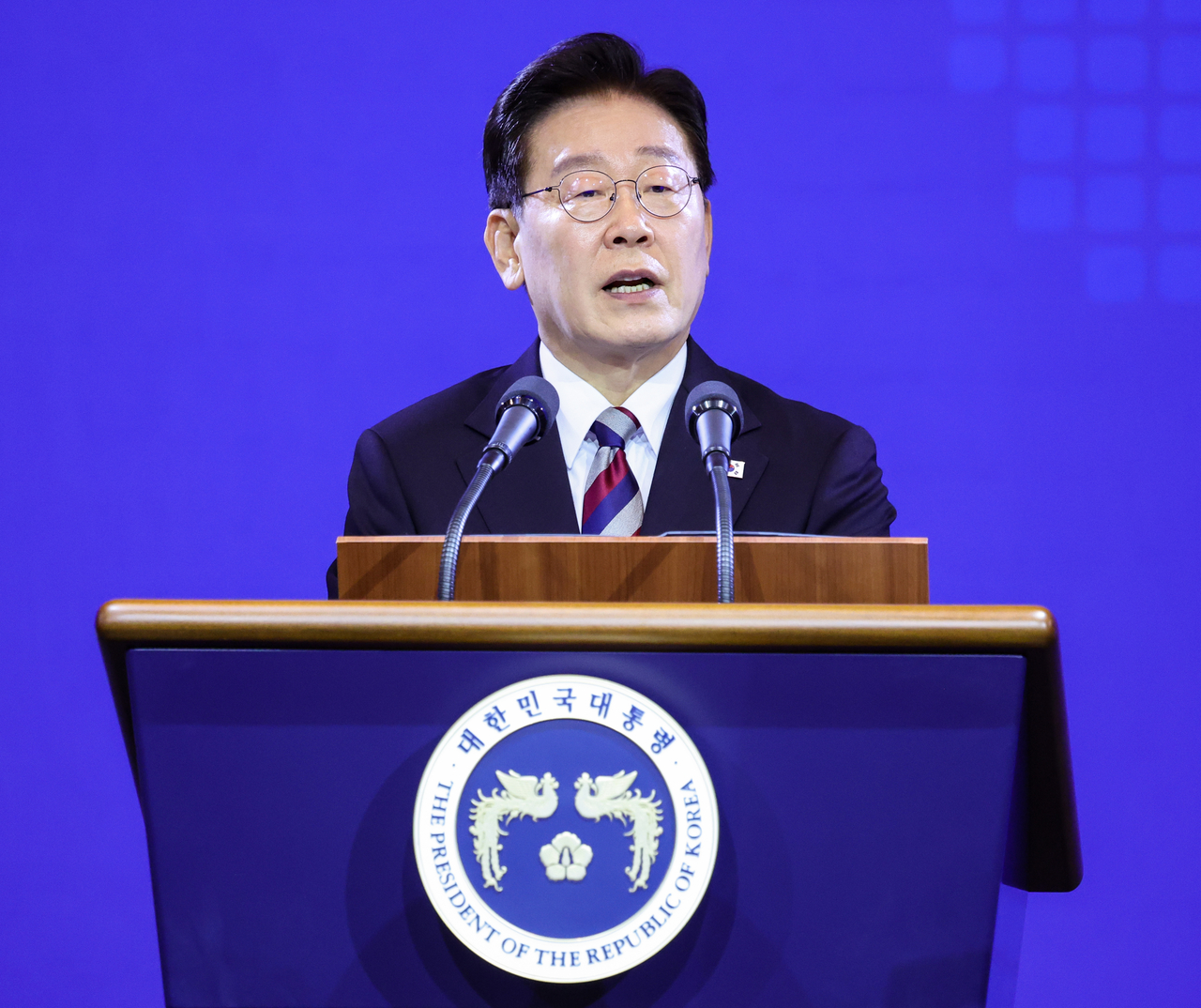
President Lee Jae Myung pledged Wednesday to create conditions for renewed US-North Korea dialogue, as he seeks to turn US President Donald Trump’s latest overtures to Pyongyang into an opening for diplomacy.
Lee underlined that South Korea must break the inter-Korean deadlock and move the peninsula beyond its decades-old armistice toward a lasting peace regime in his address to Americas-based members of the Peaceful Unification Advisory Council.
“As President Trump’s determination has created at least some possibility for a change in the situation on the Korean Peninsula, we must work to create the conditions for constructive discussions aimed at building trust between North Korea and the US and resuming dialogue,” Lee said.
Trump has repeatedly made public overtures to North Korean leader Kim Jong-un, whom he met on three occasions between June 2018 and June 2019, to return to the dialogue table amid long-stalled nuclear diplomacy since the last meeting.
As part of such efforts, Trump in mid-August ordered US Defense Secretary Pete Hegseth to “substantially reduce” annual combined military exercises between South Korea and the US, which Trump said sent a “signal that is totally inappropriate and hostile” toward North Korea.
As a result, the allies agreed to shorten the 2026 Ulchi Freedom Shield exercise from 11 days to five days and scale down associated field training exercises.
Backing Trump’s push to revive summit diplomacy with Kim, Lee also stressed South Korea’s responsibility as a direct party to peace on the Korean Peninsula, reiterating his commitment to regaining wartime operational control from the US.
“Peace on the Korean Peninsula is not a matter for us alone. It is a key task for the security of Northeast Asia and, more broadly, for world peace,” Lee told some 750 members of the presidential advisory body on unification from 24 countries across North, Central and South America.
“As a party directly concerned with this momentous task, we will fulfill our responsibility by regaining wartime operational control.”
In his speech, Lee also called for replacing the armistice framework that has governed the Korean Peninsula since the 1953 cease-fire of the Korean War with a more durable peace regime.
“We must institutionalize peace for stable and responsible peaceful coexistence,” Lee said. “We must transform the armistice regime, which is premised on confrontation and conflict, into a peace regime based on cooperation and prosperity so that tensions do not recur with shifts in domestic politics or the vicissitudes of the international environment.”
Lee stressed that it is high time for South Korea to break the prolonged impasse between the two Koreas, pointing out that the “South and North, which should be closest to each other, remain completely cut off.”
“We are wasting strength that could be used to move forward together on confronting and opposing each other,” Lee said. “It is truly unfortunate, and a grim reality that must be changed. This is a wall that has been built up over more than 80 years.”
“It will not come down simply by waiting. That is why we must act,” he said. “But we should move forward without rushing, while clearly determining where we are headed.”
Lee invoked his Liberation Day speech on Aug. 15, in which he laid out blueprints for moving beyond the principle of peaceful coexistence and putting it into practice.
The three principles were inclusive peaceful coexistence, aimed at overcoming division and putting peace into action; stable peaceful coexistence, focused on removing sources of tension and ensuring substantive security; and responsible peaceful coexistence, aimed at realizing peace on the Korean Peninsula and contributing to world peace.
“Now that we have set the milestones, it is time to move forward,” Lee said.
In his speech, Lee once again reiterated the need to move forward despite the prolonged freeze in inter-Korean dialogue. Lee cited a line from a novel about Korean immigrants who put down roots in Mexico in 1905: “Here and now, we bear responsibility for that destiny.”
“The clock on inter-Korean dialogue has been stopped for seven years. The wall has grown higher, and the path is nowhere to be seen,” Lee said. "Still, we must keep walking. If we walk ahead, a path will be made. I believe that is the responsibility and mission of our generation.”
dagyumji@heraldcorp.com