
Chong pitches fast-track reconstruction and Yongsan AI hub, while Oh warns against ‘return to Park Won-soon era’
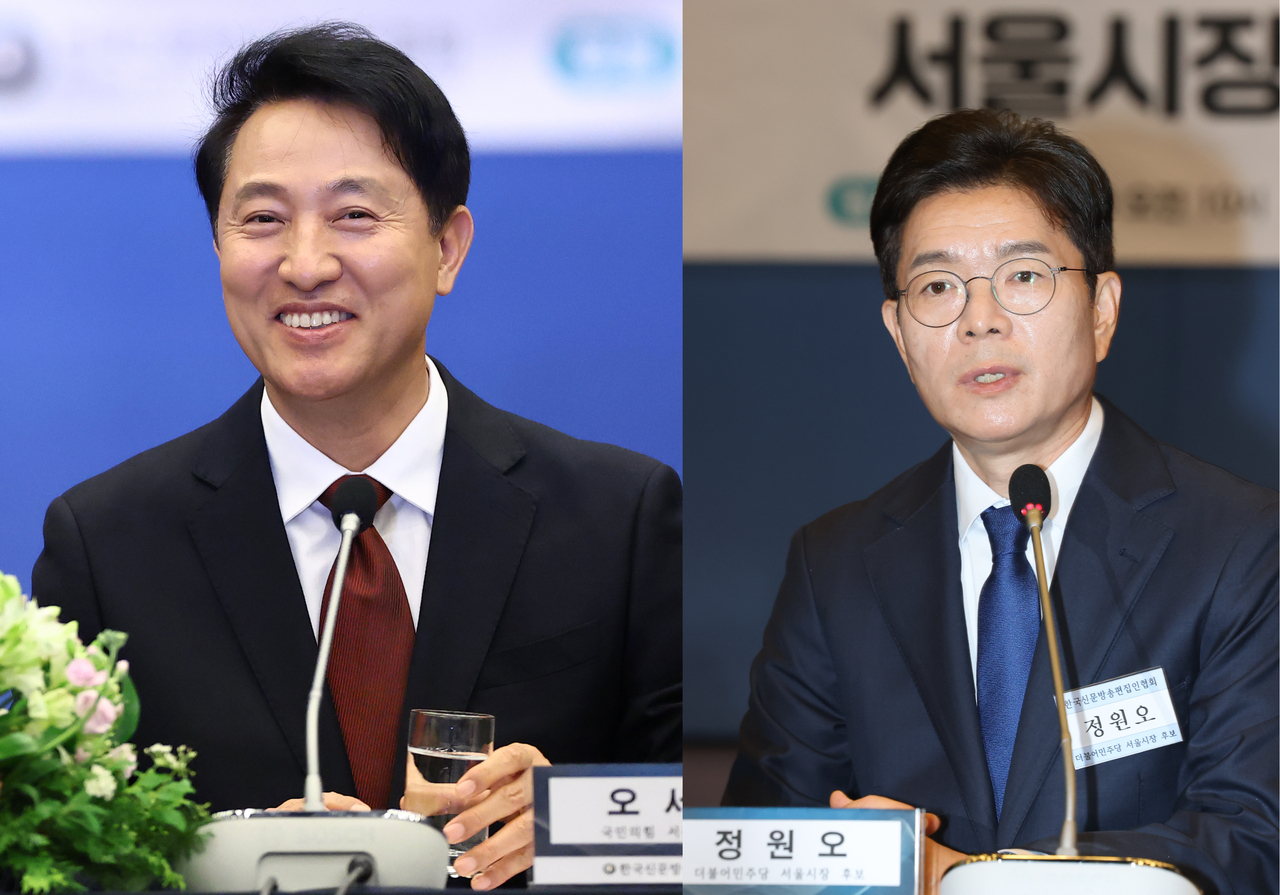
Seoul mayoral candidates Chong Won-o of the ruling Democratic Party of Korea and Oh Se-hoon of the opposition People Power Party on Thursday laid out sharply contrasting visions for Seoul’s housing and redevelopment policies, on the first day of their official candidate registration.
At separate sessions hosted by the Korea News Editors’ Association at the Korea Chamber of Commerce and Industry in central Seoul, the two candidates sparred over redevelopment speed, housing supply and the future of major development projects including the Yongsan International Business District.
The forums came as no one-on-one televised debate between the candidates has yet been scheduled, despite repeated calls from Oh for a direct faceoff ahead of the June 3 local elections.
Chong pushes ‘fast-track redevelopment’
Speaking at the morning session, Chong emphasized the need to prioritize profitability in redevelopment and reconstruction projects to boost housing supply amid rising housing costs and slowing supply.
“When the real estate market is good, redevelopment and reconstruction projects become active and supply increases. But when the market weakens, supply shrinks,” Chong said.
“Right now, we should concentrate our capabilities on increasing supply. Between public interest and profitability, this is the time to prioritize profitability,” he added.
Chong unveiled his so-called “smooth development” initiative aimed at shortening redevelopment and reconstruction timelines from up to 20 years to around 10 years through regulatory simplification and simultaneous approval procedures.
Under the proposal, Seoul would push to revise the Urban and Residential Environment Improvement Act to allow multiple redevelopment approval stages to proceed concurrently.
Chong pledged to decentralize approval authority for smaller redevelopment projects involving fewer than 500 households to district offices to ease administrative bottlenecks at City Hall.
Chong also introduced a broader economic development vision centered on transforming Seoul into what he called “Asia’s economic and cultural capital.”
The candidate pledged to develop Yongsan into a global AI and finance hub by attracting a “UN AI Hub” project to the Yongsan International Business District. The plan includes regulatory exemptions, corporate tax benefits and special visa programs aimed at drawing global AI firms and venture capital investment.
“Yongsan is the strategic transportation center connecting Seoul, Gyeonggi and Incheon,” Chong said in remarks previously made at the Yongsan development site. “It should become a place where global talent and capital gather to create new knowledge and jobs.”
When asked further on the gap between promoting Seoul as a global tourism hub and making it a livable city for long-term foreign residents by The Korea Herald, Chong acknowledged that foreign workers in Seoul still struggled with practical barriers in daily life, including language access and medical services.
However, he stopped short of presenting a concrete road map or timeline for institutional reforms to improve long-term residency plans for foreigners.
His proposal also includes fostering five major industries in the area from AI, robotics, biotechnology, defense technology and digital finance, while linking the Yongsan ddistrict with Yeouido’s financial sector.
Oh says liberal win would bring back 'failed' policies of Park Won-soon era
At the afternoon session, incumbent Mayor Oh framed the election as a referendum on both the Lee Jae-myung administration and Seoul’s future housing policy direction.
“This election will determine whether the current government moves into a mode of humility, or shifts beyond soft authoritarianism into something much harsher and more overt,” Oh said.
Oh argued that housing policy would be the election’s defining issue, warning that Seoul could return to what he described as the failed redevelopment policies of former Mayor Park Won-soon’s administration.
“During former Mayor Park Won-soon’s 10 years in office, 389 redevelopment and reconstruction projects were canceled, which became the decisive cause of today’s housing crisis,” Oh said.
“The people who implemented those policies are still in the Democratic Party and are now in Chong Won-o’s campaign discussing real estate policy,” he added.
Oh directly criticized Chong’s redevelopment pledges and Yongsan development proposal, saying the Democratic Party candidate lacked a clear understanding of the existing plans.
“I listened to Chong’s explanation this morning, and he said many things that were factually incorrect,” Oh said.
He disputed Chong’s proposal to expand housing supply in the Yongsan International Business District to around 10,000 units, arguing that doing so would undermine the area’s intended role as an international business hub.
“If you increase it to 10,000 units, the ratio between business and residential functions becomes 50-50,” Oh said. “Then the meaning of an international business district disappears.”
Oh also dismissed Chong’s proposal to attract a UN AI Hub to Yongsan as unrealistic within a mayoral term.
“The buildings would have to be constructed first,” Oh said. “It’s not something a mayor serving four years could even dream of accomplishing.”
Regarding Chong’s pledge to reduce redevelopment timelines to 10 years, Oh argued his administration had already shortened average project durations from around 20 years to 12 years through aggressive streamlining efforts.
“Reducing it further from 12 years to 10 years is extremely difficult and close to impossible,” Oh said.
Oh again pressed Chong to accept a direct debate, criticizing the lack of a head-to-head format in the campaign so far.
“Whenever I propose a one-on-one debate, he avoids it with unrelated answers,” Oh said. “Even if Democratic Party leader Chung Cheong-rae moderated it on Kim Ou-joon’s program, I would still participate.”
The Korea News Editors’ Association forums were held sequentially after negotiations for a bilateral debate between the two candidates broke down. Another forum hosted by the Kwanhun Club on May 20 is also expected to feature separate sessions rather than a direct debate.
The forum came as the Seoul mayoral race appears to be tightening.
According to a poll released Thursday by the Korea Social Opinion Institute, commissioned by CBS, Chong led with 44.9 percent support compared with Oh’s 39.8 percent, placing the two candidates within the margin of error of plus or minus 3.1 percentage points.
The gap narrowed significantly from a survey conducted three weeks earlier, when Chong was ahead of Oh by 10.2 percentage points.
The poll of 1,002 Seoul residents aged 18 and older was conducted via automated wireless phone surveys on May 12-13 and had a response rate of 5.3 percent.
jychoi@heraldcorp.com