South Korea plans to conduct a joint analysis of debris recovered from unidentified airborne objects that struck a South Korean-operated vessel in the Strait of Hormuz earlier this month, as authorities work to determine the type of weapon used and who was behind the attack, officials said Tuesday.
Foreign Minister Cho Hyun said in the morning that fragments believed to be from the propulsion systems of the airborne objects are expected to arrive in Seoul soon for detailed analysis.
Speaking to reporters, Cho said the debris would be examined jointly by the Defense Ministry and research institutes with relevant expertise once it arrives in South Korea.
“The debris is expected to arrive in South Korea shortly, and authorities plan to carry out a comprehensive analysis and disclose the findings once the examination is completed,” Cho said.
A Foreign Ministry official who requested anonymity later said the government is reviewing plans to bring the debris to South Korea for analysis by specialized institutions “to ensure the accuracy of the investigation.”
The official added that the government is still reviewing the timing and method of transport, as well as which agencies and institutions will take part in the analysis.
“There may be local procedures required for removing the debris, so the Consulate General in Dubai is reviewing the situation and consulting with headquarters on how and when to transport it,” the official said.
While diplomatic sources said the debris could be transported via diplomatic pouch, the Foreign Ministry stressed that no final decision has been made.
Institutions such as the Agency for Defense Development, the state-run military research and development agency under the Defense Ministry, have been mentioned by officials and experts as possible participants in the investigation.
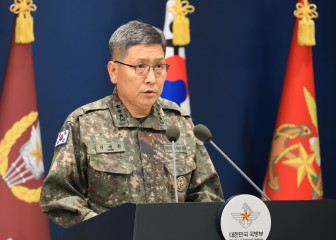
Lee Kyung-ho, deputy spokesperson for the Defense Ministry, reiterated during a regular briefing Tuesday that the ministry “is supporting the government investigation,” but declined to provide further details.
The comments came after the Foreign Ministry on Sunday released preliminary findings from a joint government investigation into the May 4 explosion and fire aboard the Panama-flagged cargo ship HMM Namu. The vessel is operated by South Korean shipping giant HMM Co.
According to the government, two unidentified airborne objects struck the port side of the vessel’s stern about one minute apart at around 3:30 p.m. while the ship was anchored near the Strait of Hormuz.
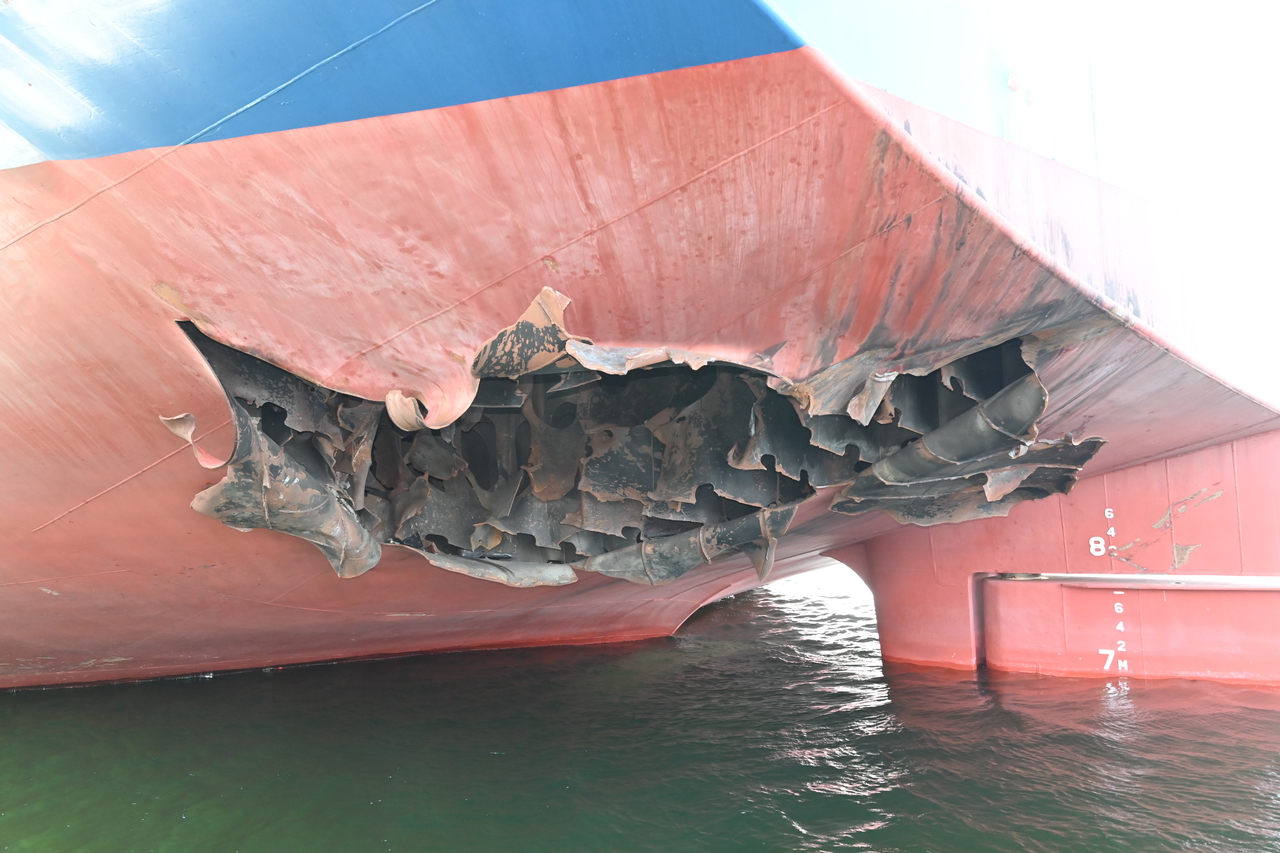
The government released photos showing major structural damage, including a 7-meter-deep by 5-meter-wide hole in the vessel’s outer hull located about 1 to 1.5 meters above sea level, damage to the engine room floor, and fire damage inside the ship.
Officials said the location of the damage made the possibility of a mine or torpedo strike unlikely.
Although the government has not identified the source of the attack, the recovery of engine debris has raised the possibility that the vessel may have been struck by drones.
The Foreign Ministry official also denied media reports claiming that the recovered debris had already been identified as part of a drone engine.
“Until a detailed analysis is completed, it is impossible to definitively determine the type or model of the airborne object, or who was responsible for the attack,” the ministry official said.
“The government will review future measures thoroughly based on the results of the investigation,” the official added.
When asked about speculation that the objects involved may have been Iran’s Shahed-series drones, including the Shahed-136, Cho stressed it was too early to draw conclusions.
“We do not know yet. At this point, it is too early to say,” he said.
US President Donald Trump earlier claimed that Iran had “taken some shots” at the HMM vessel and other targets. However, the Iranian Embassy in Seoul said Tehran “firmly rejects and categorically denies” any involvement by its armed forces in the incident.
Iran has not publicly commented further since Seoul announced the preliminary findings of its investigation.
Cheong Wa Dae on Monday strongly condemned the attack, stressing that assaults on civilian vessels in the Strait of Hormuz “cannot be justified or tolerated.”
Authorities initially said none of the 24 crew members aboard the vessel, including six South Koreans, had been injured, but later confirmed that one crew member had sustained minor injuries.
The investigation is expected to take time, with experts noting the difficulty of identifying both the aircraft involved and the actor responsible.
Yu Ji-hoon, a research fellow at the Korea Institute for Defense Analyses, said maritime provocations are more difficult to trace than attacks on land because of limitations in identifying both the point of origin and the actor involved.
“There are conflicting interpretations over whether the unidentified object that struck the HMM Namu was a drone or a missile,” Yu said.
“To determine that, investigators would need to closely examine factors such as the flight trajectory, angle of impact and explosive residue,” he added, noting that more time would likely be needed because sufficient evidence has not yet been secured.
The Foreign Ministry has also been communicating with both Iran and the United States regarding the incident.
The incident has also prompted a broader shift in the South Korean government’s handling of the case, with the Foreign Ministry increasingly taking the lead over the Ministry of Oceans and Fisheries.
The Oceans Ministry initially oversaw communications with the shipping company and the immediate response following the incident. But political observers say the presidential office now appears to view the case less as a maritime accident and more as a sensitive diplomatic and security issue linked to the broader war in the Middle East.
First Vice Foreign Minister Park Yoon-joo summoned Iranian Ambassador to Seoul Saeed Kouzechi to the Foreign Ministry building on Sunday, the day the preliminary findings were announced, and explained the results of the investigation.
Typically, the Iranian ambassador’s counterpart at the Foreign Ministry would be the director-general for African and Middle Eastern affairs. Calling in the ambassador at the vice ministerial level was therefore viewed by some analysts as a signal of the gravity with which Seoul regards the incident.
The findings are believed to have been shared with Tehran, though no official response from Iran had reportedly been conveyed to Seoul as of Tuesday.
Park also spoke by phone with James Heller, the acting US ambassador to South Korea, to explain the on-site investigation results in detail.
Foreign Ministry spokesperson Park Il said during a regular press briefing in the afternoon that the government would continue communication with Iran regarding the HMM Namu incident while also working to ensure the safety and navigation of South Korean vessels in the Strait of Hormuz.
mkjung@heraldcorp.com