Jeong Geun-sik says international learning should move beyond overseas exchanges, as Seoul schools adapt to more diverse classrooms, admissions pressures, demographic change
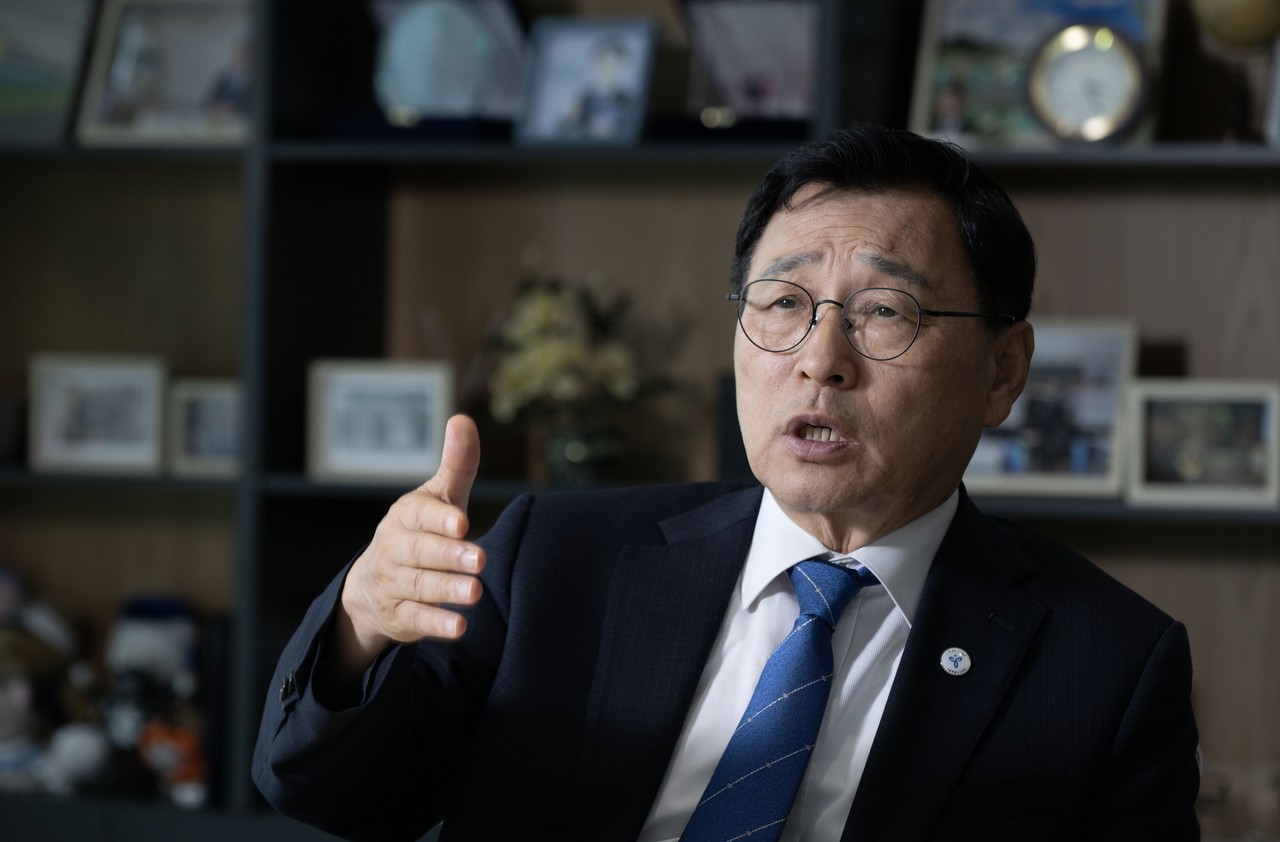
Within five to 10 years, Seoul education chief Jeong Geun-sik wants students to routinely discuss climate change with classmates in France, work on urban problems with peers in Indonesia and carry out AI projects with students in the United States — without leaving their own classrooms.
“Students should be able to encounter and learn about the world in Seoul classrooms even without going abroad themselves,” Jeong said in an interview with The Korea Herald.
Rather than treating international education as overseas exchanges for a select group, Jeong argues that different cultures and perspectives should become part of ordinary classes, from science and history to art and vocational education.
“The internationalization of Seoul education that I envision is about developing the capacity of students from different cultures and with different ways of thinking to consider and solve together the problems facing the world,” Jeong said.
“It should not stop at simply cultivating students who are good at foreign languages or increasing opportunities to go abroad.”
He cited climate change, artificial intelligence, infectious diseases, international conflicts and migration as issues that cross national borders. Schools, he said, should cultivate what he calls “global competence”: the ability to understand different cultures and worldviews, collaborate across differences and work toward common solutions.
“Ultimately, the internationalization of Seoul education goes beyond ‘education that goes outside’ to ‘education that brings the world into the classroom,’” Jeong said.
Jeong, a former sociology professor at Seoul National University, won a by-election in October 2024 and secured a second term in the June 2026 local elections. He previously chaired South Korea’s second Truth and Reconciliation Commission, which investigated historical human rights abuses, including civilian killings around the Korean War.
His internationalization agenda sits within a broader effort to reshape Seoul schools as they face seemingly contradictory pressures: fewer school-age children but more diverse classrooms; falling enrollment but growing demands for individualized support; and calls for new teaching methods even as university admissions remain dominated by high-stakes testing.
Diversity as educational asset
For Seoul, internationalization is no longer only about connecting students with schools abroad. It is also about how schools teach children from different linguistic and cultural backgrounds who already share a classroom.
The number of students from migrant backgrounds has grown by about 50 percent since 2017, from 15,122 to roughly 22,700 as of April. They now account for about 3.5 percent of Seoul students, according to the Seoul Metropolitan Office of Education.
More students need Korean-language instruction, help adapting to school, as well as academic and career guidance. But Jeong said helping them fit into the existing system should not be the endpoint.
“Multicultural education policy should expand beyond supporting Korean-language education and school adaptation for migrant-background students, toward developing the languages and cultural backgrounds that students possess into educational assets and their own capabilities,” he said.
At schools with large migrant-background populations, Jeong said curricula and activities should draw on the languages and cultures students bring to class.
Seoul has tried a bilingual festival, where students present in Korean and their mother tongues, as well as a multilingual picture-book project in which students translate and record books in different languages.
Such activities also give other students opportunities to communicate and cooperate across cultures.
“Ultimately, what Seoul education aims for is not simply expanding separate support for migrant-background students, but creating an environment where different languages and cultures become resources for school education,” Jeong said.
However, migrant-background students are not evenly distributed among Seoul schools. Jeong is cautious about deliberately dispersing them, citing commuting rights, school choice and the concentration of migrant families in particular neighborhoods.
Instead, the education office is putting more resources into schools where those students are concentrated.
To give teachers more room to assess each child’s learning level and provide tailored instruction, schools where migrant-background students make up at least 20 percent of enrollment can cap classes at 22 students.
The cap falls to 20 when the share reaches 40 percent and to 18 at 60 percent. The education office is also considering giving some high-concentration schools autonomous status to develop curricula around their multicultural characteristics.
Jeong calls the aim “natural dispersion” through better educational conditions rather than administrative redistribution.
From International Baccalaureate to Korean model
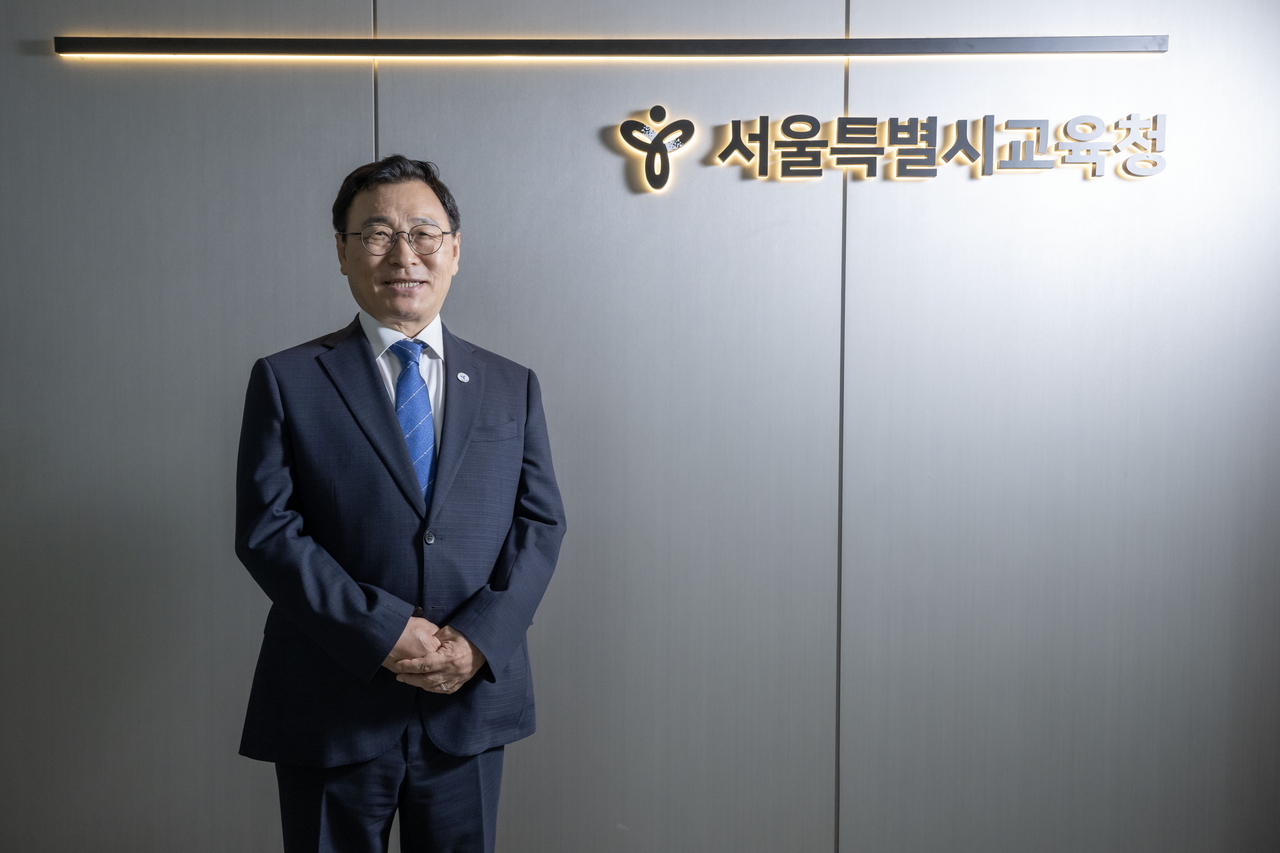
The question for Jeong’s classroom reforms is whether schools can change how students learn while the university admissions system continues to shape how they are taught and assessed.
Seoul introduced the International Baccalaureate framework at select schools in 2024. Jeong acknowledged that the program cannot simply be transplanted into Korea’s public education system.
Differences between IB and the national curriculum make it difficult for schools to satisfy both sets of requirements simultaneously.
IB places greater emphasis on essays, written responses and criterion-based assessment. Korea’s College Scholastic Ability Test, or Suneung, by contrast, remains designed largely to differentiate students through standardized scores.
Jeong said applying IB-style assessment wholesale to the Suneung would be unrealistic under current conditions.
But he argued that such forms of assessment are better suited to cultivating critical thinking, creativity and problem-solving — skills he sees as increasingly important for students entering a rapidly changing society.
His proposal goes beyond individual IB schools.
Jeong has proposed shifting both school grades and the Suneung toward absolute assessment and substantially expanding essay and written-response evaluation beginning with the 2033 admissions cycle, before eventually abolishing the Suneung in 2040.
At the same time, he wants to develop what he calls the Korean Baccalaureate by adapting elements of IB for ordinary public schools.
Those include a competency-oriented curriculum, inquiry-based classes, essay and written-response assessment, and collaborative school management.
Seoul aims to begin operating KB schools in 2030, using its experience with IB and other assessment reforms as a bridge toward a broader model for public education.
International exchange beyond head counts
Seoul’s international joint classes have expanded rapidly. But a growing list of participating schools cannot show whether the exchanges change what students learn. Jeong says that is the question the program now needs to answer.
Participation rose by about 85 percent, from 193 schools in 2023 to 358 in 2025. The number of schools continuing an exchange into the following year more than quadrupled, from 64 to 286 over the same period.
The program began in 2021, when pandemic travel restrictions led schools to connect students online. It started with 53 schools in seven countries.
Early exchanges often centered on food, culture and daily life; more recent projects have brought students together to examine history, AI, ecological transition and scientific problems, including collecting and analyzing data with overseas peers.
Jeong wants to know whether students come to understand other perspectives, collaborate across languages and cultures, and see global issues as connected to their own lives.
“The essence of international joint classes is not simply ‘meeting’ overseas students,” Jeong said. “It is for students from different backgrounds to ‘learn together and solve problems together.’”
Seoul plans to develop performance indicators and standardized evaluation guidelines for teachers to assess those changes and use the findings in their curricula, he said.
Fewer students, more demands
Falling enrollment has fueled arguments for reducing education spending and teacher numbers. Jeong rejects the idea that staffing should decline automatically with student numbers when schools are being asked to provide more kinds of support and more choices in what students learn.
The education office estimates that giving every first and second grade public class 10 more hours of Korean and mathematics instruction each week would require about 2,100 additional teachers.
Placing one dedicated AI and digital education teacher in each public elementary school would require another 566. Jeong cautioned that the needs may overlap, so the figures should not simply be added together.
Schools are also expected to provide special education, support for migrant-background students and a wider range of courses under the high school credit system. Those demands, Jeong said, cannot be captured by a formula based on student numbers alone.
The credit system is intended to let high school students choose subjects according to their interests and career goals.
But smaller schools can struggle to provide the teachers needed to offer those choices. Relative grading adds another obstacle: Students may avoid a subject they want to study if they fear it will hurt their grades.
Seoul is expanding online schooling and courses shared across schools while pressing for staffing formulas that reflect educational needs.
Jeong applies the same reasoning to school closures. He says enrollment should matter, but so should commuting distances, nearby school capacity, housing plans and prospects for future population growth.
Protecting teachers, resisting uniform control
Jeong draws a distinction between complaints that schools should handle collectively and decisions best left to individual schools. It underpins his approach to protecting teachers, setting rules for smartphones and responding to school violence.
Consultations related to infringements of teachers’ rights more than quadrupled, from about 13,800 in 2021 to almost 58,000 in 2025.
Ordinary complaints should go to school response teams rather than individual teachers, Jeong said. The education authority should step in when repeated complaints seriously disrupt teaching or teachers face violence or threats.
Serious cases could warrant legal action, including a complaint filed in the superintendent’s name.
On students’ smartphones, however, he favors school-level discretion over a citywide rule requiring phones to be collected at the gate. Any revision of Seoul’s student rights framework, he said, should clarify restrictions, exceptions and rule-making procedures rather than simply reduce existing rights.
Jeong also sees unintended consequences in the requirement, in effect from the 2026 admissions cycle, to reflect school-violence disciplinary measures in every university admissions track.
He supports protecting victims and holding offending students responsible. But even relatively minor sanctions can now carry an admissions penalty, he said, encouraging countercomplaints, administrative appeals and lawsuits.
The result, Jeong argues, can be less room for schools to mediate and help students repair harm.
The challenge is to protect victims and hold offending students accountable, while giving schools room to intervene before every conflict becomes a high-stakes legal dispute.
seungku99@heraldcorp.com


