
Nationwide inspections to focus on illegal political banners ahead of June 3 local elections
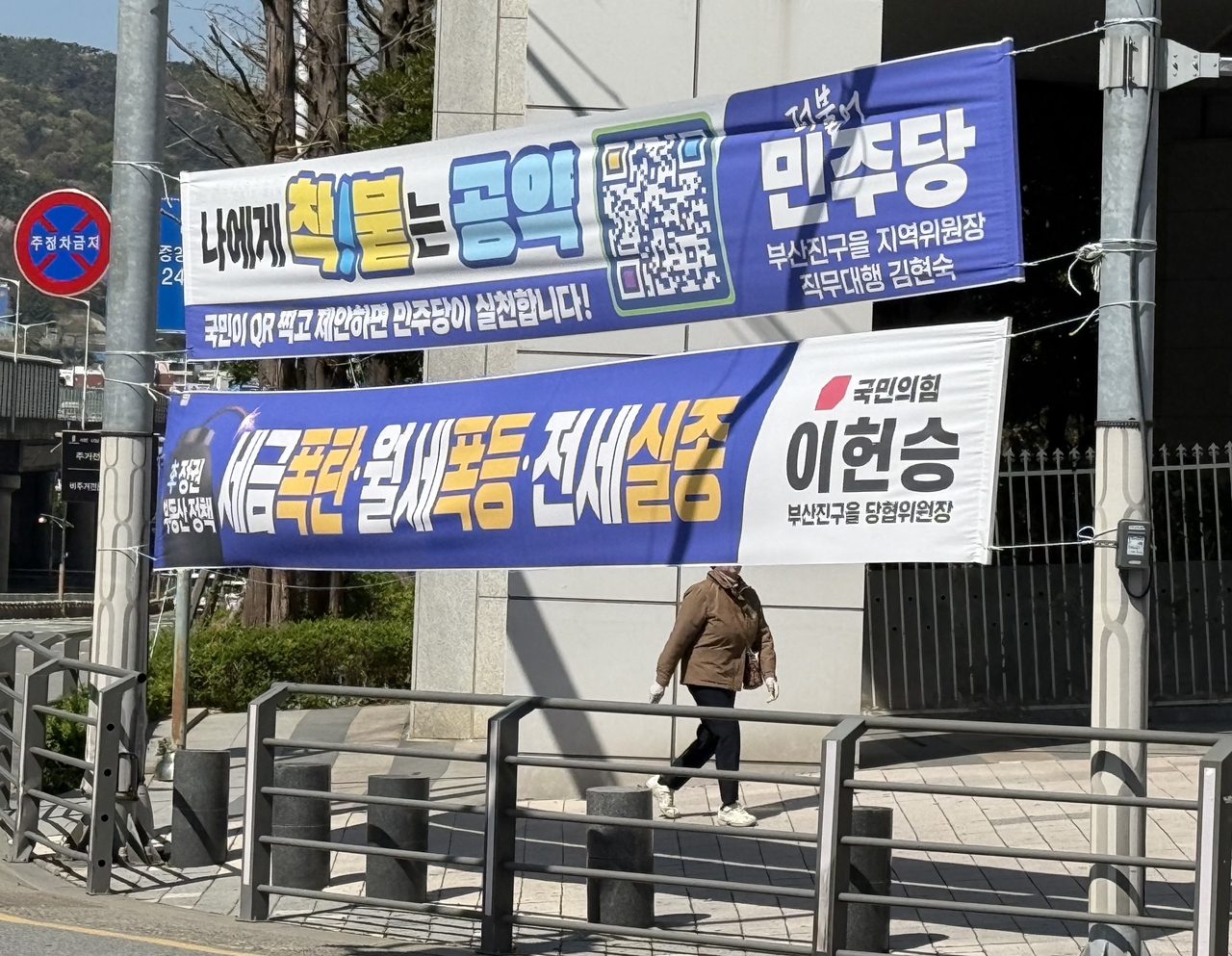
The South Korean government on Monday began a nationwide crackdown on illegal political banners, after an accident last month in which an 11-year-old boy lost consciousness when his neck was caught by a banner string.
The Ministry of the Interior and Safety will continue the inspections until June 2, the day before local elections are held. On April 15, the ministry sent regional governments and political parties guidelines on banners promoting politicians, parties or election candidates.
The crackdown plan had been confirmed before the April 25 accident in Pocheon, Gyeonggi Province, where an elementary school student got a banner string caught around his neck and sustained non-life-threatening injuries.
Political banners are a sensitive issue because of concerns over freedom of expression.
They are governed by the Act on the Management of Outdoor Advertisements and Promotion of the Outdoor Advertisement Industry, which has been revised amid disputes over political expression, public safety and discriminatory content.
The ministry’s guidelines provide criteria for determining which banners violate the rules. Political banners approved by the National Election Commission are not subject to the outdoor advertisement law, but banners not directly related to election candidates are subject to standards under the act.
Under revisions that took effect in 2024, political party banners are limited to two per eup, myeon or dong, the smallest administrative units in Korea. They cannot be installed near fire-related facilities or child safety zones, or in locations that block traffic lights, safety signs or other banners.
The size of each banner is limited to 10 square meters, and the content cannot be contemptuous or slanderous. Banners can be displayed for up to 15 days, while those found to be in violation can be ordered removed or corrected.
The 2024 revision also added a clause banning banners from being installed in places that obstruct pedestrians or traffic. The banner involved in the April 25 accident had been illegally set up near a crosswalk, creating a safety hazard for pedestrians.
“A child was hurt and lost consciousness because of an illegal banner. Commercial banners are strictly regulated, but the reality is that rules are applied loosely to political banners,” said Kim Hyeon-gu, a member of the Pocheon City Council, calling for stricter regulation.
Controversy over political banners
According to the Safety Ministry, illegal political banners set up in child safety zones and near fire-related facilities increased by 38.1 percent in the first quarter from a year earlier. Gyeonggi Province and Seoul, the country’s two most populous regions, had 7,543 and 4,037 such illegal banners, respectively.
In total, 29,582 political banners were illegally installed across the country between January and March.
Violations can be reported to authorities, and regional governments can remove illegal banners or order them fixed. People are advised not to remove illegal banners themselves, as doing so could expose them to punishment for property damage.
Despite the law and subsequent revisions, political banners remain a persistent problem. Some critics question the effectiveness of the rules, as the number of illegal banners continues to rise.
Many illegal banners installed recently carry politically charged attacks, while others contain messages of racial hatred or contempt toward specific groups.
President Lee Jae Myung in November ordered measures to curb what he called “racial contempt, discrimination and distortion of facts.”
Liberal parties have since pushed related bills, including one that would remove the exception granted to political banners. If passed, banners put up by political parties could be removed if they contain messages of contempt or discrimination.
minsikyoon@heraldcorp.com