South Korea on Thursday pushed back against US Republican lawmakers’ claims that Seoul is targeting American firms, saying investigations into Coupang are being carried out in line with domestic law regardless of nationality.
A Foreign Ministry official, requesting anonymity, said the government is “fully implementing” its commitment not to subject US digital companies to discriminatory treatment or unnecessary barriers, in accordance with agreements reached by the two countries’ leaders in the South Korea-US Joint Fact Sheet.
“The investigation and measures concerning Coupang are being carried out in accordance with domestic law and due process, and are conducted in a non-discriminatory manner regardless of nationality,” the ministry official said in a statement.
The response came after 54 Republican lawmakers from the Republican Study Committee sent a letter Tuesday to South Korean Ambassador to the US Kang Kyung-wha. In it, they urged Seoul to stop what they characterized as discriminatory treatment of US companies.
The lawmakers cited firms including Apple, Google, Meta and Coupang, an e-commerce firm mostly active in Korea but listed and headquartered in the US. They accused the South Korean government of launching a “targeted assault” on US businesses, particularly in connection with a large data breach involving more than 33 million Coupang users.
"The systematic targeting of American companies such as Apple, Google, Meta and Coupang is particularly concerning because these businesses serve as an important economic bridge between our two countries. For example, Coupang has consistently been the largest source of US foreign direct investment into Korea over the past decade and now sells many billions of dollars in US goods and agricultural products to Korean customers each year," the letter read.
"To avoid further tensions in our bilateral relationship, and to ensure the United States Congress remains supportive of our countries’ important economic and national security partnership, we ask your government to end its targeted assault of American companies immediately."
Seoul's Foreign Ministry official said the ministry has conveyed its position to the US Congress and would continue to do so. The official further explained that South Korea and the US are maintaining close communication through various channels to implement security-related agreements under the Joint Fact Sheet.
Separately, speculation has grown in Seoul that Washington may be linking ongoing bilateral security talks — including discussions under the Joint Fact Sheet such as South Korea’s push for nuclear-powered submarines — to concerns over the treatment of Coupang and the personal safety of its chairman, Kim Bom-suk.
The controversy surrounding Coupang stems from a massive data breach disclosed in November 2025, which exposed the personal information of more than 33 million users, prompting a sweeping, multi-agency investigation by South Korean authorities. The case quickly escalated into a political issue, with the National Assembly launching hearings to examine the company’s response and accountability. Lawmakers criticized Coupang for a delay in disclosing the data breach and inadequate safeguards, while founder Kim Bom-suk’s absence from the hearings further fueled tensions.
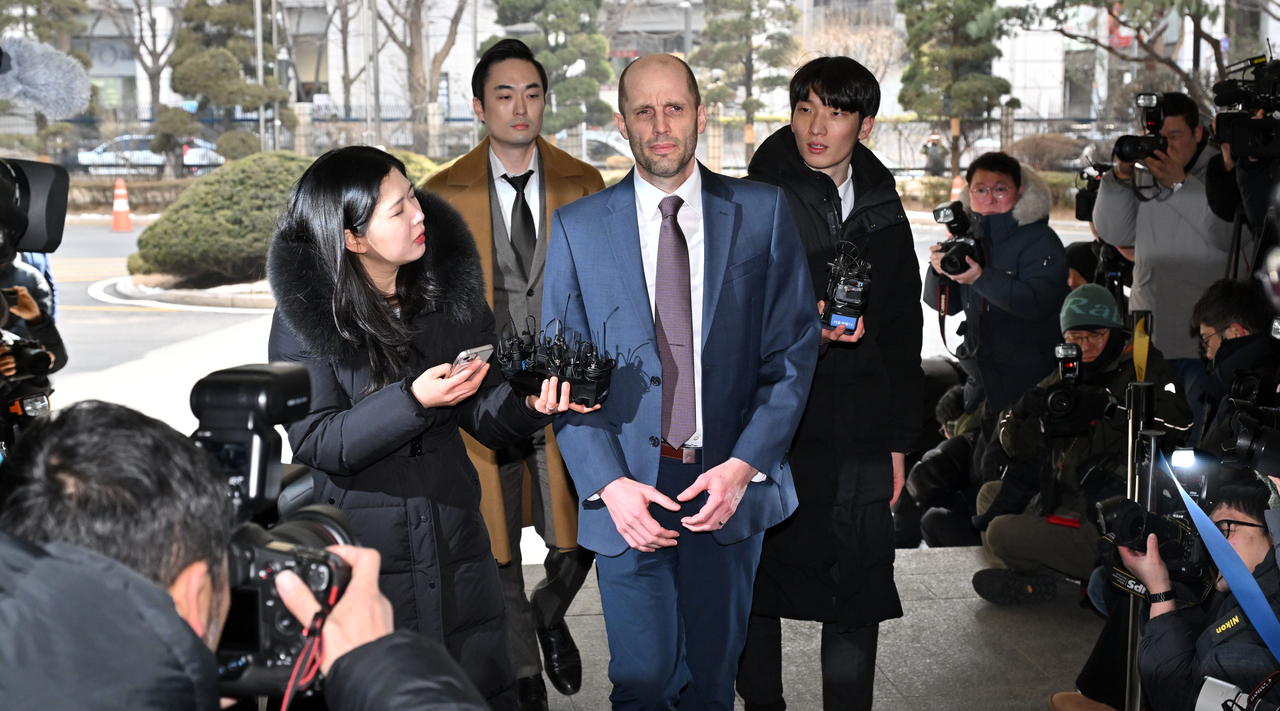
Interim Coupang CEO Harold Rogers, who appeared before lawmakers, faced intense questioning over the company’s internal handling of the breach and was later summoned by police on suspicion of evidence tampering and procedural violations. Authorities are also reviewing whether Coupang downplayed the incident or provided misleading testimony, broadening the probe beyond data protection into potential legal and governance breaches.
Coupang has said it will fully cooperate with the investigation, framing the breach as the result of a rogue employee rather than systemic failure, while pledging stronger data protection measures and compensation for affected users.
The case has since taken on broader significance, emerging as a flashpoint in US-Korea economic relations, with Washington raising concerns over what it sees as excessive or discriminatory enforcement, while Seoul maintains the process is being carried out in accordance with domestic law and non-discrimination principles.
The Seoul Foreign Ministry official said the government will continue consultations with Washington to ensure that the Coupang issue does not negatively affect bilateral security discussions, while maintaining that such talks should proceed independently of the matter. Though not stated directly by the ministry, the discussions encompass ongoing talks under the Joint Fact Sheet, including Seoul’s pursuit of nuclear-powered submarines.
“Security cooperation should move forward separately from the Coupang issue,” the official said.
mkjung@heraldcorp.com