
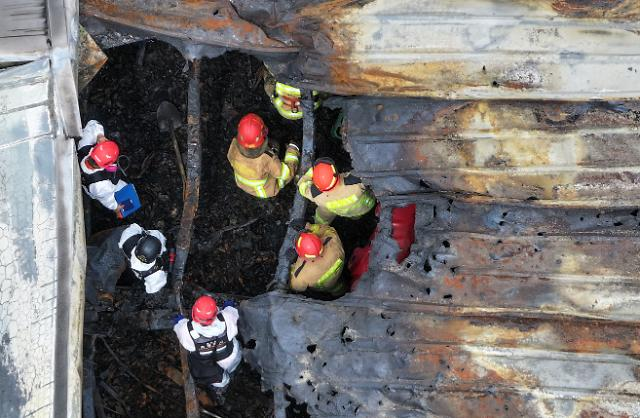
Aricell Chief Executive Park Soon-kwan was sentenced to four years in prison on appeal over the 2024 battery plant fire in Hwaseong, Gyeonggi Province, that killed 23 workers, sharply reducing the 15-year term handed down by a lower court.
The Suwon High Court also sentenced Park’s son, Park Jung-eon, Aricell’s head of operations, to seven years in prison and a 1 million won ($680) fine. Six other Aricell officials and employees indicted in connection with the case received suspended prison terms.
The court upheld the lower court’s decision to fine Aricell 800 million won.
In September 2025, the lower court sentenced both Park and his son to 15 years in prison, with the son also fined 1 million won. The ruling was the harshest punishment imposed since the Serious Accidents Punishment Act took effect in 2022.
Both prosecutors and the defendants appealed. Prosecutors had sought a 20-year prison term for Park and 15 years for his son.
The defense argued that the lower court had erred in its legal interpretation of whether defects in lithium batteries were foreseeable and whether the company was obligated to install heat detectors, saying the sentences were excessive.
A central issue in the appeal was whether Park qualified as a “responsible management official” under the Serious Accidents Punishment Act.
Park’s lawyers argued that he was only Aricell’s nominal chief executive. The lower court rejected that claim and found that he was the company’s responsible management official.
The appellate court said the fire had “very grave consequences,” but found insufficient evidence to conclude that Park had delegated a substantial portion of Aricell’s operations to his son in an effort to evade responsibility.
Park was indicted and detained in 2024 on charges of failing to fulfill his duty to ensure workplace safety and health in connection with the June 24 fire at Aricell’s factory in Hwaseong.
Investigators found that Aricell had broadly failed to meet safety management obligations by not installing emergency exits, failing to conduct fire drills, altering fire compartments without authorization and skipping heat inspections.
Authorities also found that the company had illegally dispatched unskilled foreign workers to high-risk processes. Prosecutors concluded that those structural safety failures led to the chain of explosions.
The disaster left 23 people dead and nine injured. Twenty of those killed, most of them Chinese nationals, were found to have been illegally dispatched workers, fueling public outrage.
seungku99@heraldcorp.com


