
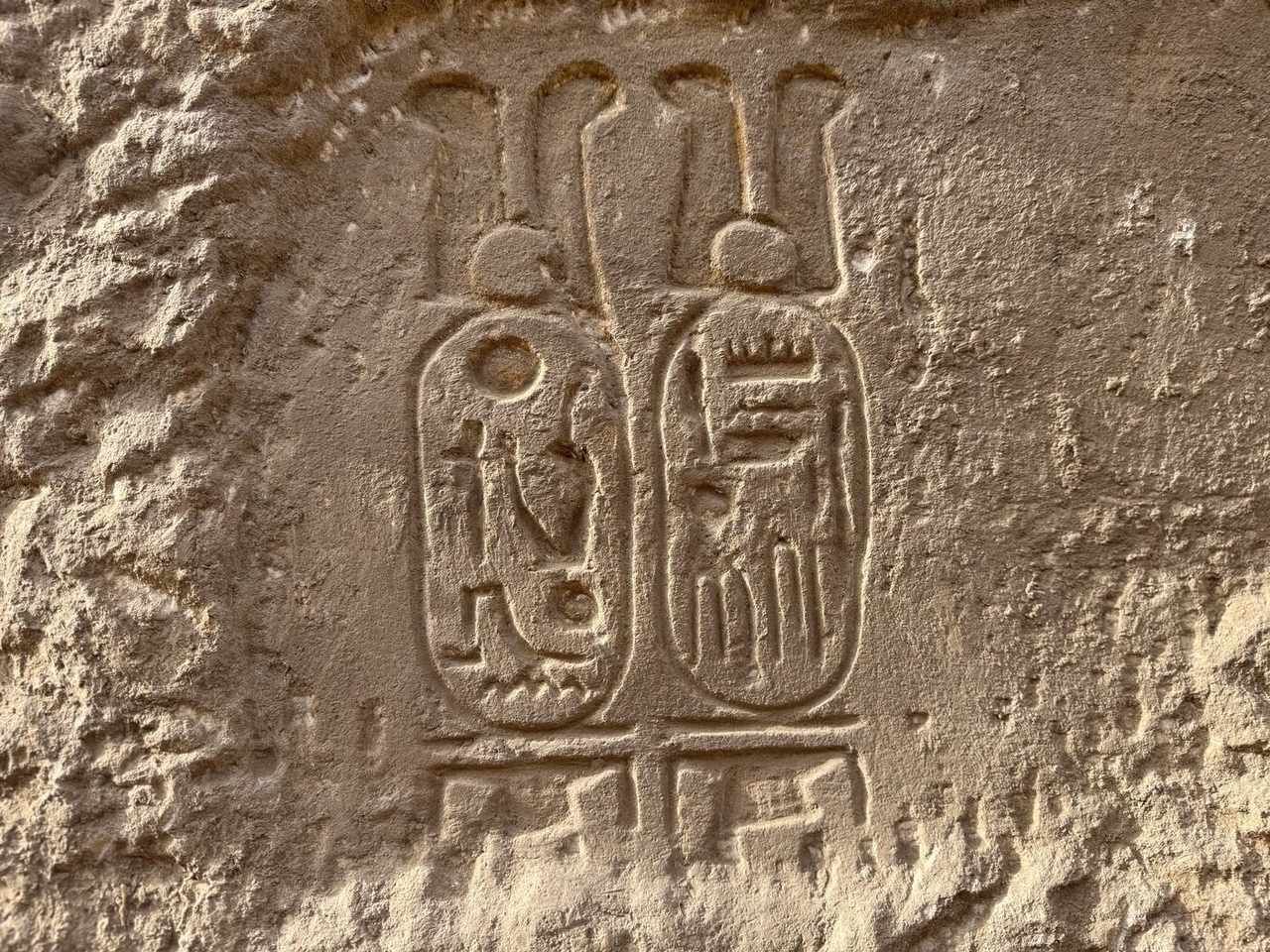
South Korea’s Cultural Heritage Administration said Thursday that it has made some remarkable discoveries, including a hieroglyph bearing the name of Ramesses II, at the Ramesseum in Luxor, Egypt.
The achievement came from a joint project with the Korea National University of Heritage to restore the temple’s pylon gate.
The most notable discovery is the cartouche, an oval-shaped frame that encloses the name of an ancient Egyptian pharaoh, containing the name of Ramesses II, unearthed during an investigation of the temple’s pylon gate area conducted in November last year.
Identifying a ruler’s name and the shape of the cartouche allows archaeologists to determine the precise historical period, giving such finds considerable research value, the administration explained.
It added that this marks the first time a cartouche has been discovered at the pylon of the Ramesseum, citing Hisham El-Leithy, secretary-general of Egypt’s Supreme Council of Antiquities, who said the newly discovered cartouche differs in form from previously known examples.
Other discoveries were also made during a survey of the pylon’s northern section that began in June last year, including structures believed to have been built to protect the site from Nile flooding.
Located on the west bank of the Nile, the Ramesseum was built during the reign of Ramesses II, who ruled from 1279 to 1213 BC. Much of the pylon gate collapsed long ago, leaving only partial remains today.
Since 2023, the Cultural Heritage Administration has been carrying out an official development assistance project in cooperation with Egypt’s Supreme Council of Antiquities to run through 2027.
forestjs@heraldcorp.com

![[Exclusive] S. Korean Embassy to US woos Trump allies to expedite skilled visa talks](https://wimg.heraldcorp.com/news/cms/2026/09/29/rcv.YNA.20260924.PGT20260924167001009_R.jpg?type=h&h=120)
![[Exclusive] Enhypen to return with new album in November, agency confirms](https://wimg.heraldcorp.com/news/cms/2026/09/29/news-p.v1.20260929.41760e88b0f048fcb5fa3e0dd9b75524_R.jpg?type=h&h=120)