
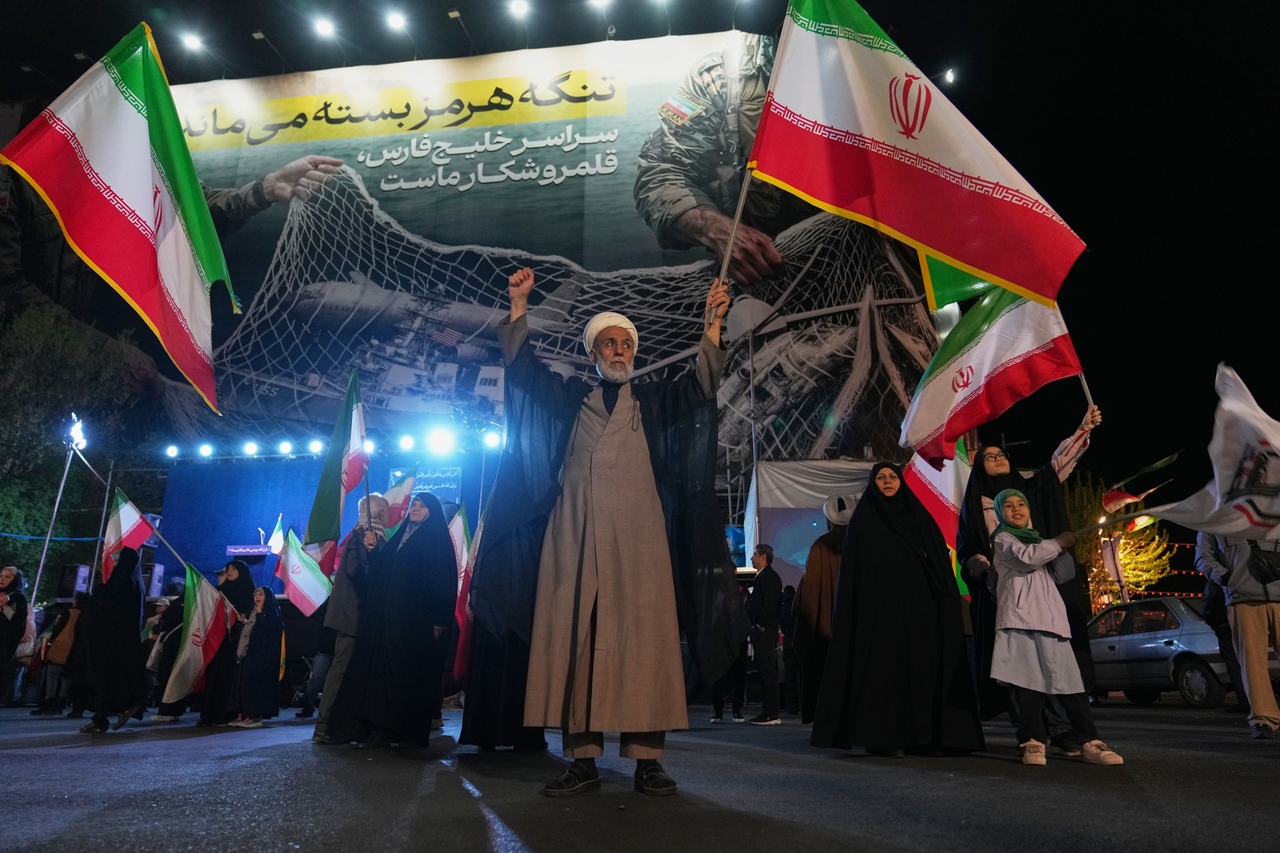
South Korea’s spy agency on Monday assessed that the war between the United States, Israel and Iran could enter a lull by late April, depending on the outcome of Washington’s intensive airstrikes in the coming days.
The National Intelligence Service presented the assessment during a closed-door briefing to the National Assembly’s Intelligence Committee, according to Rep. Park Sun-won of the ruling Democratic Party of Korea and Rep. Lee Seong-kweun of the main opposition People Power Party.
“The US is expected to carry out intensive airstrikes over the next three to four days, and depending on the results, (the US) will decide whether to conduct further strikes,” the NIS was quoted as saying by Park during a briefing held at the Assembly. “Based on that, we believe the situation could shift into a lull toward the end of this month.”
The agency said that since launching its campaign, referred to as “Operation Epic Fury,” on Feb. 28, the US has struck more than 12,000 targets using missiles and other means, eliminating around 50 senior Iranian figures, according to Park.
“Of the five objectives behind the US entry into the conflict — eliminating nuclear capabilities, neutralizing missile capabilities, destroying the defense industrial base and dismantling naval and air forces — a significant portion appears to have been achieved,” Park quoted the NIS as saying.
Despite battlefield advantages secured by the US and Israel, the Seoul agency noted that Iran is attempting to leverage its geopolitical position by controlling the Strait of Hormuz and triggering a surge in global oil prices.
“While the US has secured military and tactical superiority, it is facing difficulties in translating that into a political victory in the form of Iran’s surrender,” the NIS was quoted as saying. “Iran, meanwhile, is seeking to strengthen its position by using the Strait of Hormuz as leverage, while struggling to respond to US demands to abandon its nuclear weapons and program.”
Park said the agency outlined three possible scenarios: a “small deal” in which Iran would reopen the Strait of Hormuz in exchange for the release of frozen funds; an escalation in which the US intensifies strikes on Iran’s core infrastructure and deploys ground forces in pursuit of regime change; and a prolonged period of uncertainty.
“Given the current war of attrition, the likelihood of a sharp escalation appears low,” the NIS said, adding that “a prolonged state of uncertainty remains a possible scenario.”
The NIS assessment is aligned with remarks by a Foreign Ministry official on Monday that this week could mark a major turning point in the Middle East conflict, depending on how the situation unfolds, including a potential expansion of US attacks and Iran’s response.
Noting that the conflict has now entered its fifth week, the official, requesting anonymity, said, “At the early stage of the war, President Trump said the conflict would last about four weeks, but in an address to the American public on April 1, he emphasized military gains and indicated plans for large-scale attacks over the next two to three weeks, continuing pressure on Iran."
Regarding the possibility of a US ground offensive, the official said, “If ground operations begin, the war is expected to become prolonged.”
Meanwhile, Iran and the US have been presented with a proposal to end hostilities that could take effect as early as Monday and potentially lead to the reopening of the Strait of Hormuz, a source familiar with the matter told Reuters.
According to the source, Pakistan has put forward a framework overnight that has been shared with both sides, outlining a two-stage approach involving an immediate ceasefire followed by a broader, comprehensive agreement.
But Yu Ji-hoon, a research fellow at the Korea Institute for Defense Analyses and former Navy commander, cautioned that "it is too early to view the move as a transition to a full settlement, as a lasting agreement would require political compromises on key issues such as Iran’s nuclear program, sanctions relief, security guarantees and maritime stability."
He explained that while a limited ceasefire or temporary de-escalation is possible in the near term, given both sides’ reluctance to sustain prolonged military and economic strain, significant gaps remain, making a comprehensive resolution difficult and leaving the situation in a fragile, transitional phase.
In the Assembly briefing, the NIS added that North Korea has so far refrained from providing weapons or material support to Iran.
“North Korea has not provided weapons or supplies to Iran to date,” the agency said, adding that Pyongyang also did not send a condolence message following the reported death of Iran’s Supreme Leader Ayatollah Ali Khamenei.
Park said that the NIS noted North Korea appears to be distancing itself from its traditionally close ties with Iran.
“When Mojtaba Khamenei, the late leader’s second son, was reportedly elevated as successor, North Korea did not send a congratulatory message,” Park said. “Compared with China and Russia, which have frequently issued statements on US and Israeli strikes, North Korea’s Foreign Ministry has released only two brief statements, neither of which expressed support for Iran or criticism of the US.”
He added that Pyongyang’s restrained stance could be aimed at securing diplomatic space ahead of potential summits involving Chinese President Xi Jinping and US President Donald Trump in May.
Separately, the NIS assessed that North Korea appears to be accelerating efforts to position leader Kim Jong-un’s daughter, known as Ju-ae, as his successor.
The agency said her recent appearances in state media, particularly in defense-related coverage, appear intended to “dilute skepticism” over a female successor and to “accelerate the succession narrative.”
Last month, the North's Korean Central News Agency reported that Kim had overseen a joint offensive tactical drill at the 60th Training Base in Pyongyang and released photos of Ju-ae accompanying him, riding inside and personally operating a tank alongside military officials — a move analysts view as part of efforts to reinforce her public profile.
mkjung@heraldcorp.com
flylikekite@heraldcorp.com