
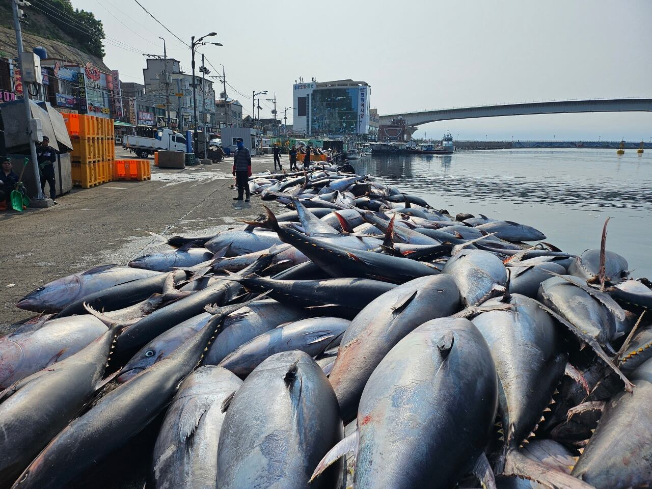
Calls are growing to raise tuna quotas for South Korea’s eastern provinces as rising sea temperatures have seen the warm-water species expand its habitat to the country’s entire East Sea coastline.
The push comes after South Korea recently identified juvenile bluefin tuna for the first time in its northernmost waters, suggesting the species may be establishing a spawning ground in Korean waters.
According to the National Institute of Fisheries Science earlier this week, three juvenile bluefin tuna were found in waters off northern Gangwon Province.
While tuna eggs and larvae have previously been detected near Ulleungdo and Dokdo in North Gyeongsang Province, this is the first such discovery in colder northern waters.
“This is a meaningful signal of changes in fishery resource composition driven by rising sea temperatures,” an institute official said. “We will expand research to better utilize bluefin tuna as a high-value resource.”
Despite growing demand for tuna as a premium food ingredient in Korea, a significant portion of the catch is being discarded or used as feed and fertilizer, as catches increasingly exceed quotas.
The species, once rarely seen and mostly caught by distant-water fleets in the Pacific and Atlantic, is now found year-round in Korean waters. Catches have surged in recent years, reaching about 500 tons in June alone, though volumes fluctuate.
Local fishers are generally fishing for other species such as pollock, but increasingly find tuna in their nets. They say they now frequently come across large tuna weighing between 100 and 300 kilograms.
The government has steadily increased quotas for North Gyeongsang Province, where tuna catches have risen sharply, but adjustments have lagged behind the pace of change. On a single day last July, about 1,300 tuna were reportedly discarded in the province.
The provincial quota has been raised from 110 tons to 260 tons, but further increases are constrained by South Korea’s annual national quota of about 1,200 tons set under international rules, which covers both coastal and distant-water catches.
“Confirmation that bluefin tuna can spawn and grow in Korean waters may be crucial in securing a larger national quota in the future,” another institute official said.
forestjs@heraldcorp.com