Seoul to distribute firefighting equipment to older apartment complexes
Nearly half the apartments and multi-household buildings in Seoul lack sprinkler systems, raising safety concerns after a series of fires at older complexes.
Of the 4,067 apartment and commercial-residential complexes in the capital, 1,874, or 46.1 percent, lacked sprinkler systems, according to National Fire Agency data revealed by Rep. Lee Sang-sik of the ruling Democratic Party of Korea.
Even among complexes that did have sprinklers, only 25.7 percent had them installed across all buildings, while the rest only had sprinklers in parts of the complex, leaving gaps in coverage.
Gangseo-gu had the highest share of complexes without sprinkler systems at 70.4 percent, followed by Nowon-gu (61.8 percent), Yangcheon-gu (59.4 percent), Dobong-gu (58.2 percent), and Gangnam-gu (55.4 percent).
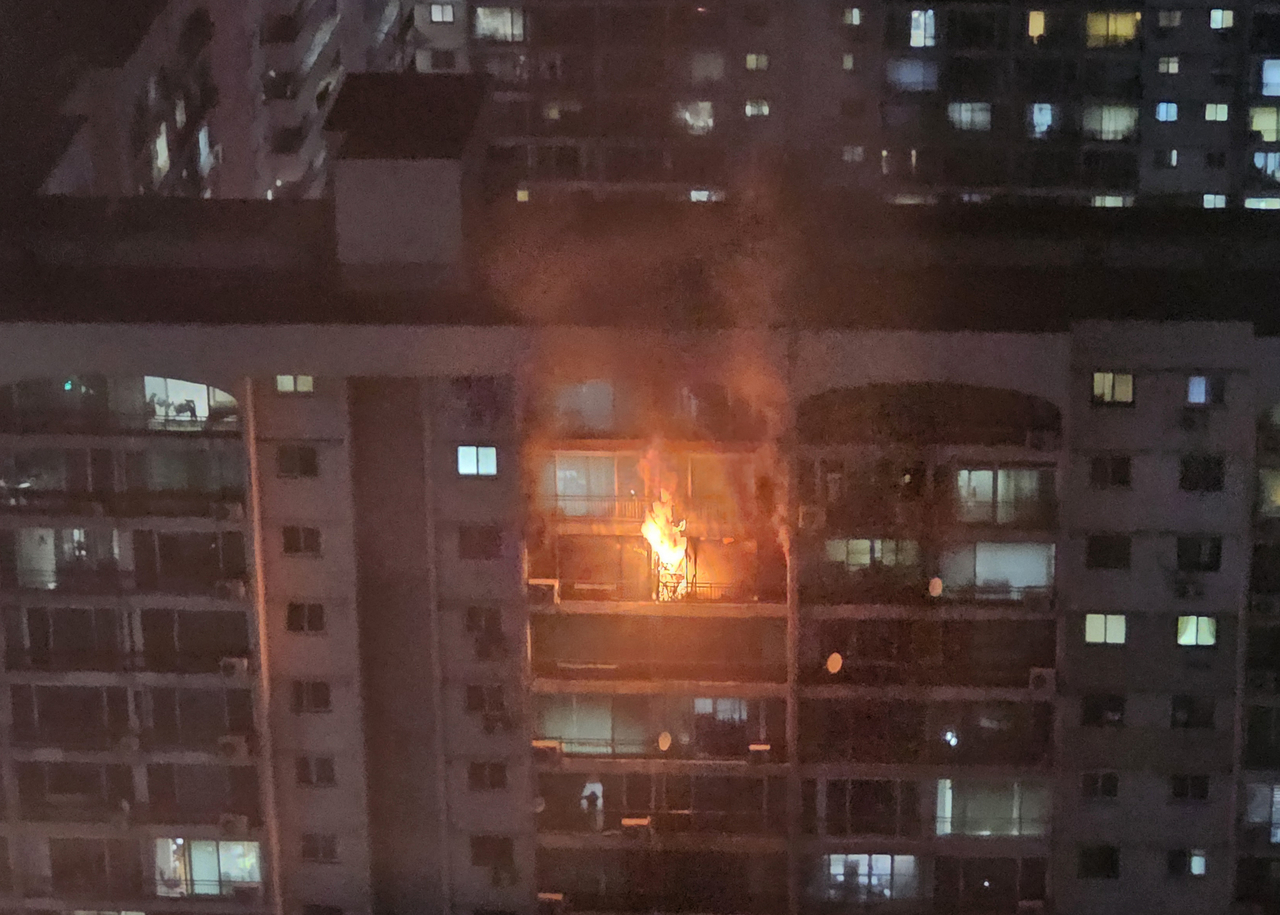
A Feb. 24 fire in Gangnam-gu at the Eunma Apartment complex left one dead and three injured in the blaze, and scorched five floors of a building. The complex was built in 1979 and did not have sprinklers.
South Korea has mandated sprinkler systems for apartment complexes since 1990. Though the regulation initially only applied to buildings with at least 16 floors, this was expanded to include those with at least 11 floors in 2004, and again in 2018 to include buildings with six or more floors.
The law is not applied retroactively, meaning older buildings constructed before 1990 fall outside the requirement. The data also does not include smaller multi-household complexes, suggesting that even more residential buildings lack fire suppression systems.
A bill mandating sprinkler systems in all multi-household residential buildings was proposed last year and remains pending at the National Assembly.
In the meantime, the Seoul Metropolitan Government said Thursday it plans to distribute alternative equipment to 88,496 households living in buildings without sprinkler systems.
This includes fire detectors and automatic diffusion fire extinguishers, which release extinguishing agents when a fire is detected. Installation is expected to be completed by December.
Seoul also plans to distribute automatic diffusion fire extinguishers to 3,560 socially disadvantaged households and 130,000 households living in city-provided rental housing.
minsikyoon@heraldcorp.com