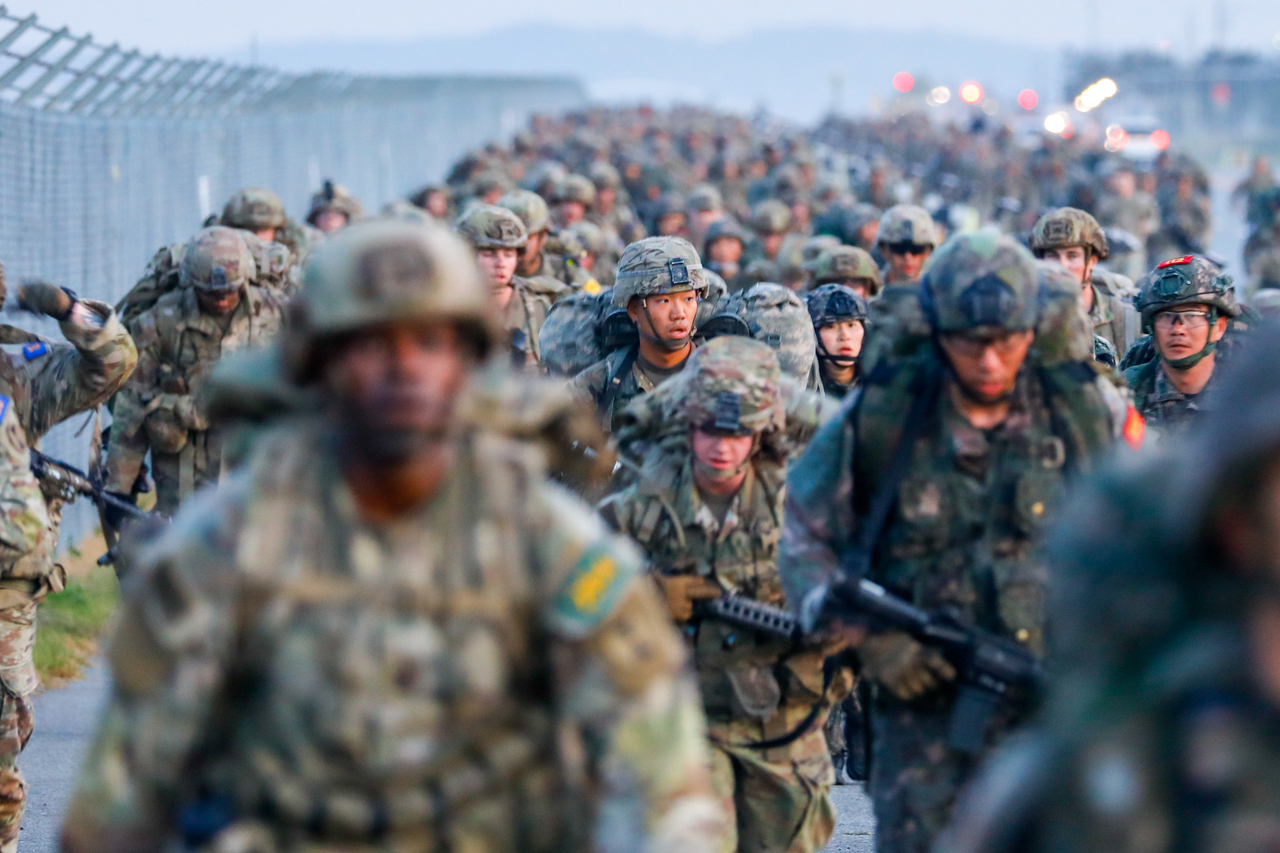
The Pentagon’s decision not to release its global force posture review is fueling concerns in Seoul over the future of US troop deployments, but experts say that the review is unlikely to lead to immediate changes in Korea.
The assessment comes after a report by US-based Politico on Wednesday that the Department of Defense has no plans to publish the Global Posture Review, a document outlining overseas troop deployments and military priorities.
According to the report, officials in Washington believe existing strategy documents sufficiently reflect the administration’s direction, opting instead for informal consultations with allies and lawmakers rather than releasing a comprehensive review.
The move fueled speculation in Seoul that Washington may seek to expand its “strategic flexibility” — a concept that regained attention under President Donald Trump’s second term — allowing forces stationed on the Korean Peninsula to be redeployed to other regions.
Shin Beom-chul, head of the Center for Strategy at the Sejong Institute, said the decision reflects a broader shift in Washington’s approach toward alliances.
“The United States appears to be moving toward giving allies more primary responsibility for their own security,” Shin said.
He noted that refraining from disclosing troop levels helps the Pentagon avoid constraints when redeploying forces.
“If specific numbers are made public, any reduction would require visible replenishment later, which could become a burden,” he said.
Shin added that the move aligned with a shift away from the traditional US doctrine of preparing for multiple large-scale wars simultaneously.
“The trend now is toward handling contingencies more sequentially,” he said.
He also pointed to the growing burden on US forces amid tensions in the Middle East, where around 50,000 troops are currently deployed.
“There are already significant forces committed to the region, and additional deployments would inevitably increase the strain,” he said.
Despite these factors, Shin assessed that a reduction in USFK was unlikely.
“Given the bilateral alliance and the security situation on the Korean Peninsula, it is unlikely that troop levels here would be reduced in a way that negatively affects Korea’s security,” he said.
Yu Ji-hoon, a researcher at the Korea Institute for Defense Analyses, said the move could signal adjustments in force levels without reducing overall military capability.
“There have been cases where rotational forces were adjusted — for example, when artillery units were withdrawn, air power was reinforced instead,” Yu said.
For instance, in January 2025, the US Army deployed the 1st Stryker Brigade Combat Team of the 4th Infantry Division to Korea on a rotational basis for about nine months, replacing a Stryker brigade under the 7th Infantry Division.
Yu noted that the United States tends to maintain overall military capability even when specific units are redeployed.
“Even if certain elements are reduced, the overall level of military capability is maintained,” he said.
Still, he added that concerns about potential changes to USFK were not unfounded.
“Such concerns are valid, but any adjustment would likely be discussed through close coordination between the allies,” he said.
The Global Posture Review has long been a key document shaping US military deployments worldwide. For Korea, where US troops are stationed on the peninsula, changes in the review have played a significant role in shaping security strategy.
A notable example dates back to 2004, when the George W. Bush administration introduced more flexible, rapidly deployable forces, giving rise to the concept of “strategic flexibility.” Following bilateral consultations, USFK troop levels were reduced from about 37,500 to 28,500, alongside base consolidations and overseas deployments.
In 2021, the Biden administration released a new review emphasizing alliance-based deterrence and a stronger Indo-Pacific focus, including repositioning forces to enhance combat readiness.
At the time, Mara Karlin, then assistant secretary of defense for strategy, plans and capabilities, said that “our force posture in the Republic of Korea remains strong and effective,” adding that no changes were being announced.
Recent developments have also highlighted the growing global demand on US forces.
The United States has reportedly redeployed some Patriot air defense assets and elements of a Terminal High Altitude Area Defense battery from Korea to the Middle East earlier this year amid heightened tensions with Iran.
In Japan, a US Marine Expeditionary Unit based in Okinawa has also been deployed to the Middle East, reflecting broader shifts in US forces posture.
flylikekite@heraldcorp.com