

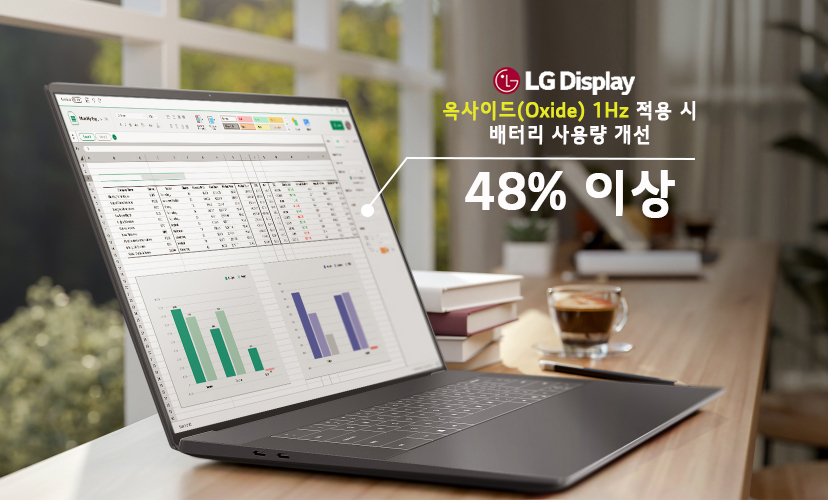
LG Display said Sunday it has become the first company to mass-produce laptop displays capable of dynamically adjusting refresh rates from 1 to 120 hertz using oxide technology, marking a breakthrough in power-efficient screens.
The Korean display-maker said the new LCD panel can drop to 1 hertz — meaning it updates only once a second — when showing static content such as documents or e-books, before scaling up to as high as 120 Hz during video playback, gaming or other motion-heavy tasks.
Refresh rates refer to how many times per second an image is redrawn on a display. Higher rates improve smoothness, but maintaining them during static viewing wastes energy.
"With the successful mass production of our world-leading oxide 1Hz panels, we aim to further widen the technology gap with competitors and cement our position as a technology-driven company," said Jang Jae-won, head of medium display product planning division at LG Display.
While variable refresh rate technology exists, LG Display said this is the first time a panel can stably operate at an ultralow 1Hz and be mass-produced for laptops, enabled by oxide-based thin-film transistor technology that minimizes power leakage.
The panel incorporates LG Display’s proprietary algorithms, panel design and new materials to enable stable operation across the full 1-120 Hz range.
According to LG Display, the panels can improve battery efficiency by 48 percent or greater by reducing unnecessary power consumption during idle screen states.
As portability remains a key buying factor for laptops, longer battery life is expected to improve mobility and user convenience, the company said. The panels could also gain traction as power consumption rises with the growing use of AI-driven computing tasks, it added.
The display panels will be supplied to US PC maker Dell for use in its premium XPS laptops unveiled at CES 2026.
The panel-maker also plans to expand the technology to organic light-emitting diode panels, targeting mass production by 2027, as demand grows for energy-efficient devices.
"We plan to continue developing and applying energy-saving technologies such as oxide 1Hz panels as part of a broader initiative to reduce carbon emissions during product use by up to 10 percent," LG Display said.
herim@heraldcorp.com