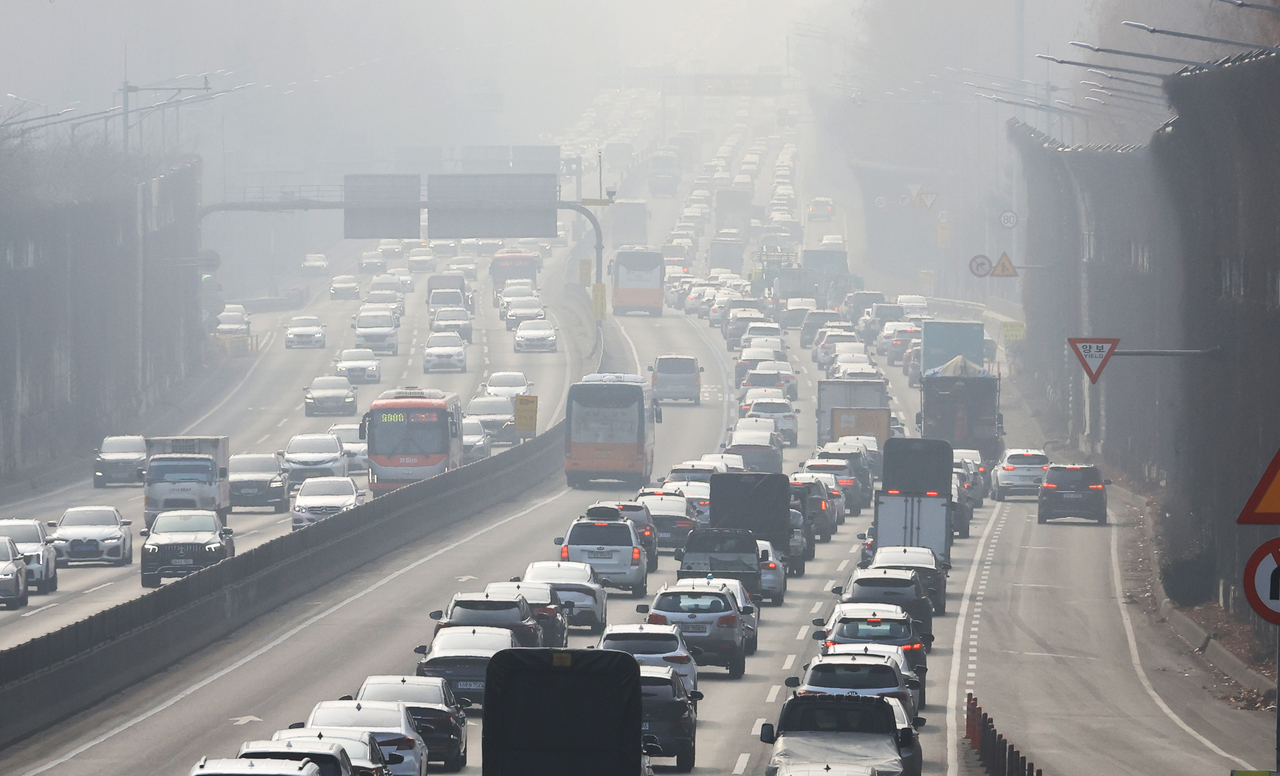
Bumper-to-bumper traffic stretched across the Gyeongbu Expressway, South Korea's busiest corridor linking Seoul to Busan, under overcast skies dimmed by a thick layer of haze as the Lunar New Year holiday period got underway on Saturday.
Saturday was the first day of the Seollal holiday window, which runs through Wednesday. Millions of South Koreans are traveling to their hometowns for the occasion.
Air quality in Seoul has sat at the "unhealthy" level on the United States Air Quality Index since Friday afternoon — a reading of 150 to 200 on a scale that runs from 0 to 500.
This was driven primarily by high concentrations of PM2.5, fine particulate matter small enough to penetrate deep into the lungs, according to South Korean Environment Ministry's real-time air quality tracker Air Korea.
At that level, health effects can extend beyond sensitive groups such as the elderly, children, or those with heart or lung conditions to the general population.
South Korea's air pollution stems from both sources at home — coal-burning power plants, diesel-fueled vehicles, and factory emissions among them — as well as factors from overseas.
Studies estimate that anywhere from 30 to 80 percent of the country's PM2.5 originates from China, depending on weather conditions and the time of year.
moonkihoon@heraldcorp.com


![[Exclusive] Ateez to return in November](https://wimg.heraldcorp.com/news/cms/2026/09/02/news-p.v1.20260902.76162fb0ba55493aad1c076f240d0750_R.jpg?type=h&h=120)