
Blueprint links Yangjae AI cluster, Suseo robot hub to form citywide 'Physical AI Belt'
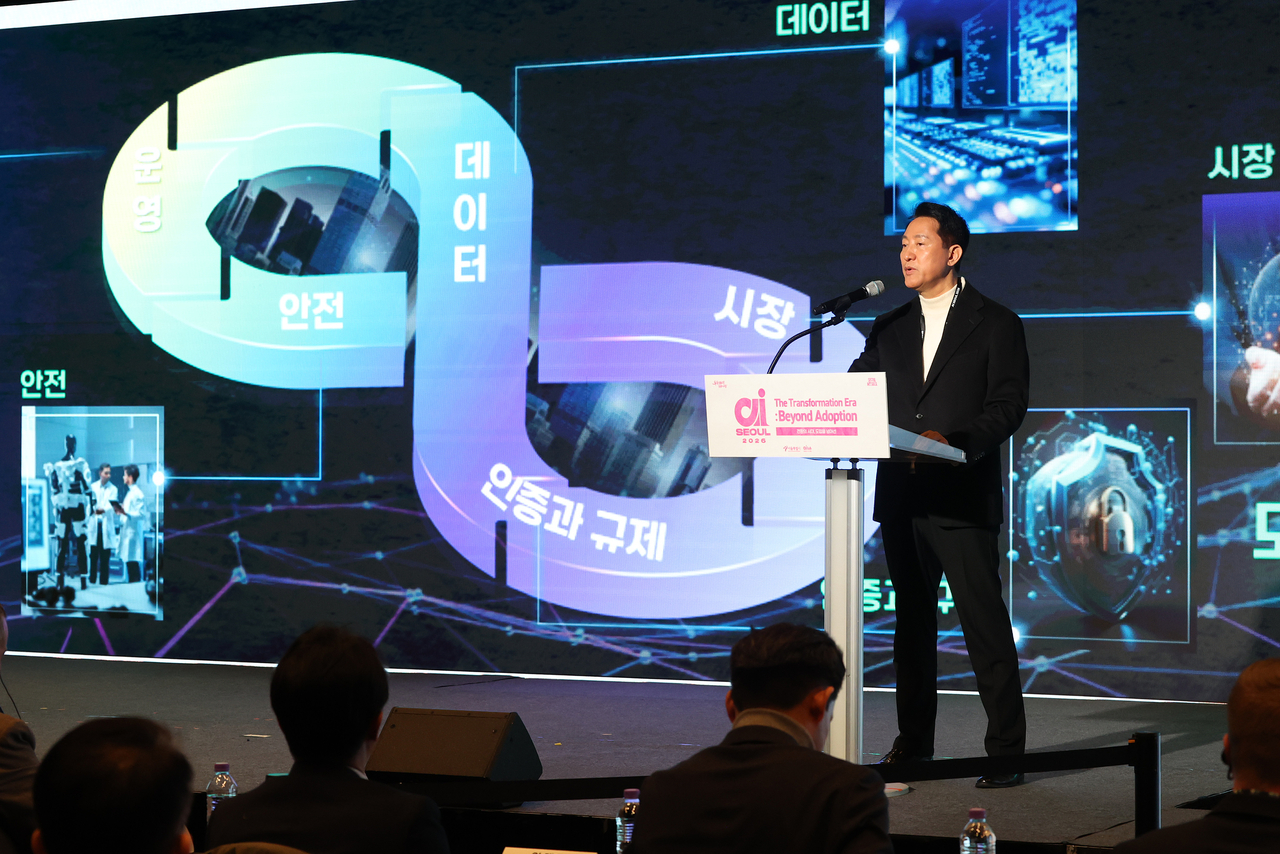
Seoul on Friday declared its vision to become a global physical AI leader, unveiling a wide-ranging blueprint that aims to turn the entire city into a testing ground for next-generation artificial intelligence technologies that operate in the physical world.
At the AI Seoul 2026 conference at Coex in Gangnam, southern Seoul, Mayor Oh Se-hoon announced a citywide strategy built on the three pillars of infrastructure, industrial ecosystem and everyday applications, declaring Seoul is "ready to embark on a journey to become the world's center and standard-setter for physical AI."
Under its infrastructure plan, the city will link two major innovation hubs: Yangjae AI Tech City, envisioned as a global cluster for AI talent and companies, and the Suseo robot cluster, a base for robotics research, development and testing.
Oh said they will form the "Seoul Physical AI Belt," integrating advanced AI capabilities with robotics. Construction of Yangjae AI Tech City is slated to begin in 2028, while the Suseo cluster is to be completed by 2030.
To strengthen the industrial ecosystem, Seoul will launch a test bed demonstration center in the second half of this year and invest 100 billion won ($70 million) by 2030 to support real-world trials and market entry.
The plan includes embedding physical AI into logistics, mobility and urban operations, while constructing infrastructure capable of collecting real-time city data. The city will also invest 70 billion won in R&D and operate a 150 billion won Seoul Vision 2030 Fund to nurture promising companies.
Seoul plans to deploy physical AI technologies across transportation, care services and safety. Level 4 unstaffed robotaxis are set to begin operating in October, while the city's early-morning autonomous shuttle bus service will expand from one route to four.
Rehabilitation robots, wearable assistive exoskeletons, AI fire-patrol robots and safety-inspection drones will be introduced across welfare and disaster-response fields. Seoul said it will invest 120 billion won in smart infrastructure management by 2030.
Reaffirming the city's commitment to responsible AI use, Oh said the city will enforce its AI ethics standards across the public sector.
In his opening remarks, Oh emphasized that physical AI represents a paradigm shift in how cities operate and how people live. "AI is no longer confined to screens," he said. "It now moves beside us, makes decisions in real time and produces tangible results. The global race to lead this new era of moving intelligence has already begun."
Oh added that Seoul has transformed from "a city trying to catch up with AI" into one that "shows where AI should go," noting progress made since the city announced its global AI innovation vision last year.
Seoul has launched a system capable of training 10,000 people in AI annually, established a 500 billion won AI fund and completed the blueprint for the Yangjae AI Tech City, he said.
"The physical AI city Seoul envisions is not one that simply chases speed," Oh said. "It is a city that designs how technology can safely integrate into people's lives and becomes a standard for others. Our goal is to make the coldest technologies create the warmest changes — protecting the people, supporting the elderly, assisting firefighters and giving people back their time."
Leading global AI figures, including 2018 Turing Award laureate Yoshua Bengio and Stanford University's Peter Norvig, also delivered keynote messages expressing expectations for Seoul's role as a physical AI test bed.
jychoi@heraldcorp.com