
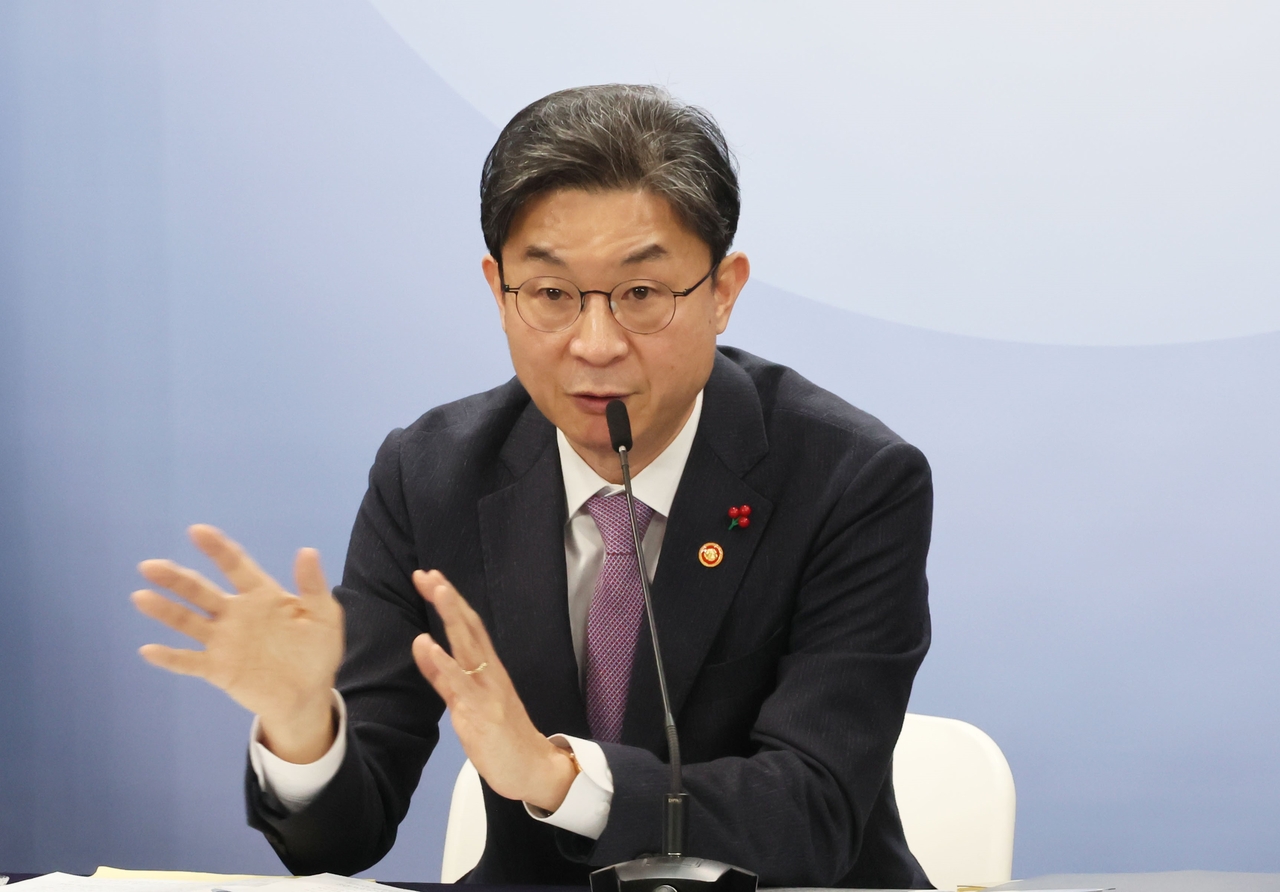
South Korea will expand its exchange-traded funds lineup to include single-stock leveraged products as regulators seek to draw back investor funds that have flowed overseas, Financial Services Commission Chairman Lee Eok-won said Wednesday.
Lee outlined the plan at a press briefing in Seoul as part of a broader reform push aimed at boosting the competitiveness of domestic capital markets while tightening oversight of cryptocurrency and financial corporate governance.
“Investor demand is going unmet because products available overseas are not offered domestically under asymmetric regulation,” Lee said, adding authorities would “move quickly to allow single-stock leveraged ETFs tracking high-quality local equities.”
Korean retail investors have piled into US-listed leveraged ETFs, with 2x products tied to Tesla and Nvidia among the most actively traded. South Korea currently allows index-based ETFs with leverage of up to two times, while capping single-stock exposure at 30 percent, effectively blocking leveraged single-stock products.
“We will swiftly issue a legislative notice on Friday to allow around two-times leveraged ETFs in line with global standards,” Lee said.
To curb potential investor losses, regulators are reviewing safeguards including mandatory pre-investment education and expanded minimum deposit requirements.
Authorities are also preparing legislation to allow active ETFs without index-tracking requirements. Current rules require active ETFs to maintain a correlation of at least 0.7 with benchmark indexes, a threshold fund managers say constrains portfolio flexibility.
Lee also outlined plans to shift crypto exchanges from a registration-based system to a licensing regime under the forthcoming Digital Asset Framework Act, undergoing political review. Exchanges currently renew registrations every three years.
“The new system will effectively grant them permanent operating status,” Lee said, adding that governance reforms and ownership restrictions were needed as exchanges take on a stronger public-infrastructure role.
Lee linked the move to talks on curbing controlling shareholders’ stakes, citing risks tied to concentrated ownership. “If control becomes overly concentrated in specific shareholders, conflicts of interest are bound to arise,” he said.
The FSC chief also set a March deadline for governance reform proposals targeting major financial groups. “We plan to review measures to strengthen shareholder oversight over CEO reappointments, which have been criticized as ‘entrenchment,’" said Lee, adding that proposals under review include tightening requirements for approving bank holding company CEOs in shareholders meetings.
Lee also struck a cautious tone on designating the Financial Supervisory Service as a public institution ahead of a final decision due Friday at a related committee under the Ministry of Economy and Finance.
“There is broad consensus on the need to strengthen democratic oversight of the FSS,” Lee said. “However, given the FSC’s unique role and the specialized nature of financial supervision, it may be more effective to reinforce oversight within the existing supervisory structure.”
He added that talks between the FSC and the FSS are nearing completion on plans to expand the watchdog’s special police unit to cover illegal private lending, while granting limited probe-initiation authority in capital-market misconduct cases.
jwc@heraldcorp.com