
The US military strike on Venezuela and the capture of President Nicolas Maduro have sent a stark warning to North Korean leader Kim Jong-un, reinforcing his belief that nuclear weapons are essential for survival, South Korean experts said Monday.
According to Lim Eul-chul, a professor at Kyungnam University’s Institute for Far Eastern Studies, the US operation could deliver two powerful messages to Kim: an “existential threat” and a “justification for nuclear fixation.”
“The humiliating capture of Maduro is likely to imprint more decisively on Kim Jong-un the belief that giving up nuclear weapons would amount to suicide,” Lim said. “This will make denuclearization negotiations on the Korean Peninsula even more difficult.”
Lim noted that the psychological impact on Kim may be amplified by the long-standing ties between North Korea and Venezuela, which have maintained close relations since establishing diplomatic ties in 1974 as part of a shared anti-US front. Both countries have faced US-led sanctions and regularly exchanged congratulatory messages during major national events.
The fact that Venezuela was unable to mount any meaningful resistance to the US military operation is likely to further intensify Kim’s obsession with nuclear armament, Lim said, adding that Pyongyang has long argued that strengthening its military capabilities — particularly its nuclear forces — is essential to countering US threats.
Lim also said the timing of North Korea’s latest missile test, on Sunday, may not have been coincidental, coming as South Korean President Lee Jae Myung departed for Beijing for summit talks with Chinese President Xi Jinping.
“Pyongyang may have sought to underscore that, unlike Venezuela, North Korea possesses the military capability to confront the United States,” he said.
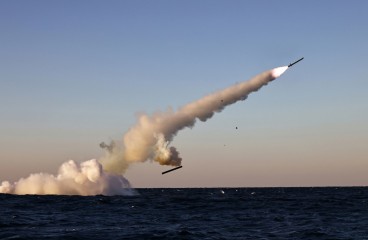
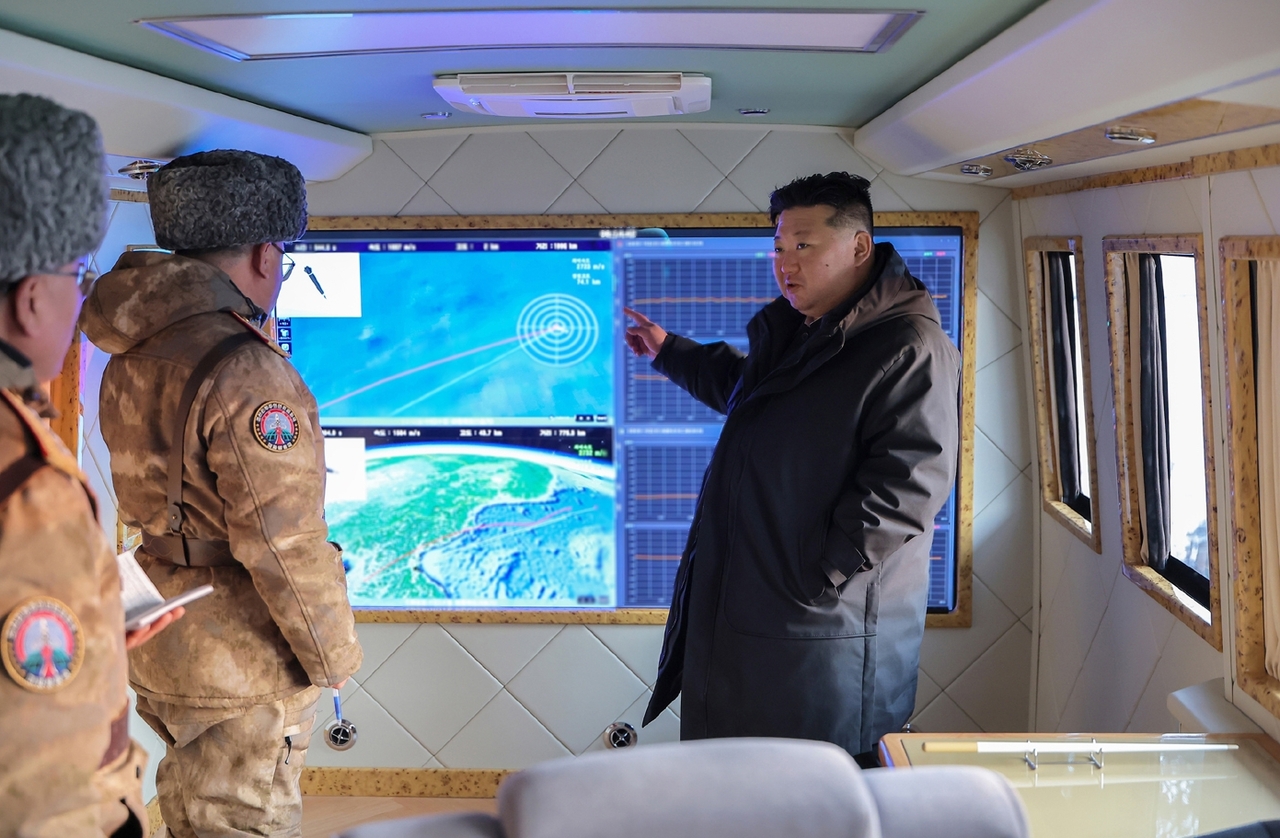
Against this backdrop, North Korea claimed on Monday that it conducted a hypersonic missile launch drill the previous day with Kim in attendance, asserting that the missiles struck targets in the East Sea.
According to its state media Korean Central News Agency, the launch was carried out by “a subunit under a major firing strike group of the Korean People’s Army” to assess war deterrence, system readiness and mission performance.
KCNA quoted Kim as saying, “Through today's launching drill, we can confirm that a very important technology task for national defense has been carried out. The missile soldiers showed the readiness of the DPRK's nuclear forces without regret and gave confidence in it.”
Kim added that the country’s nuclear forces have been placed “on a practical basis” and prepared for “an actual war,” stressing the need to “continuously upgrade the military means, especially offensive weapon systems,” calling the effort “an essential undertaking for self-defense.”
He was further quoted as saying, “To be honest, our such activity is clearly aimed at gradually putting the nuclear war deterrent on a high-developed basis. Why it is necessary is exemplified by the recent geopolitical crisis and complicated international events.”
While KCNA did not specify what Kim meant by the “recent geopolitical crisis,” North Korea’s Foreign Ministry earlier condemned the US strike on Venezuela that led to Maduro’s capture, calling it “the most serious form of encroachment of sovereignty.”
South Korea’s military detected the missile launch at 7:50 a.m. Sunday, hours before Lee departed for Beijing.
According to KCNA, the missiles were launched from Pyongyang’s Ryokpho District and hit targets about 1,000 kilometers away in the East Sea. Kim expressed gratitude to the unit involved and extended New Year’s greetings, adding that “All the missile forces would remain faithful to their sacred mission as a reliable shield for defending the sovereignty and security of the DPRK by fulfilling their consistent and responsible combat duty under iron discipline.”
KCNA did not disclose the specific missile type. However, South Korea’s military assessed that it was likely the Hwasong-11Ma, a system developed by attaching hypersonic glide payloads to the KN-23 missile.
Hong Min, a senior research fellow at the state-run Korea Institute for National Unification, said North Korea’s rhetoric and weapons demonstrations amount to a “North Korean-style response” to the US attack on Venezuela.
Pyongyang’s emphasis on “constant readiness and lethality,” Hong said, was intended to demonstrate retaliatory capability and what it calls “permanent mobilization” — a posture designed to complicate South Korea-US preemptive strike concepts such as the Kill Chain.
Hong said Kim’s reference to “recent geopolitical crises and complicated international events” was a clear allusion to the US operation in Venezuela, while simultaneously signaling that North Korea — unlike Venezuela — possesses war deterrence and nuclear capabilities.
He also linked the missile test to North Korea’s recent disclosure of a factory producing multipurpose precision-guided weapons, including so-called “spike-type” missiles, describing the moves as part of a broader effort to showcase more precise strike capabilities across air and ground platforms.
When combined with what Pyongyang has described as “guided weapons to replace conventional rocket artillery,” Hong warned, the hypersonic missile could significantly raise the possibility of a saturation attack within the Korean Peninsula theater.
Technically, Hong said the missile was most likely the Hwasong-11Ma, noting the use of a five-axle, 10-wheel transporter-erector-launcher, the same configuration used in previous KN-23 launches. While the KN-23’s range is typically 800 kilometers — or about 600 kilometers for the heavy-warhead version — the reported 1,000-kilometer flight suggests the hypersonic warhead extended its range through glide flight during the terminal descent phase.
mkjung@heraldcorp.com