
Growing speculation that US President Donald Trump could meet North Korean leader Kim Jong-un in Pyongyang has fueled concerns that such a meeting would focus more on publicity and political gains than nuclear and other outstanding issues.
As signs of renewed diplomacy emerge in Washington and Seoul, experts increasingly see the North Korean capital as a possible meeting venue.
Former US National Security Adviser John Bolton this week became the latest prominent figure to raise the possibility, arguing that Pyongyang could offer Trump the kind of dramatic setting he has yet to experience in his diplomacy with Kim.
“I think Trump would look at Pyongyang,” Bolton said during an online forum hosted by the Institute for Corean-American Studies on Tuesday.
Trump’s first summit with Kim, which was also the first-ever meeting between a sitting US president and a North Korean leader, took place in Singapore in June 2018. The two met again in Hanoi in February 2019, but talks broke down over the scope of North Korea’s denuclearization and corresponding sanctions relief.
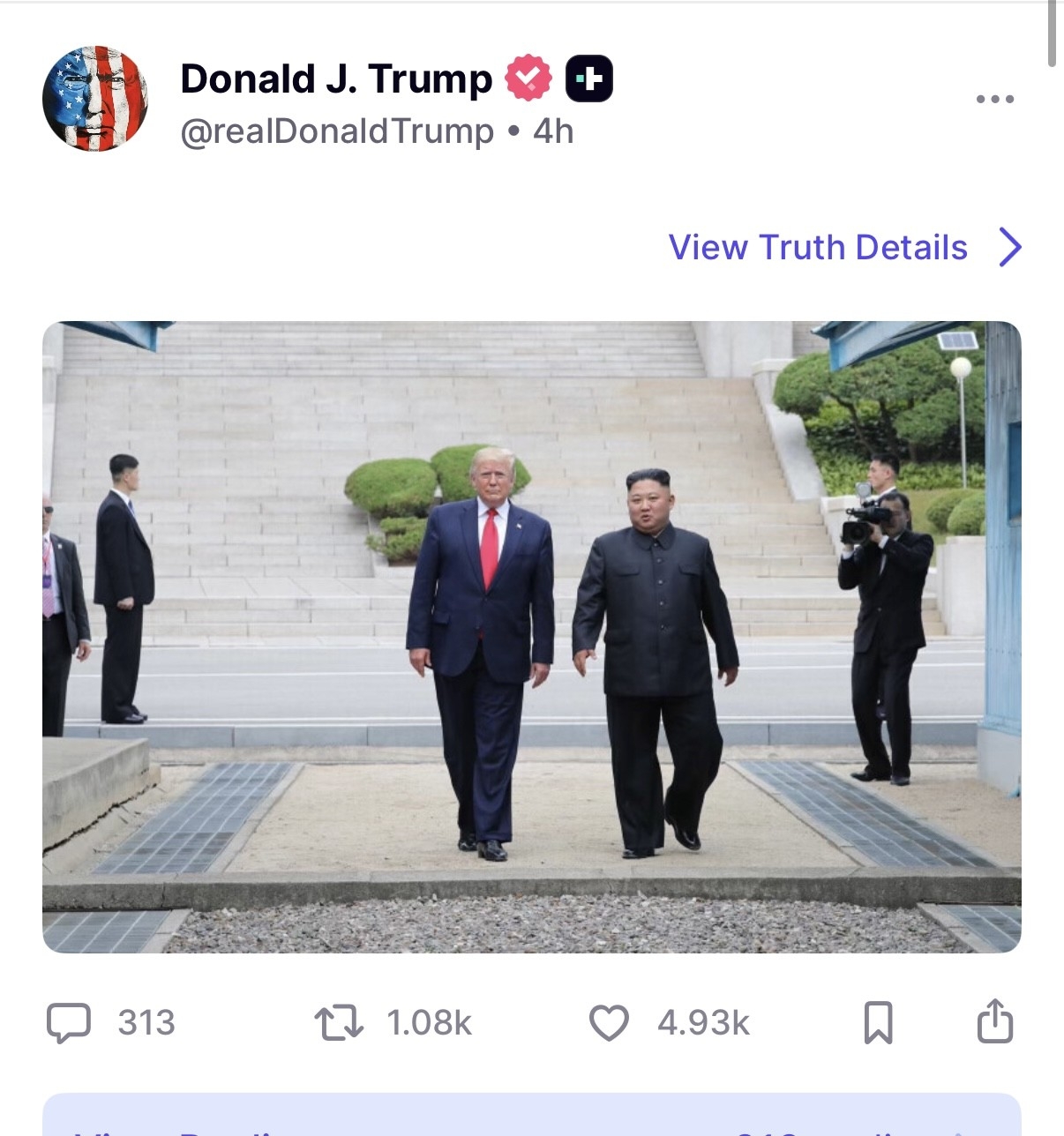
Their third encounter came in June 2019 at Panmunjom, where Trump briefly crossed the Military Demarcation Line into North Korea, becoming the first sitting US president to set foot on North Korean soil.
If a Pyongyang summit materialized, it would mark the first time a sitting US president visited the North Korean capital and met a North Korean leader there.
According to Bolton's assessment, Trump is seeking publicity rather than substantive diplomacy ahead of the Nov. 3 midterm elections.
“The purpose of a trip to Pyongyang is the publicity. That's the sum and substance of it,” he said, adding that Trump wants “pictures” and a distraction from domestic and international challenges.
Echoing Bolton's stance, Cho Han-bum, a senior research fellow at the Korea Institute for National Unification, said Trump’s personality and political incentives make a Pyongyang visit entirely conceivable.
“Trump is someone who is willing to do just about anything, so there is no reason to think he wouldn’t go to Pyongyang,” Cho said. “If he were to go to Pyongyang, it would probably be breaking news around the world. It would command global attention.”
Cho argued that even a limited nuclear deal with Pyongyang could allow Trump to claim a major foreign policy victory. If Kim agreed to halt further nuclear or missile development, Trump could present the deal to US voters as having made America safer, Cho said.
An even more dramatic scenario would be an agreement to replace the Korean War armistice with a peace arrangement.
Trump could then claim to have ended the Korean War more than seven decades after the fighting stopped, Cho said, calling such an achievement potentially more politically significant for Trump than developments involving Iran or the war in Ukraine.
“If Trump believes there is an accomplishment to be gained from it, there is no reason he wouldn’t go to Pyongyang,” he said.
Cho described Trump's recent overtures as amounting to “practically courting” Kim and linked the renewed focus on North Korea partly to Trump's need for a major diplomatic breakthrough ahead of the midterm elections.
“At times like this, Trump tends to stage a reality show in which he himself is the star,” Cho said. “And the one person who could attract the most attention worldwide as his counterpart is Kim Jong-un.”
Another South Korean expert similarly saw political incentives for both leaders.
Nam Sung-wook, a distinguished professor at Sookmyung Women’s University and former head of the Institute for National Security Strategy, said the possibility of a Pyongyang summit would ultimately hinge on Kim’s willingness to host Trump.
“If Kim Jong-un proposed holding a summit in Pyongyang, there is a strong possibility that Trump would accept,” Nam said.
For Kim, hosting Trump could also bolster his standing at home and abroad. Russian President Vladimir Putin visited Pyongyang in 2024, while Chinese President Xi Jinping visited the North Korean capital this June. A visit by a sitting US president would allow Kim to portray himself as a leader courted by the world’s major powers, Nam said.
South Korean intelligence authorities, meanwhile, appear to see renewed Trump-Kim diplomacy as an increasingly realistic possibility.
The National Intelligence Service told lawmakers Tuesday that a summit between Trump and Kim could take place “at any time” this year.
A senior NIS official told a plenary meeting of the National Assembly Intelligence Committee that while Seoul has not confirmed any specific contact between Washington and Pyongyang, there are signs pointing toward dialogue, according to Reps. Youn Kun-young of the Democratic Party of Korea and Yoo Yeong-ha of the People Power Party.
The NIS also said it was discussing possible ways to support a summit.
There have been indications in Washington that the White House is at least preparing for contingencies surrounding renewed talks.
Kelly McKeague, director of the US Defense POW/MIA Accounting Agency, said recently that the White House had asked what his agency could do should Trump reach an agreement with Kim.
Speaking at an event hosted by the National Committee on North Korea in Washington on Monday, McKeague said the situation was “no different than the lead-up to the Singapore summit in 2018,” adding that the agency had told the White House it was ready to resume engagement with Pyongyang on recovering the remains of US service members.
Remains recovery was one of the concrete areas of cooperation to emerge from the first Trump-Kim summit. Following their June 2018 meeting in Singapore, North Korea handed over 55 boxes containing remains believed to include those of US service members killed during the 1950-53 Korean War.
The growing speculation comes as Trump has repeatedly signaled interest in reviving personal diplomacy with Kim.
Last month, Trump ordered a scaling back of the allies’ Ulchi Freedom Shield exercise, citing his “very good” relationship with Kim and arguing that the drills were costly and sent an inappropriate and hostile signal to North Korea.
He has also repeatedly referred to Kim in recent weeks and posted images recalling their previous encounters.
Some observers, however, are skeptical that Pyongyang would be a viable venue, citing the logistical and security challenges involved in a US presidential visit to North Korea.
Pyongyang has previously hosted former US presidents, but never a sitting one. Jimmy Carter traveled to the North Korean capital in 1994, three years after leaving office, and met then-North Korean leader and founder Kim Il-sung amid a mounting nuclear crisis, helping reopen a diplomatic channel that ultimately led to the 1994 US-North Korea Agreed Framework.
Bill Clinton made a separate trip to Pyongyang in 2009, eight years after leaving office, meeting Kim Jong-un's father, Kim Jong-il, and securing the release of two detained American journalists.
mkjung@heraldcorp.com