

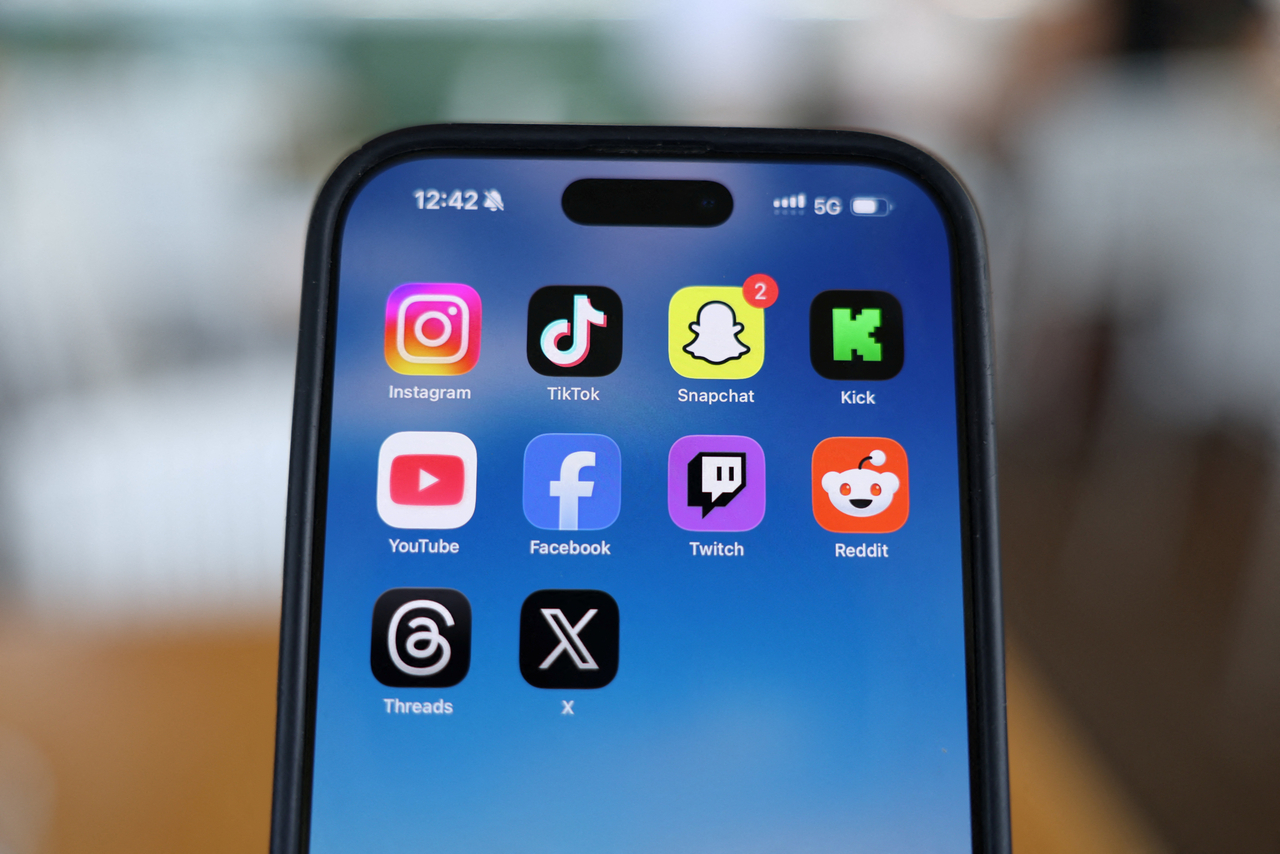
South Korea has begun weighing whether to regulate teenagers’ social media use, as Australia’s recent ban on under-16 access reignites a global debate over youth safety in the digital space.
Australia last week became the first country to legally bar children under 16 from social media platforms, prompting other governments — including Malaysia, Denmark and France — to explore similar measures. In Korea, however, policymakers are leaning toward usage limits rather than an outright ban.
Recent data from WiseApp and Retail, as of November, shows that Instagram is the most widely used social media platform among Korean teenagers, with 4.04 million users. TikTok follows with 2 million users, while Pinterest and X have 1.69 million and 1.6 million teenage users, respectively.
Concerns over excessive use are mounting.
A 2024 survey by the Ministry of Science and ICT and the National Information Society Agency found that 46.7 percent of Korean teenagers struggle to control their social media usage. In particular, 42.2 percent reported difficulty limiting time spent on short-form content — a higher rate than among younger children, adults or seniors.
Against this backdrop, discussions in Korea have shifted toward introducing legal safeguards for minors. Rather than banning access altogether, policymakers are exploring ways to cap daily usage time.
Last year, Rep. Cho Jung-hun of the ruling People Power Party proposed an amendment to the Act on the Promotion of Information and Communications Network Utilization and Information Protection that would impose daily time limits on social media use for teenagers. The bill, however, has stalled amid concerns over fairness, enforceability and potential violations of fundamental rights.
The issue regained momentum this week at a National Assembly hearing, where Kim Jong-cheol, nominee for chair of the Korea Communications Commission, expressed openness to examining Australia’s approach.
“I believe this is something that should be reviewed without exception,” Kim said, emphasizing that protecting minors in the digital environment is one of Korea’s most pressing policy challenges.
His remarks have fueled debate within the tech industry and academic circles, with experts urging caution.
Jeon Seong-min, a professor of business administration at Gachon University, warned that poorly designed regulations could prove more ineffective than protective. He pointed to Korea’s now-abolished “Shutdown Law,” which restricted minors’ access to online games late at night but was widely circumvented and ultimately repealed.
“In the past, minors easily bypassed measures like the Shutdown Law by using parents’ accounts or payment information,” Jeon said. “Simply blocking social media access for those under 16 is unlikely to solve the problem.”
Some platforms themselves have moved ahead with voluntary safeguards.
Meta has rolled out teen accounts that allow parents of users aged 14 to 18 to enforce private settings, limit sensitive content and set daily usage caps. TikTok automatically places accounts of users under 16 in private mode and restricts screen time for those under 18 to one hour per day.
In Korea, Kakao has introduced parental controls to restrict minors’ access to open chat rooms and short-form content on KakaoTalk, citing risks such as digital grooming and sexual exploitation. Naver has deployed AI-based systems to block explicit images and videos.
yeeun@heraldcorp.com