
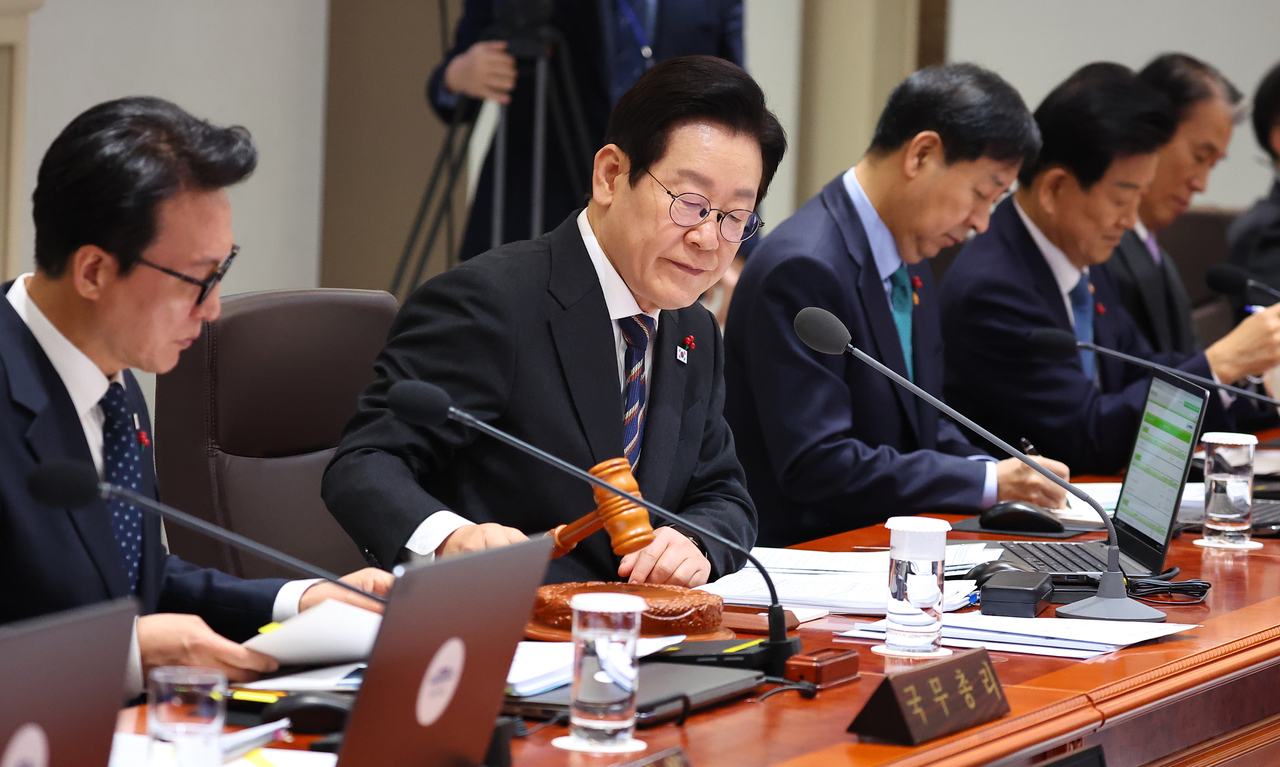
President Lee Jae Myung on Tuesday ordered a renewed review of legal measures to dissolve religious organizations engaged in political interference or unlawful activities, amid growing controversy over the Unification Church's alleged activities.
Presiding over a Cabinet meeting at the presidential office in Yongsan-gu, central Seoul, Lee pressed Minister of Government Legislation Cho Won-cheol to examine dissolution options for religious entities accused of abusing their corporate status.
“Individuals are sanctioned when they commit crimes or antisocial behavior. Likewise, if a corporation commits acts that violate the Constitution and the law, it should be dissolved,” he said.
Lee reminded Cho of his comments at last week’s Cabinet meeting, during which Lee had cited Japan’s dissolution order against a religious corporation as a precedent and asked for a similar review in Korea. The statements have been widely interpreted as referring to the Unification Church, which is being investigated for allegedly providing illicit political funds — not only to main opposition People Power Party lawmakers but, according to new testimony, also to figures in Lee’s own Democratic Party of Korea.
Cho responded that dissolution is legally feasible under certain conditions, citing Article 38 of the Civil Act, which allows the government to cancel a corporation’s establishment permit if it violates its founding purpose or engages in acts harmful to the public interest.
“It is less a constitutional issue than an application of Article 38,” he said. “If a religious organization engages in continuous, severe unlawful conduct in an organized manner, dissolution becomes possible — but the facts must meet that threshold.”
When Lee asked which government body holds the authority to revoke a religious organization’s permit, he said he would “look into it further.” Cho replied that he would provide a detailed report. He added that if a corporation is dissolved, its assets are handled according to its bylaws, and if no bylaws exist, they revert to the state.
The president’s comments come as court testimony by former Unification Church global headquarters chief Yun Young-ho has triggered fierce political backlash. Yun, who is on trial for allegedly funneling church funds to People Power Party lawmakers ahead of the 2022 presidential election, told the court last week that he had also approached — and in some cases financially supported — Democratic Party politicians.
Yun claimed to have given tens of millions of won to two Democratic Party lawmakers during the Moon Jae-in administration and said as many as 15 Democratic Party politicians may have received support through donations or bulk book purchases.
He also said he previously disclosed this information to the special counsel team in August, leading critics to accuse special counsel Min Joong-ki of conducting a “selective investigation” focused solely on the opposition People Power Party.
The special counsel announced Tuesday afternoon that it has referred to the National Office of Investigation claims that the Unification Church contacted Democratic Party lawmakers and provided some of them with illegal political funds. It had previously acknowledged receiving Yun’s statements, but said the Democratic Party's allegations fall outside the counsel's mandate, which centers on inquiries into former first lady Kim Keon Hee.
People Power Party Floor Leader Song Eon-seog escalated the political dispute during a morning intraparty meeting, announcing he would file a criminal complaint against Min for allegedly ignoring evidence implicating Democratic Party lawmakers in the Unification Church scandal.
Song accused the special counsel of “dereliction of duty” and “selective investigation,” questioning why prosecutors “raided People Power Party headquarters and arrested senior lawmakers” while “not even taking formal statements” in cases involving Democratic Party figures. He also criticized the presidential office for reviving the long-stalled nomination process for a special inspector, calling it a political distraction, and urged the government to act quickly to counter rising energy costs driven by a weakening won.
Former People Power Party Chair Han Dong-hoon also blasted the president’s remarks, describing them as a “public threat” directed at the Unification Church ahead of further testimony, in a Facebook post on Tuesday. Han argued that Lee’s comments amounted to warning the group not to disclose alleged financial contributions to lawmakers of the ruling party, quipping that the scene resembled “a mafia movie.” He said the unfolding scandal should instead spur a bipartisan effort to uncover and punish all politicians who may have accepted illicit funds.
Democratic Party Rep. Park Jie-won also weighed in, insisting that the Lee administration has maintained “clean governance” despite allegations that the Unification Church provided funds to both current and former Democratic Party lawmakers.
In a Facebook post Monday night, Park wrote, “Attack is the best defense,” and that if the church’s “dark influence” reached the Democratic Party, then “it must be thoroughly uncovered.”
He added that the Unification Church scandal “will become the biggest political issue,” reiterating his belief that “the Lee Jae Myung administration is clean.”
The deepening scrutiny of the Unification Church comes as the group remains at the center of one of Korea’s most combustible political scandals, spanning allegations of illicit political funding, influence peddling and improper ties with figures linked to the former Yoon Suk Yeol administration.
Special counsel Min is already investigating accusations that former first lady Kim received luxury gifts from church officials seeking business favors, while prosecutors have indicted senior church leaders for allegedly funneling political funds to People Power Party lawmakers during the 2022 presidential campaign.
mkjung@heraldcorp.com