
Allies set up three task forces to translate joint fact sheet into action
The Lee Jae Myung administration is not considering scaling back regular combined military exercises between South Korea and the United States as leverage to engage North Korea in dialogue, national security adviser Wi Sung-lac said Sunday.
Wi drew that line as he pledged to shift the government’s focus toward resurrecting long-stalled inter-Korean dialogue after six months of diplomatic gains abroad, while conceding that no tangible progress has been made in easing tensions on the Korean Peninsula.
"We decisively stabilized South Korea-US relations, reshaped South Korea-Japan ties in a far more forward-looking way than expected and even put South Korea-China relations — which had been at their worst — back on the path to recovery," Wi said at a briefing marking six months since the inauguration of the Lee administration in June.
"Building on these achievements, starting next year we intend to channel the momentum we have generated into advancing the (peace) process on the Korean Peninsula. North Korea’s response will be decisive, however."
Wi rejected the idea when asked if he would propose scaling back annual combined military exercises between South Korea and the US as part of efforts to reinvigorate the Korean Peninsula peace process in earnest next year.
"To do so, there are various options we must consider — and there are indeed many possible cards we could play," Wi told reporters. "However, at this point, we are not directly considering combined military exercises as one of those cards. We will explore a wide range of possible approaches."
Wi’s comments came amid mixed signals within the Lee administration over whether scaling back regular, defensive-oriented combined military exercises should be considered as leverage to help create conditions conducive to reviving the long-stalled dialogue between the US and North Korea.
South Korean Unification Minister Chung Dong-young has called for adjusting the combined military exercises to help resume talks between Pyongyang and Washington.
Asked about the timing of when the two Koreas might resume dialogue, Wi said that "engagement between the US and North Korea is likely to come before inter-Korean talks," if he were to venture a guess.
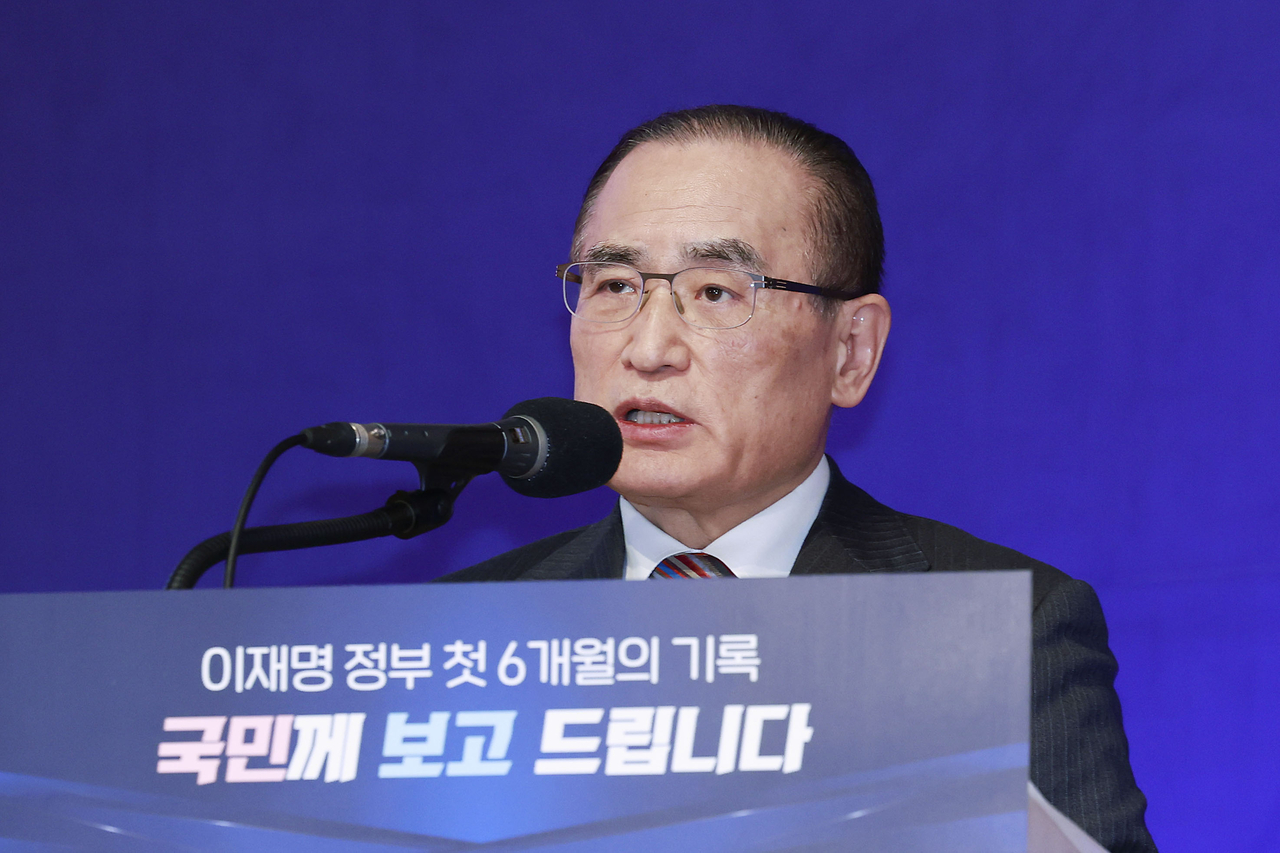
Speaking at the same briefing, Kim Hyun-jong, first deputy director of the National Security Office, said Seoul and Washington have formed task forces under the overall coordination of the National Security Office to implement their leaders’ commitments outlined in the joint fact sheet.
The first task force focuses on discussions over South Korea’s bid to secure rights for civilian uranium enrichment and spent fuel reprocessing for peaceful purposes. The second covers Seoul’s pursuit of developing nuclear-powered submarines. The third addresses South Korea’s pledge to increase its defense spending to 3.5 percent of gross domestic product.
"Working-level consultations with the US are set to begin this month, but any visible outcomes are likely to emerge in the first half of next year. As the working-level talks proceed, high-level consultations may also be carried out in parallel when necessary," Kim said.
"Visible outcomes mean concrete steps such as finalizing a shared timeline between South Korea and the US, as well as confirming the specific agenda items to be discussed," he added.
dagyumji@heraldcorp.com