
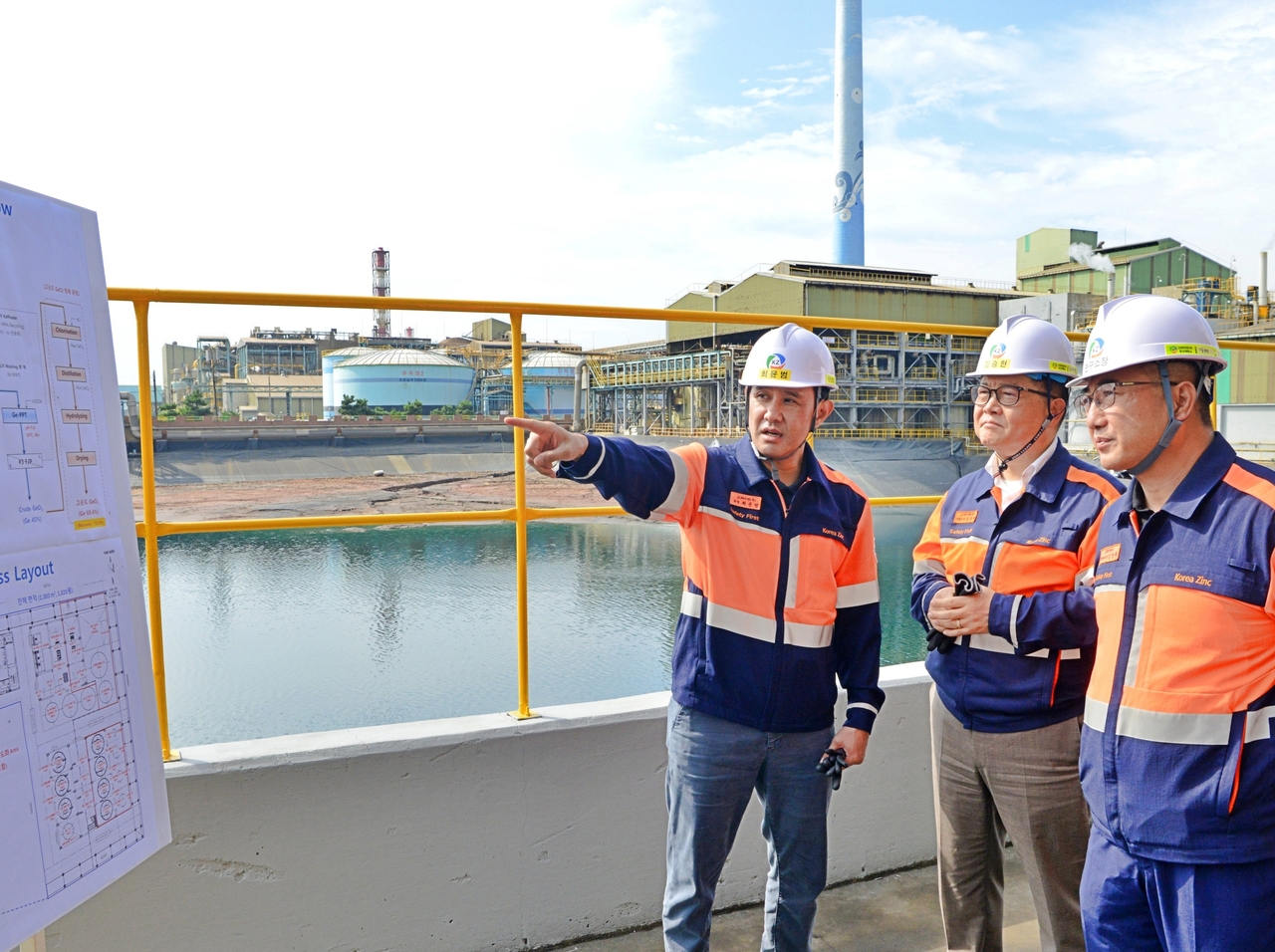
Korea Zinc said Monday that it plans to construct a gallium recovery facility at its Onsan smelter in Ulsan, marking another milestone in the company’s expansion into strategic minerals long dominated by China.
Under the 55.7 billion won ($39.3 million) project, the facility is scheduled to begin pilot operations in the first half of 2028. Once fully operational, it is expected to produce about 15.5 metric tons of gallium annually, generating roughly 11 billion won in profit based on a market price of $920 per kilogram. Backed by Korea Zinc’s R&D center, the firm has commercialized its gallium extraction technology, allowing for cost-efficient production and improved profitability.
The investment follows the company’s August announcement of a separate 140 billion won project to build a germanium plant, also at the Onsan smelter, with an annual production capacity of 10 tons.
Gallium is a critical raw material used in advanced technologies, including semiconductors, LEDs and high-speed integrated circuits. Recognizing its strategic significance, the Korean government has designated gallium as one of 33 critical minerals under the Special Act on Resource Security, while the US Department of Energy lists it among its Critical Minerals List, highlighting its national security importance.
China, which accounts for an overwhelming 98.7 percent of global gallium production — roughly 762 tons as of 2023, according to the US Geological Survey as cited by Korea Zinc — has imposed a full export ban to the US, tightening its grip on the strategic mineral. Given the rising supply disruptions, Korea Zinc underscored that its investment in gallium production is expected to play a key role in strengthening resource security and stabilizing global supply chains.
After ramping up production, the company also expects to recover more than 16 tons of indium annually as a by-product of gallium production, generating an additional 8 billion won in profit based on a market price of 5 billion won per ton.
As of 2024, Korea Zinc produces about 150 tons of indium annually, meeting roughly 11 percent of global demand outside China and positioning itself as the world’s largest non-Chinese indium refiner. However, with China still accounting for around 70 percent of global output, supply chain stability remains a major concern.
“With China’s export restrictions, escalating global supply chain risks and intensifying competition among advanced economies for critical minerals, the strategic importance of resource security has increased significantly,” said a Korea Zinc official. “As Korea’s only integrated hub for strategic minerals, Korea Zinc will continue to enhance its technological leadership and reinforce supply chain resilience through ongoing investment and innovation.”
Korea Zinc’s low-temperature, low-pressure hematite process — a rare zinc-smelting technology developed exclusively by the company — was designated as a National Core Technology by Korea’s Industry Ministry earlier in October. The company was also recognized for its high-nickel precursor design and manufacturing technology in 2023.
hyejin2@heraldcorp.com