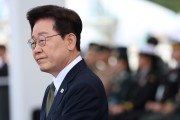
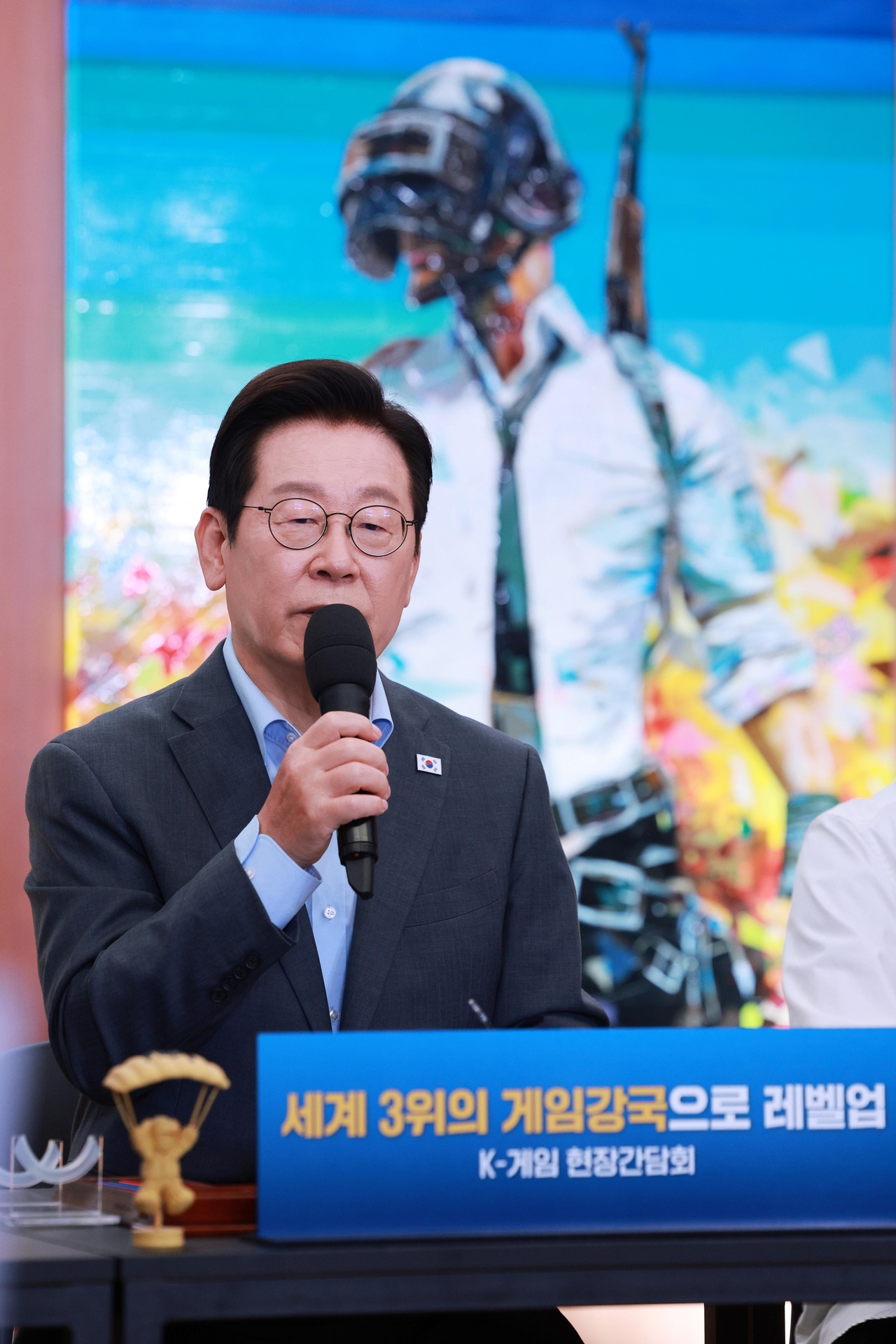
President Lee Jae Myung on Wednesday touted South Korea's gaming industry as a driver for the nation's exports, saying it has the potential to rank among the top three gaming powerhouses.
"For a resource-poor country like South Korea, a country that thrives on exports, game exports seem like a truly authentic export," Lee told representatives of South Korea's gaming industry in Seoul, adding that games are "not an addictive substance."
As he met with gaming industry entrepreneurs, game musicians, translators, professional gamers and students — for the first time as the South Korean president — Lee recalled the time when he was serving as the mayor of Seongnam city in Gyeonggi Province from 2010 to 2018. The city on the outskirts of Seoul houses Pangyo tech hub, where gaming companies such as Nexon and NCsoft are headquartered.
There, he underscored how previous administrations' perception that games can cause addiction or excessive immersion had allowed global competitors in the gaming market to widen their lead in overseas markets.
"What I felt at the time was that the government's basic mindset was to define (games) as one of the four major (causes of) addiction along with drugs," Lee said, referring to the times when conservative former Presidents Lee Myung-bak and Park Geun-hye were in office.
"Instead of providing support, they implemented policies to suppress the industry's growth. I think that's why (our gaming industry) was suddenly overtaken by China."
Lee, however, said that the country needs to consider how the gaming industry could thrive further, adding that breaking the monopoly held by a select few is a critical step to making it a valuable industry.
Presidential spokesperson Kang Yu-jung told reporters Wednesday that Lee, during the closed-door session of the meeting, stressed a need to tackle deceptive practices by gaming firms involving in-game items. Some companies greatly reduce the probability of winning randomized virtual items in games and are not transparent about probabilities.
Regarding calls to ease work hour regulations for game developers, Lee said the government could not stave off concerns that gaming business owners reap all the rewards and therefore ostracize young employees from benefits the companies earn, even though the gaming industry's growth could contribute to job creation for South Korean youth.
"Our job is to ensure that no young employees experience human rights violations or are used as consumables and ultimately discarded, which is the worst case scenario," Lee said, adding that the matter "cannot be left to the ethics and morals of business owners."
Kang also said Lee collected opinions about tax incentives for game developers, but added that the president saw it as a "sensitive matter that needs further discussion."
The event was held at PUBG Seongsu in eastern Seoul, a cultural space named after the blockbuster battle-royale style shooter game developed by South Korea-based Krafton.
Before the meeting, Lee played Krafton's artificial intelligence-powered life simulation game InZOI at the venue and inspected goods related to PUBG: Battlegrounds.
The event follows Lee's promise to increase tax breaks and strengthen the safety net for content artists as his office pushes support for the "K-culture" sector.
At a meeting with his aides on Monday, Lee called for a policy development to support the growth of the creative industry, saying that the future of South Korea lies in the success of the country's popular culture.
consnow@heraldcorp.com