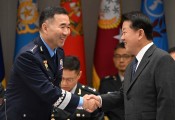

US President Donald Trump and South Korean President Lee Jae Myung are separated by thousands of kilometers, yet they share striking similarities. Both wield considerable executive authority, face weakened opposition forces and enjoy the backing of fervent supporters. Both have faced legal challenges, with criminal charges pending, though trials were largely suspended after they were elected. Each battled prosecutors during their campaigns and now seek to curb judicial power to advance their agenda. They both portray themselves as champions of the common people against elites and the establishment. In many ways, they are political doppelgangers — leaders with remarkably parallel traits.
Important differences remain. Trump hails from a wealthy family and built his career in business, benefiting from inherited fortune. Lee, in contrast, rose from poverty, becoming a lawyer through sheer determination. Trump, as a Republican, espouses conservative ideals of small government and free markets. Lee, from the Democratic Party of Korea, represents progressive policies favoring stronger government and expanded welfare. Yet despite their ideological differences, the two converge in how they view power, governance and communication.
Most notably, both presidents believe elected authority outweighs appointed authority. Since taking office in June, Lee has repeatedly emphasized that bureaucrats and other appointed officials must “respect” elected power because legitimacy originates from the people’s mandate. “There is a pecking order in power,” he declared during a press conference marking his first 100 days, placing elected leaders above all other institutions.
Lee has extended this reasoning to the judiciary. “The judiciary structure is not made by the judiciary branch,” he argued, insisting that courts must operate within frameworks created by the legislature. His Democratic Party has moved to reform the judiciary, contending that it remains aligned with the previous administration of Yoon Seok Yul, who was impeached and imprisoned for attempting martial law. Lee’s allies also seek to weaken prosecutorial power by dividing the Prosecution Service, claiming it has been prone to abuse.
Trump has long advanced a similar argument. From his first term, he alleged that unelected bureaucrats, intelligence agencies and federal officials formed a “Deep State” determined to undermine him. Investigations into his conduct by the FBI, Department of Justice and other agencies were, in his telling, politically motivated conspiracies. In his second term, his campaign against the Deep State intensified, featuring mass firings of top officials, abrupt reorganizations of federal agencies, and the placement of loyalists — including defense lawyers from his trials — into senior government posts.
Such moves in both Seoul and Washington may streamline policy execution, but critics warn of serious risks. By concentrating power in the executive, the delicate system of checks and balances — the backbone of democracy — can be eroded, inviting authoritarianism. This danger grows sharper when governing parties dominate legislatures and opposition forces are weak.
In Seoul, Lee’s ruling party and its allies hold nearly two-thirds of the National Assembly, commanding unusual legislative strength. The opposition People Power Party, reeling from Yoon’s failed martial law declaration, has seen its approval ratings collapse to about 24 percent, compared with 40 percent for the ruling party. In Washington, Republican control of both houses allows Trump to push forward with relatively few constraints. As more working-class voters abandon Democrats for Republicans, opposition voices grow thinner and more fragile.
Another shared trait is their hostility toward elites and established power centers in society.
Trump has lashed out at elite universities, threatening to cut federal grants. Lee has not attacked elite schools directly, but weakens their dominance by promoting graduates of non-elite universities. He also plans to elevate nine regional universities to the level of Seoul National University in a bid to reduce the top university’s outsized influence.
Both leaders also reject traditional military power sources. Lee appointed a defense minister without the usual background as a retired general; the chair of the Joint Chiefs is from the Air Force rather than the more powerful Army. Trump chose a defense secretary who had served in the National Guard and worked as a TV commentator.
Trump and Lee also share combative, direct communication styles. Both prefer blunt rhetoric over polished speeches and seek to bypass legacy media by engaging the public through direct channels. Trump has famously attacked outlets such as CNN and The New York Times as “enemies of the people,” preferring platforms like Twitter (currently X), and later his own Truth Social. Lee likewise gravitates toward independent outlets and social media channels friendlier to his agenda, avoiding the conservative legacy press. Both leaders follow and amplify the voices of influential online personalities — Trump with figures like Laura Loomer, Lee with commentators like Kim Eo-jun.
The origins of these similarities are unclear. One explanation may be institutional: Korea’s democratic system, shaped under US influence, mirrors aspects of American politics. Another lies in global trends — polarization, nationalism and populism push leaders to adopt similar tactics regardless of context.
Whatever the cause, the parallels are striking. The hope is that if these two doppelgangers continue to learn from one another, they borrow more of the good than the bad.
Lee Byung-jong
Lee Byung-jong is a former Seoul correspondent for Newsweek, The Associated Press and Bloomberg News. He is a professor at the School of Global Service at Sookmyung Women’s University in Seoul. The views expressed here are the writer’s own. — Ed.
khnews@heraldcorp.com