Lee’s Cabinet changes fall short of addressing
the policies driving his approval ratings down
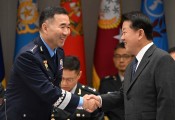
President Lee Jae Myung’s partial Cabinet reshuffle on Sunday appears to reflect his determination to restore the momentum of his administration, which has been weakening amid a recent decline in his approval ratings.
Most notably, the two top officials in charge of real estate policy, which has been a major source of public discontent, have been replaced. The Lee administration’s real estate policies so far, including punitive tax reforms and half-baked initiatives such as plans to develop Yongsan Park into a housing complex, have created considerable market turmoil. The simultaneous replacement of the finance and economy minister and the land, infrastructure and transport minister is being seen as a de facto reprimand.
In fact, Cheong Wa Dae bears the ultimate responsibility for real estate policy. Kim Yong-beom, the presidential policy chief, is the figure behind the punitive tax measures and housing supply policies that have caused confusion. He was also the target of calls for his dismissal from the opposition over the introduction of high-risk single-stock leveraged ETFs, which caused major turbulence in the stock market and led to losses for domestic investors.
Nevertheless, Kim Yong-beom remained in his post, while the two ministers stepped down. The nominees to succeed the ministers are vice ministers who served under the outgoing ministers, so the overall policy direction is unlikely to change.
It remains doubtful whether this cabinet reshuffle will lead to a government overhaul that the public can accept. Above all, the decision to nominate Kim Seung-won, a lawmaker from the Democratic Party of Korea, as justice minister has sparked intense controversy. Despite concerns and criticism from many members of the public, Kim Seung-won led the ruling bloc’s efforts to abolish the prosecution’s investigative authority.
Furthermore, he co-chaired a group of lawmakers calling for the withdrawal of indictments in cases involving President Lee. He also recently became a co-sponsor of a special counsel bill to investigate allegedly fabricated prosecutions, which the opposition argues the Democratic Party plans to use as a pretext for the indictment withdrawal.
The party has formally announced that it will push ahead with the legislation of the bill. The president is supposed to appoint the special counsel, but having the president appoint a special counsel with the authority to withdraw indictments in cases involving him is ultimately no different from having him appoint the judge who will preside over his own cases.
As if that were not enough, he nominated as justice minister someone who had called for the withdrawal of indictments against him. This amounts to putting in place a dual mechanism for withdrawing indictments, one through the special counsel and the other through the Ministry of Justice. Lee's decision to appoint such a person as justice minister can only be interpreted as a message to take a more active role in seeking the withdrawal of indictments in his cases.
Recent opinion polls are sending a strong warning to the entire ruling camp. A Gallup Korea poll released on Friday showed that Lee's job approval rating had fallen to 42 percent, its lowest level since he took office. In particular, public discontent over the Lee administration’s real estate policy is pronounced.
The recent tax measures have sparked backlash for being punitive and effectively restricting freedom of residential choice, as they would raise the comprehensive real estate tax burden not only on owners of high-priced homes but also on single-home owners who do not live in their homes, while sharply reducing the long-term holding deduction for capital gains tax.
Lee's falling approval rating is due to policies that are heightening public anxiety. This is the cumulative result of one-way governance, an us-versus-them approach, legislative overreach, and the repeated disregard of risk warnings, among others. Without a fundamental shift in policy direction, personnel changes alone are unlikely to revive his approval ratings.
khnews@heraldcorp.com