Expectations are rising that South Korean defense firms will emerge as key beneficiaries of Europe’s expanding defense spending, with much of the optimism attributed to the country’s proven capacity to meet NATO’s surging procurement demands.
Speaking Thursday after returning from the NATO summit in The Hague, national security adviser Wi Sung-lac said, “With NATO moving to raise its defense spending from around or even below 2 percent to 5 percent of GDP (gross domestic product), demand is bound to surge — and that means there’s significant room for cooperation. South Korea is one of the few countries capable of meeting that growing demand.”
Wi attended the summit on behalf of President Lee Jae Myung, delivering Lee’s letter expressing Seoul’s strong commitment to deepening defense industry cooperation with the alliance. NATO Secretary-General Mark Rutte welcomed the message and reaffirmed NATO’s willingness to strengthen ties with South Korea, according to Wi.
The strengthening of ties between South Korea and NATO came amid the trans-Atlantic alliance’s broader efforts to boost defense spending to historic levels.
At the summit in The Hague, NATO members adopted a joint communique agreeing to raise defense budgets to 5 percent of gross domestic product by 2035, more than double the alliance’s previous 2 percent guideline.
Of the new target, 3.5 percentage points will go toward traditional defense expenditures such as weapons procurement and personnel, while the remaining 1.5 percentage points will support military infrastructure, including cyber defense, logistics and artificial intelligence-enabled systems.
According to the International Institute for Strategic Studies, European defense spending climbed 11.7 percent year-on-year to $457 billion in 2024. If the 5 percent NATO target is met, that figure could surge to $800 billion — vastly expanding the market for suppliers like South Korea.
One expert noted South Korea is already well-placed to take advantage of NATO’s growing defense spending, attributing this to its long-standing military investments — widely seen as a response to persistent security threats from North Korea.
“Unlike many countries that scaled back military investment after the Cold War, South Korea has continuously built up its capabilities,” said an analyst at the Korea Institute for Defense Analyses, who declined to be named.
“That long-standing commitment has resulted in field-tested, export-ready systems — giving Korean firms a clear edge in responding to Europe’s urgent defense needs.”
Local defense firms are also viewing Europe’s expanded defense budgeting as a major opportunity to scale up exports and solidify their foothold in the region, while saying South Korea's defense industry is capable of doing so.
“South Korea’s strength lies in its mass production capabilities. It will likely take European manufacturers four to five years to rebuild that level of capacity, so this spending increase represents a major opportunity for us,” said an official at a Korean defense firm.
According to the official, South Korean firms are well-prepared to meet the surge in demand, thanks to ongoing efforts to localize production in response to increased demand following Russia’s invasion of Ukraine.
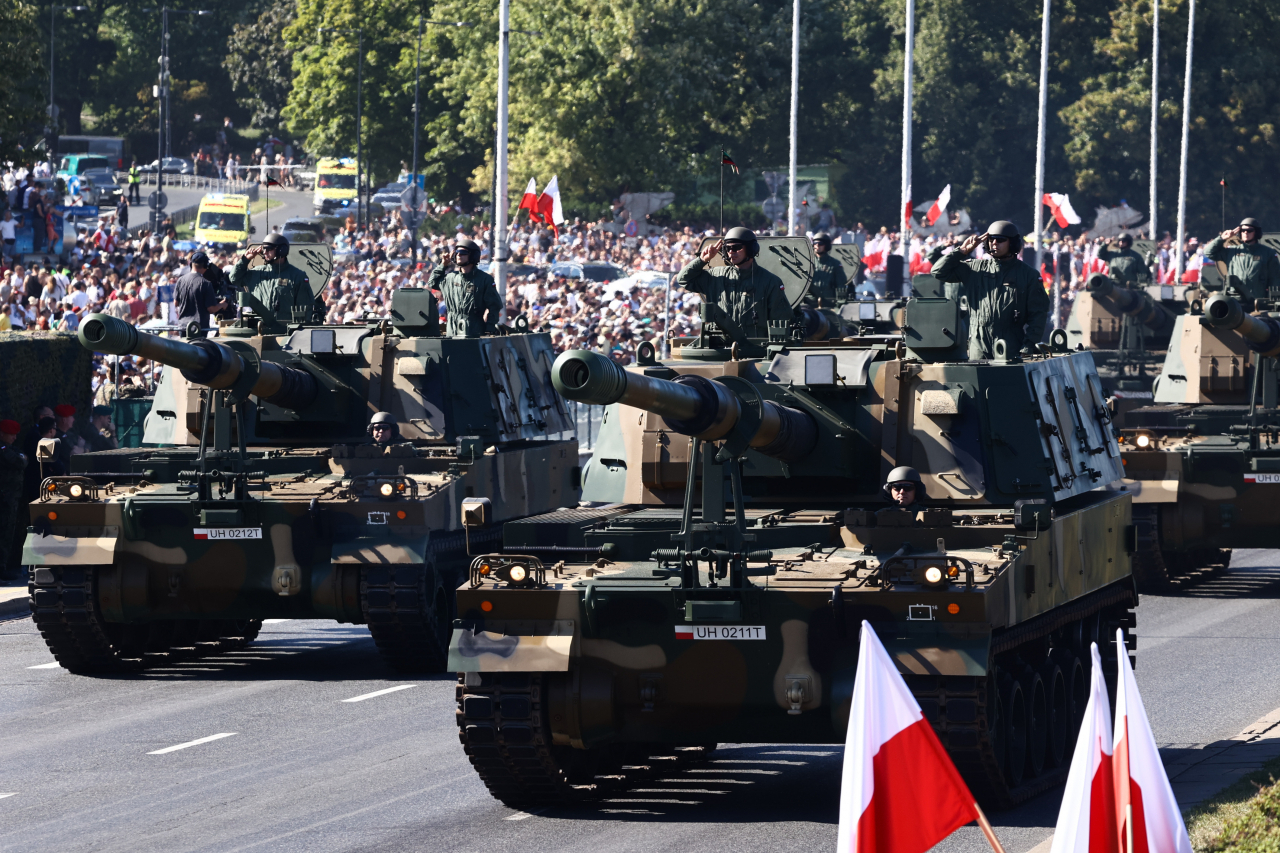
Hanwha Aerospace, for example, is expanding artillery exports and building production lines in Poland and Romania, LIG Nex1 is preparing to open its first European office in Germany and Hyundai Rotem is nearing a $6 billion deal with Poland to supply 180 additional K2 tanks.
Riding on the uptrend in defense exports, South Korea and NATO agreed this week to create a bilateral consultative body to facilitate regular dialogue on defense industry cooperation.
Wi said the new platform will support greater interoperability through defense standardization and enable deeper coordination in NATO’s High-Visibility Project — a multilateral initiative for the joint development and procurement of next-generation capabilities.
“If we achieve a higher level of standardization, it will create a better environment for exports and deeper cooperation,” Wi said. “The new consultative body aims to accelerate this process.”
flylikekite@heraldcorp.com