Korea Herald correspondent
TALLINN, Estonia — For Estonian defense companies seeking deeper ties with South Korea, one of their selling points is something money alone cannot easily buy: experience.
“The lessons learned, lessons identified from Ukraine, it is something that is measured in gold right now,” said Marko Kaseleht, founder of Estonian battlefield intelligence company SensusQ.
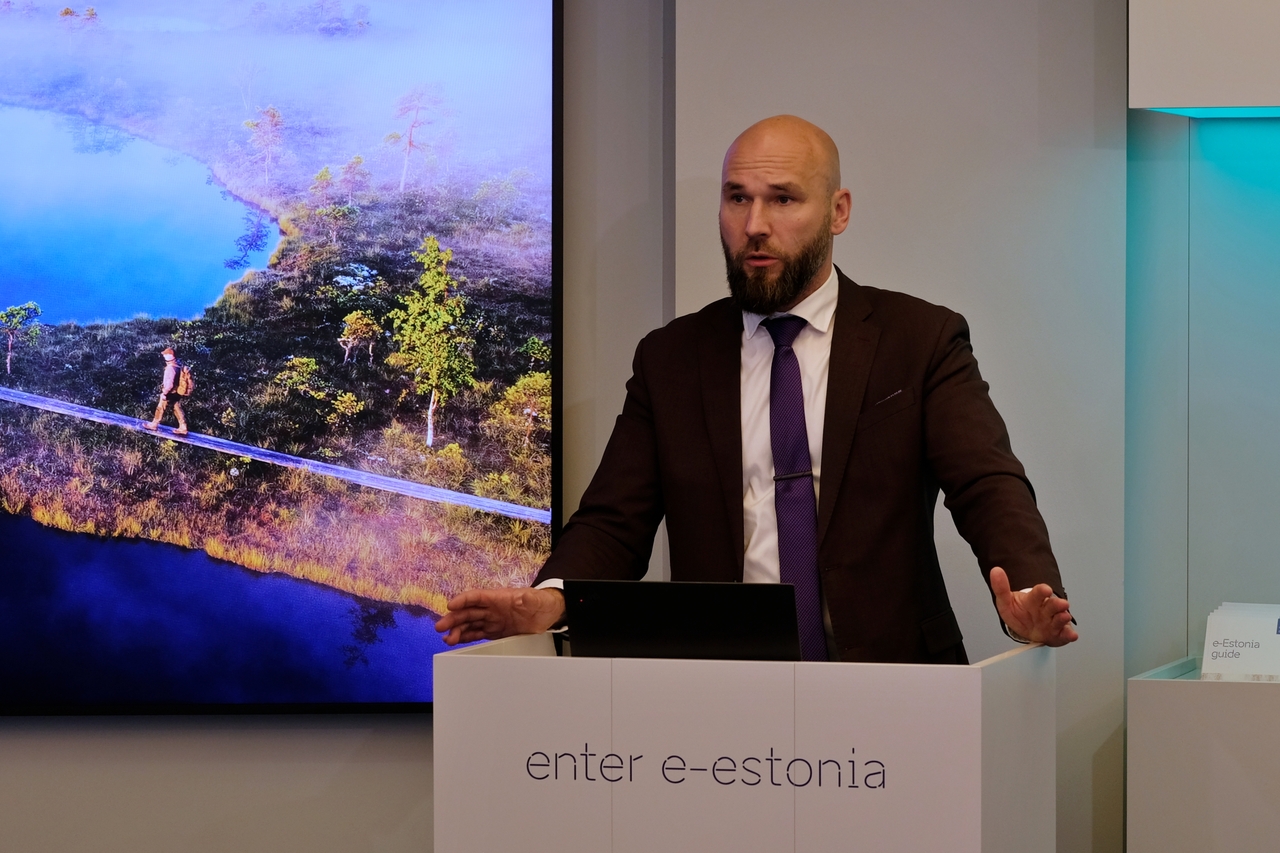
“Getting feedback, understanding how your adversaries are collaborating, all that is something that everybody is after,” he told South Korean reporters Wednesday at the headquarters of Enterprise Estonia, or EIS, in Tallinn.
Kaseleht, who spent 15 years in the Estonian Defence Forces before entering the defense industry, also serves as senior vice president for defense at Nortal, an Estonian software and digital transformation company.
Since Russia launched its invasion of Ukraine in 2022, Estonia, which shares a border with Russia, has developed close defense ties with Kyiv. Estonian companies have supplied technologies to Ukraine and used feedback from the battlefield to update their products as threats and tactics evolve.
Kaseleht said some of the most valuable lessons involve unmanned systems.
“I think the most important knowledge that they currently have is everything related with unmanned aerial and unmanned ground systems. Not only the offensive but the defensive part as well,” he said.
Significance for Seoul
That experience carries particular relevance for South Korea as North Korean troops and weapons have become involved in Russia’s war.
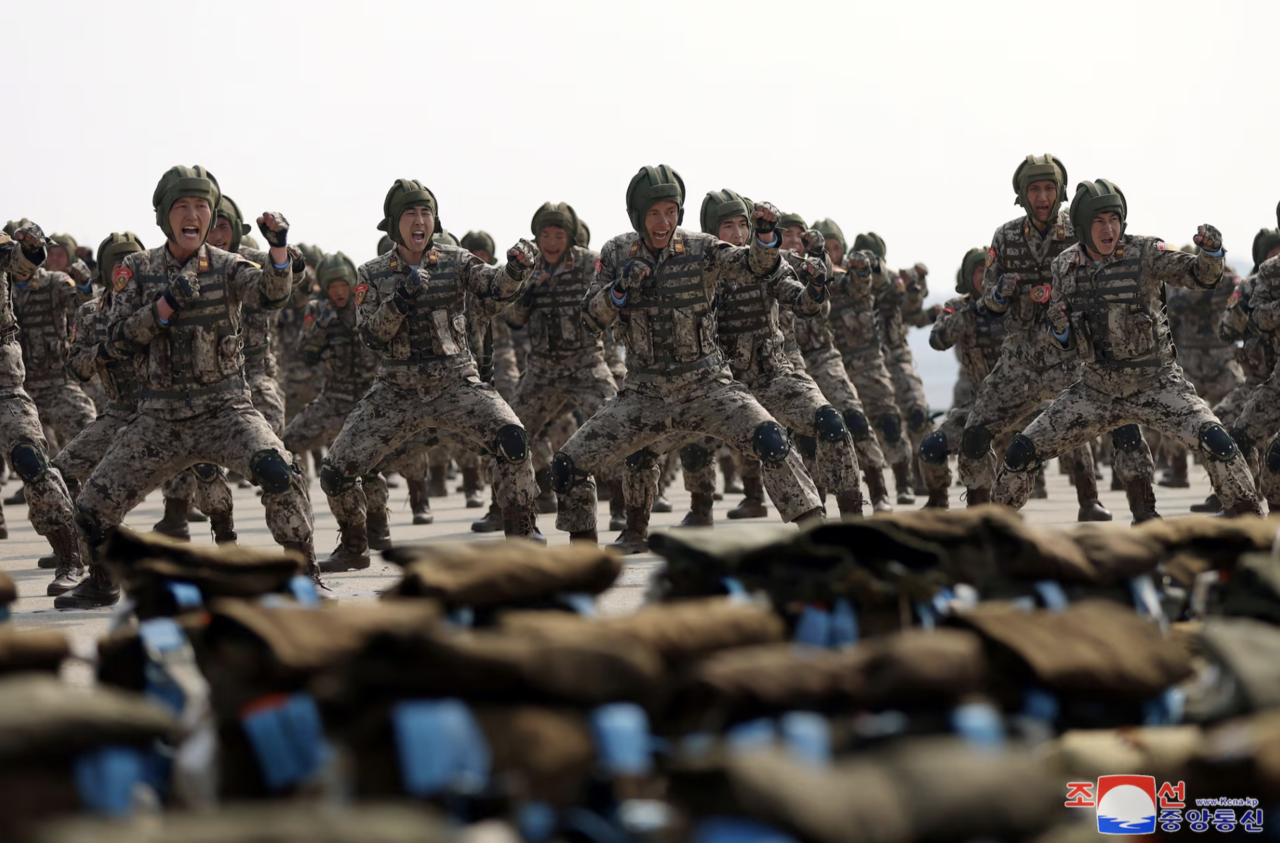
South Korean military and intelligence authorities estimate that North Korea has deployed roughly 14,000 to 15,000 troops to support Russia since late 2024. According to reports, North Korean troops adapted their tactics after initially suffering losses to Ukrainian first-person-view drones; a captured North Korean soldier said his unit had used Russian-supplied anti-drone jamming equipment.
Kaseleht argued that the transfer of wartime knowledge could pose a concern for Seoul.
“Everything that Russia is doing potentially will land on North Korea’s knowledge base,” he said, referring to lessons from hybrid warfare and other battlefield scenarios.
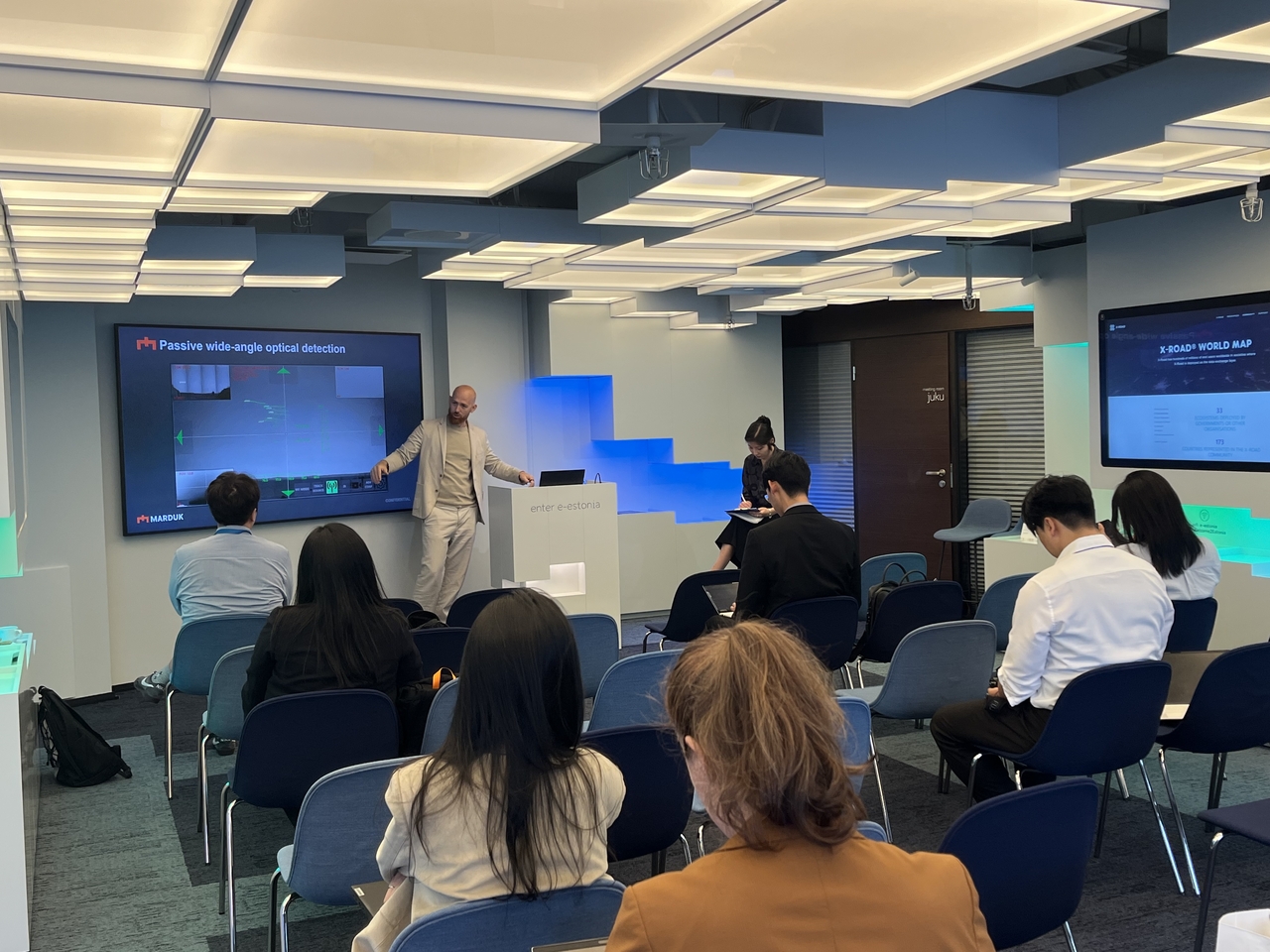
Marduk Technologies, an Estonian counter-drone company, is exploring how such knowledge-sharing could work with South Korean partners.
Rauno Lember, the company’s chief operating officer, said Marduk continually updates the software behind its drone-detection systems to recognize new Russian, Chinese and North Korean models appearing over Ukraine.
“If the cooperation fully gets underway, the sharing of knowledge and data will naturally take place,” Lember said of potential cooperation with South Korean companies. “That’s our business logic,” he said.
Still, such sharing is not entirely up to the companies themselves.
Rene Ehasalu, cluster manager at the Estonian Defence and Aerospace Industry Association, pointed to European Union rules on technology transfers and sensitive information, as well as Estonia’s export licensing process.
Nonetheless, he said battlefield experience accumulated by Estonian companies in Ukraine could be shared if joint research, development or capability-building projects with Korean companies materialize.
“Honestly, there has so far been no precedent in which the government directly intervened or put the brakes on technology or information sharing between private companies,” Ehasalu said.
Estonia’s defense buildup
What may sound like a somewhat assertive push for closer ties comes as Estonia ramps up defense spending and expands its defense industry.
Estonia is spending 2.4 billion euros ($2.75 billion) on defense this year, equivalent to 5.4 percent of gross domestic product and up 42 percent from 2025. More than half of the budget is earmarked for procurement, while Tallinn plans to keep defense spending above 5 percent of GDP in the coming years.
The country’s defense industry recorded turnover of 730 million euros in 2025, including 450 million euros in exports, and is targeting 2 billion euros by 2030.
For Estonian companies, South Korea offers something Europe increasingly lacks: the ability to manufacture weapons at scale and deliver them quickly.
Kaseleht said European defense manufacturers are struggling with production bottlenecks as orders pile up years in advance.
“The Korean defense industry, and overall industry, is extremely strong at platforms, production and scale,” he said, also highlighting South Korea’s ability to deliver systems quickly.
Hanwha Aerospace has been the most visible example of that defense relationship.
The company has exported K9 self-propelled howitzers to Estonia, while Tallinn has also contracted for nine Chunmoo multiple rocket launchers. The first six were ordered in late 2025, with three additional systems ordered in May this year.
Kaseleht said such cooperation should go beyond individual arms sales.
“Let’s not look at this as a supplier-customer relationship,” he said. “It’s much more.”
Hanwha signed a memorandum of understanding with Nortal and SensusQ in September 2025 to jointly develop a next-generation battlefield management system, including for platforms such as the Redback. It has also signed a separate agreement with Marduk on counter-drone cooperation.
Other Korean defense companies are pursuing opportunities in Estonia as well. HD Hyundai Heavy Industries and Hanwha Ocean, part of Hanwha Group, are among four companies competing for Estonia’s planned acquisition of new naval vessels, alongside Sweden’s Saab and Estonia’s Baltic Workboats.
NATO gateway
Another potential benefit is access to the broader European and NATO ecosystem by adapting Korean systems to European and NATO standards.
Kaseleht said the two countries’ strengths could complement each other in that process, with South Korea strong in weapons platforms, manufacturing scale and delivery, and Estonia specializing in software, data and cybersecurity.
“So if we put Korean platforms together with NATO-interoperable software layers that are built in Estonia, we actually get products that are ready for EU and NATO markets,” he said.
“It’s much more. It’s an opportunity for both countries to develop something that doesn’t exist worldwide.”
When asked whether integrating Korean defense systems with Estonian technology could help them fit into the wider NATO ecosystem, Rannar Park, head of business engagement at the e-Estonia Briefing Centre under EIS, said shared NATO standards could make interoperability more important than the origin of individual technologies.
“It doesn't matter if the technology is Estonian, Korean or somewhere in between,” Park said. “Rather, it's NATO technology. It's defense technology that can benefit all sides.”
The concept is not entirely theoretical. Estonia has already modified communications and control equipment on its K9 howitzers to fit its operational environment, and a similar process is expected as the country introduces Chunmoo.
South Korea is also moving in the same direction. In August, the Defense Acquisition Program Administration, the country’s state arms procurement agency, introduced its first formal guidelines allowing Korean defense companies to obtain NATO standards, aimed at improving interoperability and helping them compete in NATO markets.
Russia factor
There is, however, a geopolitical limit to how closely Seoul can embrace the Estonian proposition.
For Estonia, Russia is the immediate military threat and support for Ukraine is closely tied to its own national security. For South Korea, the calculation is more complicated.
A Seoul official, speaking on condition of anonymity due to the sensitivity of the issue, said South Korea could not simply disregard its relationship with Moscow, which remains a factor in security on the Korean Peninsula, including the North Korean nuclear issue.
The official said Korean companies should first show that they understand Estonia’s security concerns before focusing on arms sales.
Kaseleht sees the calculation differently.
He argued that Russia’s expanding military cooperation with North Korea has already changed the strategic environment facing South Korea.
“South Korea shouldn’t be afraid to establish a better and stronger dialogue, both political and business, with Ukrainians,” Kaseleht said. “That is only going to help you.”
He added that closer engagement with Ukraine would not necessarily have to mean supplying lethal weapons, pointing to medicine, protective equipment and generators as other possible forms of support.
Asked whether additional formal arrangements were needed to deepen cooperation, Kaseleht said existing mechanisms were sufficient.
“The framework exists,” he said. “What we’re lacking, we’re lacking actual projects, actual programs.”
Wednesday’s session was arranged by Enterprise Estonia for South Korean reporters visiting Tallinn as part of the Korea Press Foundation’s “2026 KPF Diploma Program: Security in the AI Era.”
flylikekite@heraldcorp.com