

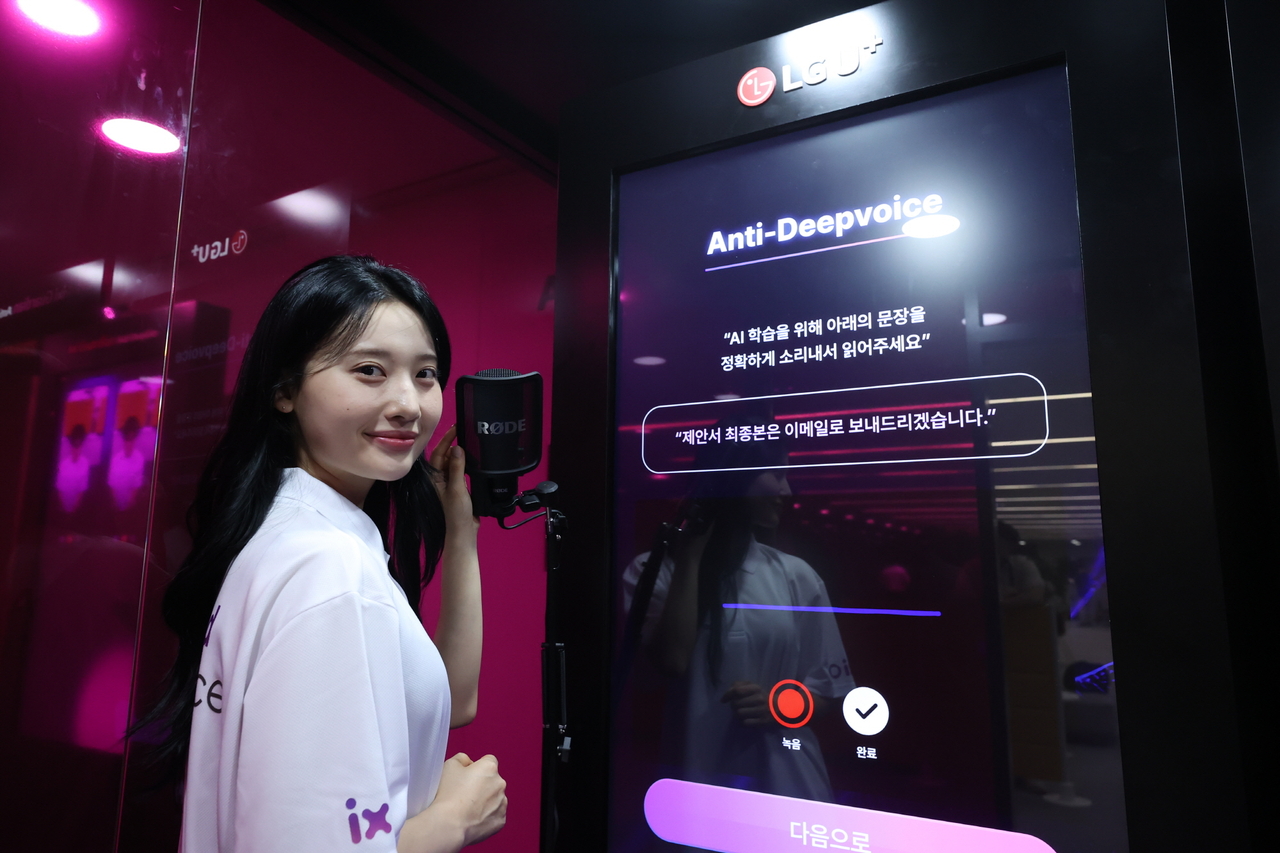
LG Uplus on Thursday announced the commercial rollout of its proprietary anti-deepvoice technology, capable of detecting artificial intelligence-generated spoofed voices, within its AI agent service, ixi O.
The Korean telecom operator said the rollout, set for Monday, marks the first time in the world such technology has been deployed in an on-device format, in which sensitive user data such as voice information is stored exclusively on the user’s smartphone rather than in the cloud. The approach is designed to enhance privacy and prevent data leaks.
The anti-deepvoice system detects fraudulent voices by identifying unnatural phonetic patterns and abnormal audio frequency fluctuations -- common indicators of manipulated or AI-synthesized voices.
The underlying detection engine incorporates LG Uplus’ voice activity detection, speech-to-text, and anti-spoofing analysis technologies. The company also focused on optimizing the system to be lightweight, enabling smooth performance even on mobile devices.
In addition to audio, the firm has also developed anti-deepfake technology capable of identifying AI-generated facial imagery. The solution, being optimized for on-device use, detects inconsistencies in texture, frame coherence and pixel-level patterns that are often imperceptible to the human eye but indicate visual tampering.
The company plans to expand the scope of this technology to detect and automatically blur or block harmful or manipulated images, giving users control over exposure settings.
“Through differentiated security technology, LG Uplus aims to become the mobile carrier most committed to AI safety,” said Jeon Byoung-ki, senior vice president of the AX technology group. “Our goal is to deliver real value by ensuring that AI contributes to a safer everyday life.”
The company's AI agent service ixi O is also being upgraded to preemptively block voice phishing threats throughout all stages of a call -- before, during and after. In August, LG Uplus plans to launch an AI-powered call agent that screens suspicious or spam calls on behalf of users.
Further upgrades in development include a pre-call AI phishing number detector and a voiceprint recognition system that identifies known scammers. The latter is undergoing approval through the Ministry of Science and ICT’s regulatory sandbox program and is slated for release in the fourth quarter.
In collaboration with financial institutions, LG Uplus also plans to roll out a real-time phishing alert system by the end of the year.
Moreover, ixi O will soon include features to identify and block communication-based threats such as digital stalking, verbal abuse and misinformation during live calls.
Expansion to global markets and partnerships with platforms like Naver and Kakao for deploying deepvoice and deepfake detection capabilities are also being considered.
yeeun@heraldcorp.com