

Critics argue pledge may disrupt privatization without offering clear gains
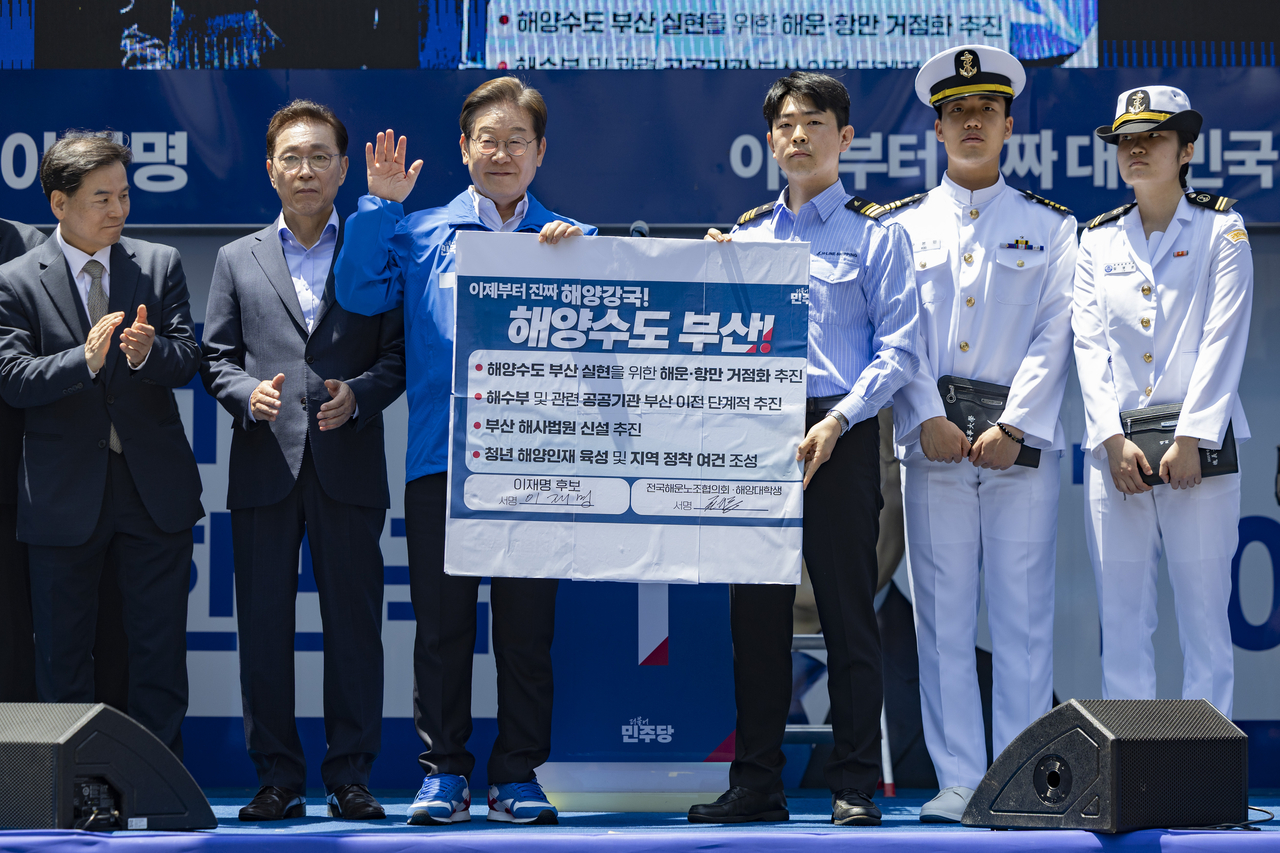
HMM, Korea’s largest shipping company formerly known as Hyundai Merchant Marine, has become a key issue in the presidential race next month, after front-runner Rep. Lee Jae-myung of the Democratic Party of Korea pledged to relocate its headquarters to Busan.
While the company already conducts its core shipping operations out of Busan Port, its headquarters, responsible for management, sales and finance, has been operating in Yeouido, western Seoul.
Announced during a campaign stop in Busan on May 14, the plan is part of Lee's broader push to make Busan the "maritime capital of Korea," mainly by moving marine-related government agencies, despite HMM being a private company.
“I will relocate HMM to Busan,” the candidate said. “When relocating a company, securing employee approval is often the biggest hurdle. But I’ve heard that employees agreed.”
However, Lee's pledge has sparked controversy over its legitimacy and feasibility, revealing notable challenges to its realization.
Government ownership or overreach?
“It won’t be easy since it’s a private company, but it’s not impossible if (the president) makes the decision, given the government’s shareholding,” Lee Jae-myung said in Busan.
More than 70 percent of HMM’s shares listed on the Kospi, Korea’s main bourse, are held by state-run entities — 36.02 percent by the Korea Development Bank and 35.67 percent by the Korea Ocean Business Corp.
“Other shareholders or some board members may raise objections (if the relocation becomes a reality), but if the government pushes strongly, it could still go through,” said Hwang Yong-sik, a business administration professor at Sejong University.
Complicating matters, KDB and KOBC are seeking a new owner for HMM.
Their control of HMM began in 2016 as part of a bailout for the company, which was on the brink of collapse.
Since then, the company has grown to become the world’s eighth-largest container shipping line, posting 11.7 trillion won ($8.53 billion) in sales last year. Public shareholders are now looking to recover funds invested during the bailout.
The most recent attempt to sell HMM fell through in February 2024, but KDB Chair Kang Seog-hoon said at an April press conference, “We are seriously considering selling our stake in HMM to maintain KDB’s financial soundness.”
Against this backdrop, Lee Jae-myung’s relocation pledge has sparked concerns that the move could constrain a future owner’s operational flexibility, creating an obstacle to the sale of KDB and KOBC’s shares.
Lee Jun-seok, the presidential candidate from the minor New Reform Party, criticized Lee Jae-myung’s pledge, saying, “The government’s electoral pledges should not add uncertainty to the fate of a specific company."
"While HMM is effectively under government ownership, its location should be determined by where the company can achieve the best performance.”
Echoing these concerns, professor Hwang said the pledge should come only after clarifying whether the government intends to retain ownership of the company. “It adds a layer of complexity to an already difficult acquisition decision,” he said.
“Forcing an uncertain move that could affect the company’s performance, the relocation may change HMM’s financial structure and overall value. Given that HMM is up for sale, is this the right step to pursue?”
No push, but little pull for HMM move
Despite Lee Jae-myung’s comment on employee support, opinions within HMM appear to be divided.
Among the company’s two unions, one representing sailors has been in talks with the Busan Chamber of Commerce and Industry to support the relocation since last year. However, the other union, representing employees at the headquarters, denied agreeing to the plan following Lee’s announcement.
A Democratic Party official told The Korea Herald that the cited support reflected the sailors’ union’s general intent to cooperate, contingent on factors like the relocation of related maritime agencies.
The official added that the party has no intention of forcing the move, but rather aims to encourage voluntary relocation to Busan.
However, experts say that under current circumstances, HMM has little incentive to relocate voluntarily due to the potential operational strain.
“HMM’s cargo clients, partners and even competitors are based in Seoul, or their overseas staff visit HMM via Incheon Airport for business meetings,” said Koo Kyo-hoon, an international logistics professor at Baewha Women’s University.
“The relocation might work if all necessary infrastructure and business functions moved to Busan at once, but that’s simply not the case today.”
Some also point out that the potential benefits of relocation remain unclear, while the costs are more evident, especially as about half of HMM’s 1,890 employees were based in Seoul as of the end of last year.
“Some possible benefits can be anticipated, such as closer collaboration among different departments to create synergy,” Hwang clarified. “However, these benefits must be weighed against the costs that relocation will incur, such as constructing new facilities.
"It is clear the relocation is intended to benefit Busan, but proponents must also clearly demonstrate how it would serve HMM’s interests. Reaching a convincing conclusion will not be easy."
forestjs@heraldcorp.com


![[World Class] HUFS bets on Songdo, AI to redefine what a global university can do](https://wimg.heraldcorp.com/news/cms/2026/10/18/news-p.v1.20260930.7e4dbeacfc1d4d16848c0e2a441c04e6_R.jpg?type=h&h=120)
