
The usual year-end boost in spending in the private sector this year appears to have not been so prominent, as credit card spending this month was found Sunday to have been even less than in November, possibly linked to the recent political turmoil on the coattails of President Yoon Suk Yeol's ill-fated Dec. 3 martial law declaration.
Nationwide sales during the period of Dec. 1-20 via Shinhan Card, KB Kookmin Card, Samsung Card and Hyundai Card were a combined 28.2 trillion won ($19.1 billion), according to data submitted to Rep. Kim Hyun-jung of the main opposition Democratic Party of Korea. The combined figures for the four major credit card companies for the period was down 2 percent compared to 28.8 trillion won in the first 20 days of November.
December's numbers marked a slight increase (2.5 percent) compared to the same period last year, which credit card officials noted is due to ongoing inflation in the country. Consumer prices in South Korea saw an accumulated 2.3 percent increase from January to November this year, according to Statistics Korea.
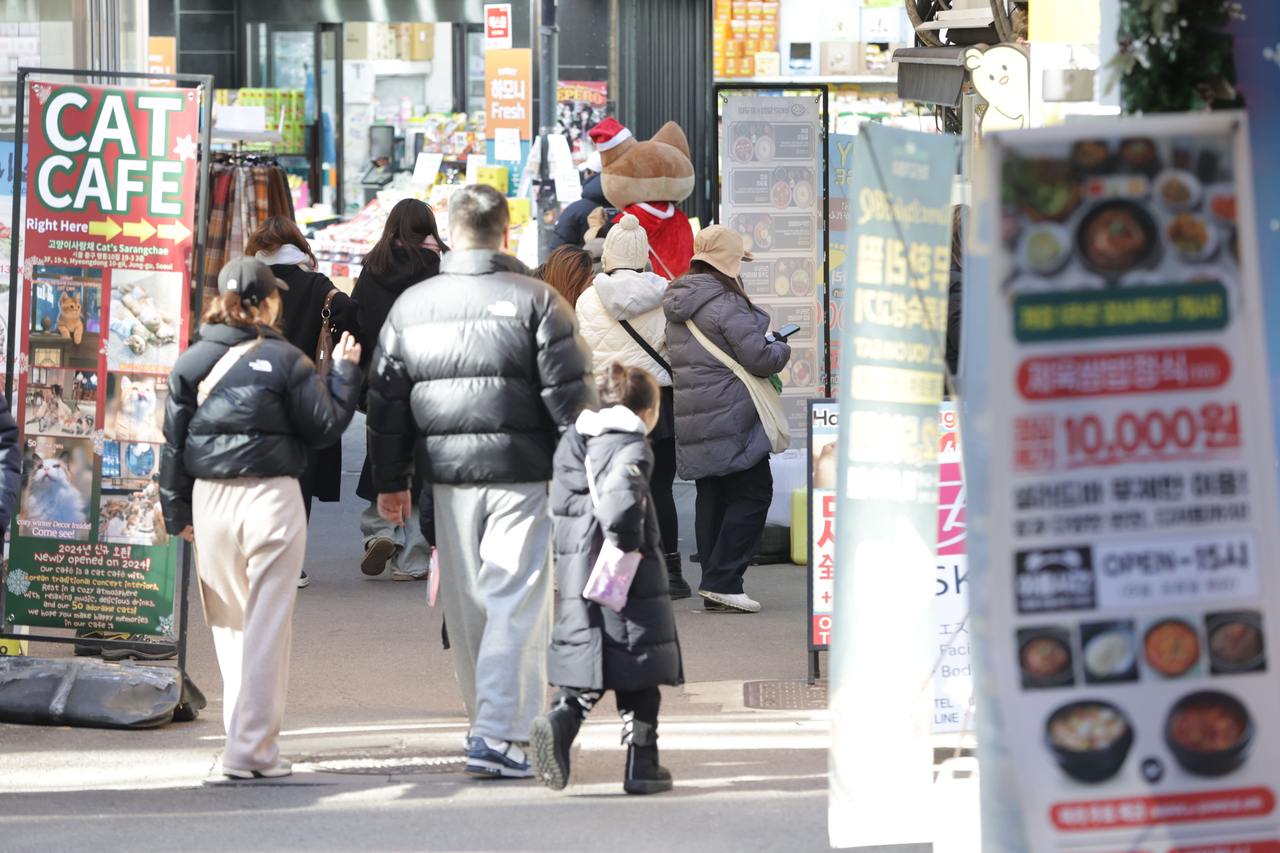
An overall drop in spending at restaurants was observed, due to a social trend of avoiding year-end meetings in light of the recent political situation. Yoon's short-lived martial law was followed by his impeachment on Dec. 14 and a series of protests, which have been held at a national scale particularly on Saturdays.
KB Kookmin Card users spent 711 billion won at restaurants and grocery stores in the December period, which marked a 4 percent drop compared to 740.5 billion won in the same period November. It was also less than 716.7 billion won for the same period in 2023.
Samsung Card's users spent 576.3 billion won at restaurants in that period, which was less than both the 601 billion won in November and 601.3 billion won in December of last year.
Spending for rest of the retail industry went up for most credit card companies. This included Shinhan Card users spending 208.8 billion won at department stores, which was up 4.7 percent compared to last month and up 3.1 percent compared to the same period last year.
This is thought to be related to buying gifts for Christmas and year-end festivities.
But ongoing uncertainties across the country have seen Koreans shying away from spending for the most part. The Bank of Korea last week announced the Composite Consumer Sentiment Index for December came to 88.4, marking a drop of 12.3 points from the previous month.
It marked the steepest drop in the CCSI since October 2008, which dropped 12.6 points compared to the previous month due to troubles stemming from the 2008 financial crisis. A CCSI figure that is below 100 means a worse consumer sentiment compared to the recent 20-year average of 2003 to 2023.
minsikyoon@heraldcorp.com
![[World Class] HUFS bets on Songdo, AI to redefine what a global university can do](https://wimg.heraldcorp.com/news/cms/2026/10/18/news-p.v1.20260930.7e4dbeacfc1d4d16848c0e2a441c04e6_R.jpg?type=h&h=120)