Science and technology ministers and experts started discussions on ways to sustain growth through technology innovation during a global science summit that opened in Daejeon on Monday.
Also on the agenda are steps needed to iron out imminent global issues, such as climate change and infectious diseases, through science and technology.
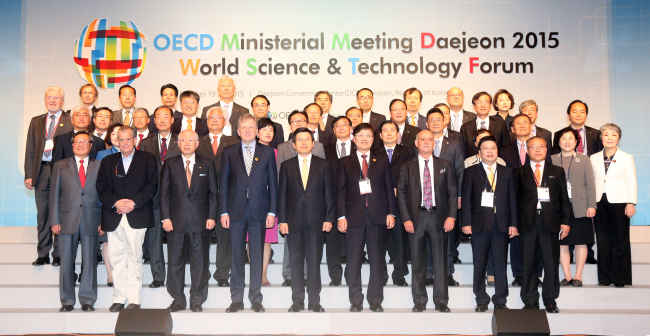
The science summit, composed of the OECD Ministerial Meeting Daejeon 2015 and World Science and Technology Forum, kicked off for a five-day run in the nation’s tech hub city.
In his opening speech, Korean Prime Minister Hwang Kyo-ahn pledged that the Korean government would make contributions to the growth of the global science and technology sectors by actively collaborating with other nations, utilizing its scientific and technological capabilities.
“Korea now has a competitive edge in a range of industries, including semiconductor, petrochemicals, shipbuilding, and nuclear energy, gained through scientific and technological advances,” Hwang said.
He also underscored the importance of collaboration between governments, academia and private sectors to deal with a number of tasks, including climate change, limited natural resources and infectious diseases.
The prime minister said Korea could play an important role in bridging the gap between the advanced and less-developed nations, emphasizing that the country had not spared any efforts to nurture scientists and researchers when it was suffering from social turmoil.
“Korea built the Daeduk Science Town in Daejeon when Korea’s GDP per capita stood at just $400 in 1973 and it has now became a science powerhouse in the world,” he said.
Korean Science and ICT Minister Choi Yang-hee said in his opening speech that the Korean government’s creative economy policy that puts emphasis on creating new markets through new ideas and innovation would serve as an exemplary economic model for other nations which need a new driving force for their economies.
The government is currently running 17 creative economy centers across the nation with Korea’s major conglomerates to help create a business environment that promotes innovation. The ministry and the big businesses also run support programs for start-ups in the local areas through the innovation centers.
Speakers at the opening ceremony also urged the governments, academia and private sector to make concerted efforts to achieve sustainable growth and innovation through science and technology.
The keynote speakers included Noyori Ryoji, recipient of the 2001 Nobel Prize in Chemistry; Aaron Ciechanover, professor of tumor and vascular biology research center; and Jeremy Rifkin, the founder of Foundation on Economic Trends.
Calling the technological advances ― 3-D printers, big data and smartphones ― of the current digital era a “remarkable leap forward,” Rifkin said such technologies will help boost the efficiency of economic productivity and reduce marginal cost to nearly zero.
He also warned of the “dark sides” of technological development, including cyberterrorism and identity theft.
The Korea Institute of Science and Technology Evaluation and Planning, a government affiliate research institute, also held a discussion session with the theme of science technology and innovation policy and R&D on the same day.
By Kim Young-won ()
wone0102@heraldcorp.com