Budapest (AFP) ― Balazs Mikusi’s heart started racing when he realized what the papers he held in his hand were: the long-lost original score of a famous Mozart sonata scribbled by the composer himself.
“When I first laid eyes upon the manuscript, the handwriting already looked suspiciously ‘Mozartish’,” said Mikusi, head of the music collection at Budapest’s National Szechenyi Library.
“Then I started reading the notes, and realized it is the famous A Major sonata ... My heart rate shot up,” he told AFP as he proudly showed off his precious discovery.
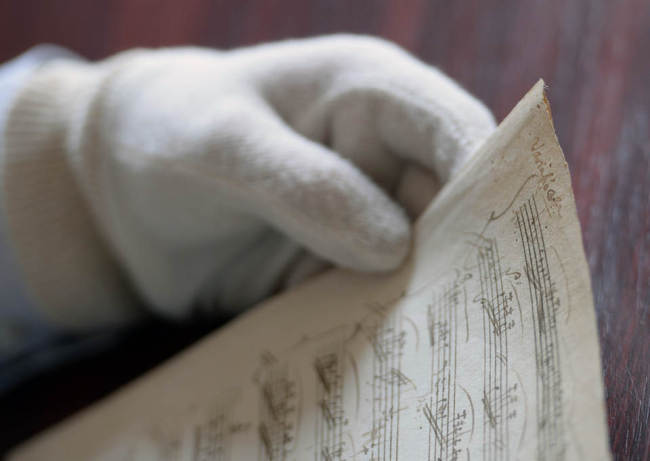
The four yellowed pages that Mikusi found in a dark corner of the library earlier this year were nothing short of a sensation.
How they came to be there is a bit of a mystery.
The Piano Sonata No. 11 in A Major (K.331) happens to be very widely known, its soothing and sublimely relaxing opening melody instantly recognizable.
“This is one of the best known Mozart pieces,” said the music historian Adam Bosze.
“Along with ‘Eine Kleine Nachtmusik’ or the first movement of the G minor symphony, the tune of the Turkish March (the final movement of the sonata) is Mozart’s best-known melody.
“Every kid knows how to whistle it,” he said.
The sonata was written around 1783. Like most of Wolfgang Amadeus Mozart’s works, the score was then copied down.
But the original manuscript was thought to be lost, with only one surviving page preserved in Salzburg, where the master was born.
“It is very rare that a Mozart manuscript pops up. Moreover the A Major Sonata had no known manuscript, so it is a really big discovery,” said Bosze.
The manuscript was revealed to the public on Friday evening at the National Szechenyi Library with Hungarian pianist and conductor Zoltan Kocsis playing the sonata.
And to the trained ear, a few differences are noticeable from the version known to the world, with a few tiny modifications in notes and rhythm.
“It won’t change our view on Mozart, and it doesn’t change the character of the music, but we get a lot better sense of what Mozart wanted to achieve,” said Mikusi.
The bespectacled and animated Mikusi, 42, originally an expert not in Mozart but in fellow composer Joseph Haydn, joined the National Szechenyi Library in 2009.
His mission for the past five years, he says, has been to “look into every dark corner”, painstakingly going through the many hundred folders of uncategorized manuscripts gathering dust.
“I wasn’t looking for Mozart, but it wasn’t accidental either that I found it,” he says.
To verify what he had found, he cross-checked it with the surviving page in Salzburg and sent photos to Mozart experts around the world. They confirmed it to be genuine.
Mozart (1756-1791) is not believed to have ever set foot in Hungary.
koreaherald@heraldcorp.com