CAPE CANAVERAL, Florida (AP) ― Mars, get ready for another visitor or two.
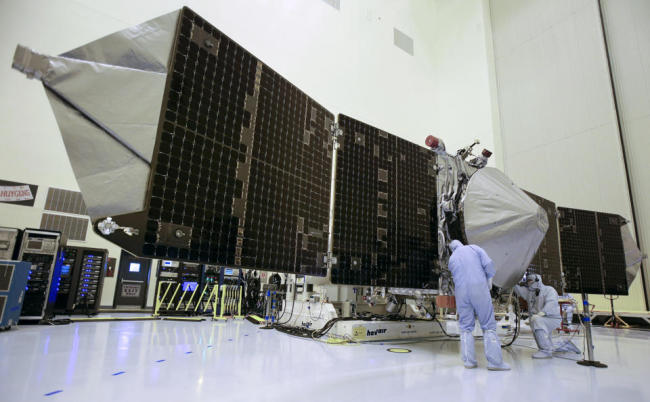
This weekend, NASA’s Maven spacecraft will reach the Red Planet following a 10-month journey spanning 900 million kilometers. If all goes well, the robotic explorer will hit the brakes and slip into Martian orbit Sunday night.
“I’m all on pins and needles. This is a critical event,” NASA’s director of planetary science, Jim Green, said Wednesday.
Maven is not designed to land; rather, it will study Mars’ upper atmosphere from orbit.
Hot on Maven’s heels is India’s first interplanetary spacecraft, Mangalyaan, which is due to go into orbit around Mars two days after Maven.
Scientists want to learn how Mars went from a warm, wet world that may have harbored microbial life during its first billion years, to the cold, barren place of today. Maven should help explain the atmospheric changes that led to this radical climate change.
“Where did the water go? Where did the carbon dioxide go from that early environment?” said chief investigator Bruce Jakosky of the University of Colorado’s Laboratory for Atmospheric and Space Physics in Boulder.
These escaping gases likely went down into the Martian crust and up into the upper atmosphere and out into space. Jakosky and his team hope to ascertain whether the climatic about-face resulted from the sun’s stripping away of the early atmospheric water and carbon dioxide.
“We measure these things today even though the processes we’re interested in operated billions of years ago,” he said.
NASA launched Maven from Cape Canaveral last November on the $671 million mission, the first dedicated to studying the Martian upper atmosphere. As of Wednesday, the spacecraft was inching toward its destination; Maven’s view of the Red Planet would be roughly equivalent to a baseball about 16 meters away.
“So Mars is really growing right now as we approach, just four days away,” said David Mitchell, NASA project manager.
The boxy, solar-winged craft is as long as a school bus and as hefty as an SUV. NASA expects a scientific bonus from Maven thanks to Comet Siding Spring. The nucleus of the comet, discovered just last year, will pass within 132,000 km of Mars on Oct. 19. NASA initially feared the trailing comet dust might jeopardize Maven, but the risk now appears to be minimal, Jakosky said. The spacecraft will observe Siding Spring, providing it can do so safely, and analyze the Martian atmosphere before and after the comet passes by.
koreaherald@heraldcorp.com