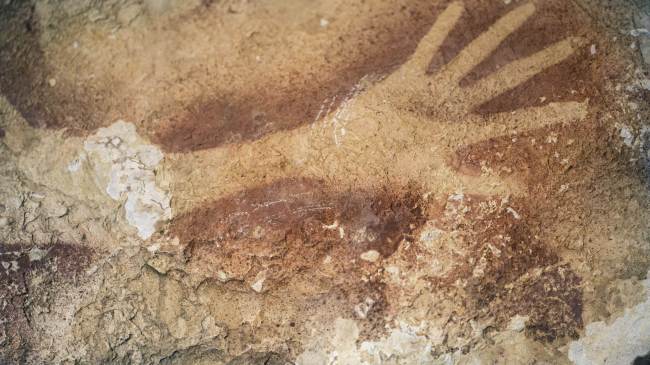
This handout picture released by the journal Nature, on October 8, 2014, shows a hand stencil found on a cave wall in Maros karsts on the Indonesian island of Sulawesi. The silhouette of a hand on a cave wall is 40,000 years old, showing that Europe was not the birthplace of art as long believed, researchers said. Created by spraying reddish paint around an open hand pressed against rock, the stencil was made about the same time -- and possibly before -- early humans were leaving artwork on cave walls around Europe that was long thought to be the first in the world...==RESTRICTED TO EDITORIAL USE - MANDATORY CREDIT "AFP PHOTO / NATURE / KINEZ RIZA" - NO MARKETING - NO ADVERTISING CAMPAIGNS - NO ARCHIVES - TO ILLUSTRATE THE EVENT AS SPECIFIED IN THE CAPTION - DISTRIBUTED AS A SERVICE TO CLIENTS==../2014-10-09 06:00:18/ <저작권자 ⓒ 1980-2014 ㈜연합뉴스. 무단 전재 재배포 금지.>
This handout picture released Wednesday by the journal Nature shows a hand stencil found on a cave wall in Maros Karsts on the Indonesian island of Sulawesi. The silhouette of a hand on a cave wall is 40,000 years old, showing that Europe was not the birthplace of art as long believed, researchers said. Created by spraying reddish paint around an open hand pressed against rock, the stencil was made about the same time ― and possibly before ― early humans were leaving artwork on cave walls around Europe that was long thought to be the first in the world. (Related story on Page 13) AFP-Yonhap