PARIS (AFP) ― Suspicions that shooting stars come from comet dust, transformed into fiery streaks as they hit Earth’s atmosphere, have been bolstered by Europe’s Rosetta space mission, scientists reported Monday.
Comets and asteroids have both been eyed as possible progenitors of meteors, also known as shooting or falling stars ― and now particles spewed from Comet 67P/Churyumov-Gerasimenko have provided proof of paternity.
“This paper shows for the first time that the fluffy, dry dust particles of a comet are (the) parents” of interplanetary dust particles which give us shooting stars, Rita Schulz of the European Space Agency told AFP.
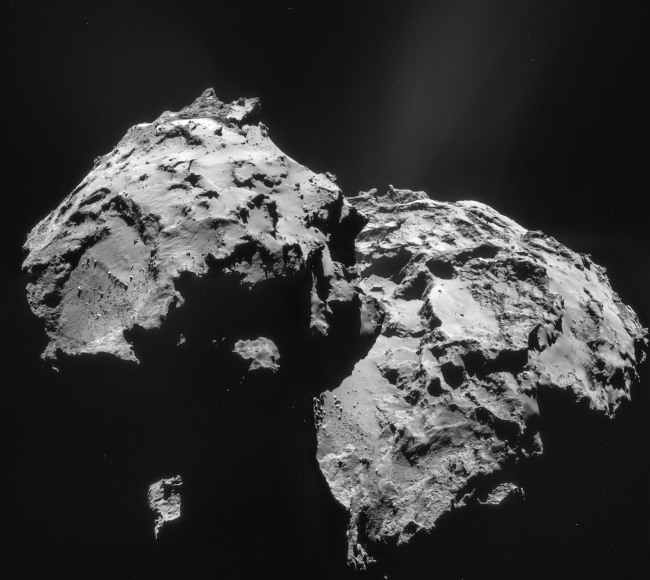
Published in the journal Nature, the study saw ESA’s probe Rosetta snare and analyze dust ejected from 67P as the comet raced towards the sun, hundreds of millions of kilometers from Earth.
Comets are clusters of primordial dust and ice that orbit our star in elliptical circuits.
As they near the sun, melted dust and ice is deposited in their wake as a visible “tail” that disappears from view as they head back into the solar system ― a cycle that continues until the celestial wanderers finally disintegrates.
Comet 67P has an orbit of about 6 1/2 years ― about four years of each cycle are spent in the cold outer reaches of space far from the sun.
During this time, the gassy outflow too feeble to lift grains from its surface, the comet builds up an outer dust mantle. But as the comet draws closer to the sun again, and is reactivated by its heat, the mantle starts to disintegrate and dust particles are shed.
The comet’s most recent switch into active mode was observed from up close by Rosetta since its arrival in August last year to October.
koreaherald@heraldcorp.com