
LONDON (AP) ― It turns out the Beagle has landed after all ― but it never called home.
The gone-but-not-forgotten spacecraft Beagle-2 went AWOL on Christmas Day, 2003, when it was supposed to land on Mars and start transmitting data back to Earth.
Instead, the British-built craft went dark. After several months, it was declared lost ― presumed to have been destroyed during its approach or while trying to land on the red planet.
On Friday, more than 11 years later, European Space Agency officials reported that the Beagle-2 had been finally found ― thanks to extensive detective work based on new photos taken by the high-resolution camera on NASA’s Mars Reconnaissance Orbiter.
The photos show the craft landed safely on Mars and partially deployed ― but was unable to fully deploy and start communicating.
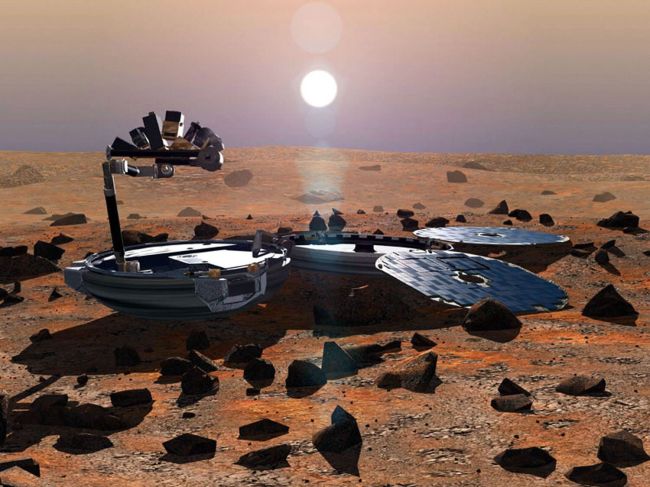
Still, it was a vindication of sorts for space scientists who had wondered for more than a decade about the fate of their pet project, which was designed to search for signs of life on Mars.
Rudolf Schmidt, ESA’s Mars Express project manager at the time, called the finding “excellent news.” He said not knowing what happened to Beagle-2 had “remained a nagging worry.”
Soon after Beagle-2’s disappearance, NASA landed both Spirit and Opportunity near the Martian equator. Both sent back troves of images and discoveries, providing the sort of information astronomers had been seeking when the first Mars probes began.
Mars is notoriously hard to reach. In a half-century of launch attempts, more than half of the missions by various countries have failed to get off the ground on Earth or overshot Mars.
Landing on the red planet is particularly treacherous because of the thin atmosphere. Incoming spacecraft traveling at 19,300 kph have only minutes to slow to a stop.
The Martian terrain is also full of obstacles ― boulders, cracks and cliffs ― and a wrong move can doom a spacecraft.
The Mars Reconnaissance Orbiter, which has circled the planet since 2006, has periodically searched for spacecraft missing in action. Still missing is NASA’s Mars Polar Lander, which lost contact during its arrival at the south pole in 1999.
Officials said careful analysis of the high-resolution photos showed the Beagle-2 had landed within its expected landing area in a basin close to the Martian equator. Signs of key entry and descent components were also spotted.
Identifying the craft was made more difficult by its small size ― it is just over 1.8 meters wide with its solar panels unfurled.
The Beagle-2 was named for the ship that carried naturalist Charles Darwin on his voyage of discovery in the 1830s. It is shaped like an oversized pocket watch and was designed to descend through the Martian atmosphere, deploy parachutes and “bounce” to a safe landing on inflatable bags.
Experts who helped identify the lander at the University of Arizona’s Lunar and Planetary Lab said the photographs are “consistent” with only a partial deployment of the Beagle-2 upon landing. They said a failure to fully deploy would explain why no data or signals from the craft were ever received, since a complete deployment of all of its solar panels would have been needed for successful transmissions.
Alfred McEwen, chief investigator of the project, said the special camera had been used to search for all of the landers that have tried to descend to the surface of Mars.
“This is the first time we found one that didn’t send a signal after it landed,” he said. “If the landing sequence works correctly, the probe sends a radio signal, and you can use that to pinpoint where it is coming from, even if it broadcasts only very briefly. But in the case of Beagle-2, we didn’t get anything. All we had to go by was the target landing area.”
Experts who worked on the project said the Beagle-2 mission can now be classified a partial success ― even if it never provided information about possible life on Mars.
U.K. Space Agency chief executive David Parker said the discovery of the craft showed its complex landing procedures had worked.
koreaherald@heraldcorp.com



![[Exclusive] Ateez to return in November](https://wimg.heraldcorp.com/news/cms/2026/09/02/news-p.v1.20260902.76162fb0ba55493aad1c076f240d0750_R.jpg?type=h&h=120)