South Korea’s tax revenue from sales of goods such as alcohol and cigarettes reached more than 55 trillion won ($50 billion) in 2012, the Korea Tax Association said Thursday.
State revenue from taxes levied on the so-called “sin products” accounted for 27 percent of the total, and was almost the same amount as value-added taxes, the country’s main source of income, collected during the same period. Its revenue from value-added taxes, or consumption taxes, stood at 55.7 trillion won.
This has raised concerns about the country’s tax revenue structure.
“Subjecting products and services to sin taxation is a regressive form of taxation as it targets low-income earners,” KTA chairman Kim Sun-taek said at a news conference.
“It violates the principles of fair taxation in which the government should collect more taxes from high-income earners.”
The Korean government initially introduced sin taxes on products or services that are viewed as vices in an attempt to change consumption patterns.
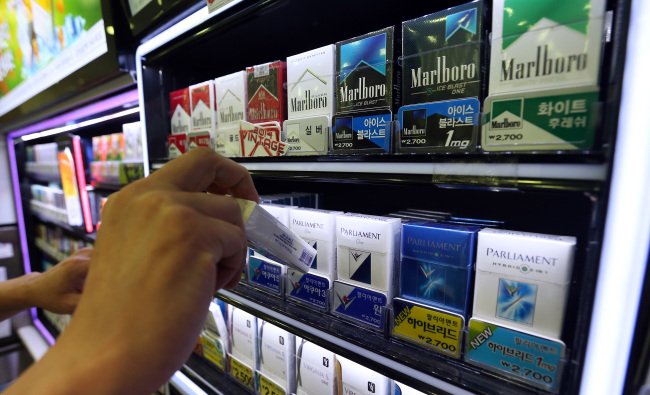
Taxes on automobiles, including vehicle registration fees, reached 38.5 trillion won, followed by cigarettes at 6.9 trillion won. Gambling on horse races and lotteries came next at 5.4 trillion won with alcohol taxation at 4.4 trillion won, the data showed.
“In order to solve the growing income inequality problem, the government needs to reduce sin taxes and raise capital gains taxes,” the chairman said.
Facing a tax revenue shortfall for three consecutive years, the government has been seeking to increase tax levies on tobacco and alcohol.
The Korean government’s tax revenue stood at 203 trillion won in 2012, lower than the initially expected 205 trillion won, according to the National Tax Service.
Value-added taxes accounted for the bulk of the tax revenue, followed by sin taxes, corporate taxes at 45.9 trillion won and income taxes at 45.8 trillion won.
By Suk Gee-hyun ()