VIENNA (AFP) ― The U.N. atomic watchdog and Iran said Wednesday that they aimed to agree next month additional “practical steps” to increase transparency over Tehran‘s nuclear program.
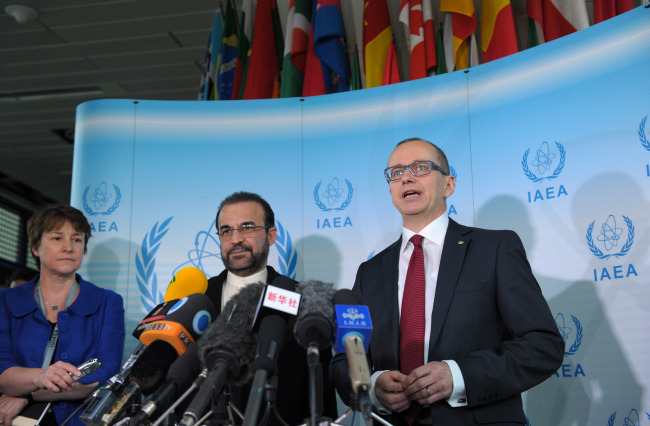
International Atomic Energy Agency chief inspector Tero Varjoranta said after talks in Vienna that the Jan. 21 meeting would also cover long-standing allegations of nuclear bomb research by Tehran.
“We aim to reach agreement on what those practical measures are in our next technical meeting, which is scheduled for Jan. 21 in Tehran,” Varjoranta told reporters.
On Nov. 11 Iran and the IAEA agreed a framework deal that included six practical steps that Tehran would take within three months ― by Feb. 11.
The first, a trip to a plant producing so-called heavy water for a reactor under construction at Arak, took place on Dec. 8 when all of the IAEA’s “technical objectives” were met, Varjoranta said.
The second, a visit to the Gachin uranium mine in southern Iran, has yet to be arranged but would take place before Feb. 11, Varjoranta said.
Others include providing information on all new research reactors, on 16 sites designated for nuclear power plants, on additional uranium enrichment facilities and on laser enrichment technology.
Reza Najafi, Iran’s ambassador to the IAEA, said Wednesday’s meeting was “very good” and that it touched on new “practical measures” to be taken in the “next phase after Feb. 11.”
The Nov. 11 agreement did not specifically mention the IAEA’‘s stalled two-year effort to get answers from Iran over the allegations that prior to 2003, and possibly since, Iran’s nuclear program had “military dimensions.”
The deal said only that Iran and the IAEA “will cooperate further with respect to verification activities to be undertaken by the IAEA to resolve all present and past issues.”
Iran denies seeking or ever having sought nuclear weapons. It says that the IAEA’s allegations, set out in a major report in November 2011, are baseless.
Some of the measures tally with a landmark deal agreed by Iran and world powers in Geneva on Nov. 24 on Iran rolling back its nuclear program for six months in exchange for modest sanctions relief.
Talks between experts from Iran and the United States, China, Russia, Britain, France and Germany -- the P5+1 -- and the IAEA on implementing that deal continued for a third day in Vienna on Wednesday.
koreaherald@heraldcorp.com